APUSH Unit 6-7 with complete verified solutions
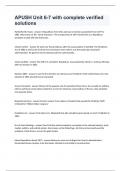
Rutherford B. Hayes A Republican from Ohio and was in elected as president from 1877 to 1881. Was known as the "Great Unknown." The Compromise of 1877 elected him as a Republican president to deal with the democrats. Chester Arthur He took over the presidency after the assassination of Garfield. The Pendleton Act of 1883 as well as the Civil Service Commission were reform acts that took place during his administration. He gave his former Stalwart pals the cold shoulder. James Garfield The 20th U.S. president. Republican. Assassinated by Charles J. Guiteau 200 days after his election in 1881. Election 1884 It saw the first election of a Democrat as President of the United States since the election of 1856. Elected Grover Cleveland. Grover Cleveland Winner of the popular vote for president three times. His crusade for political reform and fiscal conservatism made him an icon for American conservatives of the era. Was president two separate times. Benjamin Harrison Former senator from Indiana. President that passed the McKinley Tariff. Criticized for "Billion Dollar Congress" Pendleton Act Civil reform act. Stipulated that jobs should be given based on merit. Published in 1833. Era of Good Stealings Post-Civil War period marked by corruption in the railroad industry, stock market, politics, and judicial system. Also known as the Gilded Age. Jim Fisk and Jay Gould used the problems of this time to corner the gold market. Liberal Republican Revolt 1872 Reformers rose out of disgust for Grant's administration. Nominated Horace Greeley to be the leader. Wanted to end military reconstruction. Resumption Act 1875 Pledged the government to withdraw greenbacks. Redeemed paper money in gold at face value. Implemented during Grant's presidency. Bland Allison Act 1878 Requires the U.S. Treasury to buy a certain amount of silver and put it into circulation as silver dollars. Vetoed by President Hayes but the veto was overruled. Helped restore bimetallism with gold and silver both supporting the currency. Stalwarts vs. Halfbreeds Division of the Republican Party at the end of the 19th century. One faction was led by Roscoe Conkling and favored the spoils system. The other faction was led by James Blaine and were against the spoils system. Hayes/Tilden Election 1876 This election was broken by the Electoral Count Act. This event led to the Compromise of 1877. Republican nominee was the person who bagged Boss Tweed in New York. Compromise of 1877 Informal deal that settled the disputed Election of 1876. Stated that Hayes could be president so long as he removed federal troops from areas in the South. Effectively ended Reconstruction. James Fisk/Jay Gould Two men who unsuccessfully tried to corner the gold market in 1869. They bought large amounts of gold without selling it, driving the prices up and making stocks crash. Two men who headed a scandal during Grant's presidency contributing to the moniker of "Era of Good Stealings". Bland-Allison Act United States treasury's response to the panic of 1873. US Treasury put silver coins into circulation. Subsidized silver producers and introduced bimetallism. Tammany Hall/W. Tweed Head of New York City's democratic political machine through bossism. He gave food and appealed to the new immigrants in turn for votes. He also built the New York court house. Big Four (Railroads) Nickname for the owners of the largest train tracks including Leland Stanford, James Hill, Cornelius Vanderbilt, and Collis Huntington. These entrepreneurs were in charge the western part of the country. Eventually they united the East and the West via train tracks. The New Immigration Post 1880s immigrants to the US. Mostly from Southern and Eastern European nations. Created many ethnic urban neighborhoods Mary Baker Eddy Founder of Christian Science Church. Preached that the true practice of Christianity heals sickness. Wrote Science and Health with Key to the Scriptures. Booker T. Washington Famous speech "Atlanta Compromise" in 1895. Believed that blacks should accept segregation in the short term to anticipate eventual political equality. Former slave. W.E.B. du Bois Rejecting Booker T. Washington's gradualism and separatism, believed blacks should be mainstreamed into American society. First black to earn a Ph.D. at Harvard. Died as a self exile in Africa, 1963. The New Morality New attitude in America, caused soaring divorce rates, the spreading practice of birth control, and the frank discussion of sexual topics, stemmed from the new roles for women and the writing of Sigmund Freud and the Jazz age Social Darwinism Came from Charles Darwin's theory, stated that the rich were rich and the poor were poor because of natural selection, this was the basis of many people who promoted a laissez faire style of economy. Gospel of Wealth Doctrine that stated that "godliness is in league with riches." Belief that the wealthy were trusted with society's riches so they had to prove themselves morally responsible. Practiced by tycoons such as Rockefeller and Carnegie. Joseph Pulitzer/William R. Hearst Leaders in yellow journalism. Competitors who championed worthy causes and sensationalized the press for more circulation. Involved in sensationalizing the Spanish-American War. Indian Wars A series of conflicts that took place between natives and white settlers. Caused due to Westward movement. Occured in Oregon, New Mexico, and Northern Montana.

Geschreven voor
- Instelling
- APUSH Unit 6-7
- Vak
- APUSH Unit 6-7
Documentinformatie
- Geüpload op
- 20 februari 2024
- Aantal pagina's
- 13
- Geschreven in
- 2023/2024
- Type
- Tentamen (uitwerkingen)
- Bevat
- Vragen en antwoorden
Onderwerpen
-
apush unit 6 7

Ook beschikbaar in voordeelbundel