

Moan (2009) Designing and Implementing Corporate Social
Responsibility
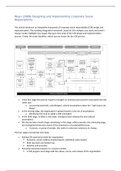
This article introduces an integrative framework of corporate social responsibility (CSR) design and
implementation. The resulting integrative framework, based on this multiple case study and Lewin’s
change model, highlights four stages that span nine steps of the CSR design and implementation
process. Finally, the study identifies critical success factors for the CSR process.
1. In the first stage the process requires managers to unfreeze past practices associated with the
status quo.
a. uncovering long-held, unchallenged, cultural assumptions about the ‘‘right way to do
things’’
2. In the moving stage, the organization is guided toward a new set of assumptions
a. Identifying the need to adopt a CSR orientation
3. In the third stage, to effect a new state, managers must refreeze the new cultural
assumptions
4. We also include a fourth stage: sensitizing. In this stage, which precedes the unfreezing stage,
top management becomes aware of the importance of sustainability issues.
a. A person, or group of people, also seeks to overcome resistance to change.
The four stages incorporate nine steps:
1. Raising CSR awareness inside the organization
Economic, social, political (market-based), Individual (value based)
Both top-down and bottom-up
Reactive and proactive
2. Assessing corporate purpose in a societal context,
A CSR program must align with the values, norms, and mission of the organization
Responsibility
This article introduces an integrative framework of corporate social responsibility (CSR) design and
implementation. The resulting integrative framework, based on this multiple case study and Lewin’s
change model, highlights four stages that span nine steps of the CSR design and implementation
process. Finally, the study identifies critical success factors for the CSR process.
1. In the first stage the process requires managers to unfreeze past practices associated with the
status quo.
a. uncovering long-held, unchallenged, cultural assumptions about the ‘‘right way to do
things’’
2. In the moving stage, the organization is guided toward a new set of assumptions
a. Identifying the need to adopt a CSR orientation
3. In the third stage, to effect a new state, managers must refreeze the new cultural
assumptions
4. We also include a fourth stage: sensitizing. In this stage, which precedes the unfreezing stage,
top management becomes aware of the importance of sustainability issues.
a. A person, or group of people, also seeks to overcome resistance to change.
The four stages incorporate nine steps:
1. Raising CSR awareness inside the organization
Economic, social, political (market-based), Individual (value based)
Both top-down and bottom-up
Reactive and proactive
2. Assessing corporate purpose in a societal context,
A CSR program must align with the values, norms, and mission of the organization



