MRM samenvatting:
Hoorcollege 1: introduction
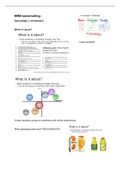
What’s it about?
Factor/reliability
Cluster analysis: groups of customers with similar preferences.
What packaging sells best? ANOVA/ANCOVA
,Regression: adding a variable between the red
ones and the money also possible, moderated
mediated regression this is.
Or dependent variable, how to find out if people stay or
not? Or switch to another or not, binary regression
Rules of the game: the book you also use with the Master thesis, also writing this. One
compulsory chapter also part of the exam on Brightspace. Also three more articles that might
be helpful to get a grip and also for the Thesis. About moderation/mediation.
Future readings: SPSS handbook for example.
Assignment 1: factor, reliability, cluster?
Part 2: the start of analyzing: conceptualization, operationalization and data
preparation:
What is there, given what I read this is what I can
use, first need o broaden view and then back to
own research question. This to the research,
analysis/results and conclusion and discussion.
Whole thesis process is explaining why you do
certain things, arguments (often new research
questions).
,Conceptualization: Academic level:
Conceptual model: Operationalisation: measure the
variables (survey/experimental)
, Measurement level:
Nominal: no high or low. The ‘hot’ scale/ordinal: order in it but no fixed intervals between the levels.
Interval: name for each scale level, also natural order and the interval between the levels is the
same. Interval or ration then do regression, factor analysis, cluster analysis etc. Ratio: there is a
natural zero, non-existing. 10 euros is twice 5 euros. Natural
zero where you can do the ration with.
Examples:
It leads to the measure of central tendency (CT) u can use!
Gender, t test not the right for example. start of
understanding what we are going to do.
Written down in the Ch.3 example of table of Thesis students,
used literature and used the scale used by Ohanian. 5 questions
he uses and uses the 7 point Likert scale. Question is getting
right data.
From data to results:
Choose which analysis, but first check the data!
Hoorcollege 1: introduction
What’s it about?
Factor/reliability
Cluster analysis: groups of customers with similar preferences.
What packaging sells best? ANOVA/ANCOVA
,Regression: adding a variable between the red
ones and the money also possible, moderated
mediated regression this is.
Or dependent variable, how to find out if people stay or
not? Or switch to another or not, binary regression
Rules of the game: the book you also use with the Master thesis, also writing this. One
compulsory chapter also part of the exam on Brightspace. Also three more articles that might
be helpful to get a grip and also for the Thesis. About moderation/mediation.
Future readings: SPSS handbook for example.
Assignment 1: factor, reliability, cluster?
Part 2: the start of analyzing: conceptualization, operationalization and data
preparation:
What is there, given what I read this is what I can
use, first need o broaden view and then back to
own research question. This to the research,
analysis/results and conclusion and discussion.
Whole thesis process is explaining why you do
certain things, arguments (often new research
questions).
,Conceptualization: Academic level:
Conceptual model: Operationalisation: measure the
variables (survey/experimental)
, Measurement level:
Nominal: no high or low. The ‘hot’ scale/ordinal: order in it but no fixed intervals between the levels.
Interval: name for each scale level, also natural order and the interval between the levels is the
same. Interval or ration then do regression, factor analysis, cluster analysis etc. Ratio: there is a
natural zero, non-existing. 10 euros is twice 5 euros. Natural
zero where you can do the ration with.
Examples:
It leads to the measure of central tendency (CT) u can use!
Gender, t test not the right for example. start of
understanding what we are going to do.
Written down in the Ch.3 example of table of Thesis students,
used literature and used the scale used by Ohanian. 5 questions
he uses and uses the 7 point Likert scale. Question is getting
right data.
From data to results:
Choose which analysis, but first check the data!