Case 4 –
Learning goals
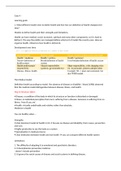
1. What different models exist to define health and how has our definition of health changed over
time?
Models to define health and their strengths and limitations
Health can have medical, social, economic, spiritual and many other components, so it is hard to
define it. The way the politics are managed defines what sort of model the country uses. How we
organise health, influences how health is delivered.
Development over time
The Medical model
Definition health according to model: ‘the absence of disease or disability’. Wood (1986) observed
that the medical model distinguishes between disease, illness, and health:
Nog in literatuur kijken
Disease: a condition of the body in which its structure or function is disturbed or deranged.
Illness: an individual perception that one is suffering from a disease. Someone is suffering from an
illness. ‘How ill you are’.
Health: virtually undefinable and relative rather than absolute.
Medicine is health
You are healthy when….
Strengths:
Most dominant model of health in US. It focuses on disease and disability; their causes, prevention
and cure.
Highly productive to see the body as a system
Specialization in medical process
Clear distinction between health and not health you can compare different health system
Limitations:
1. The difficulty of adapting it to emotional and psychiatric disorders.
2. It deemphasizes preventive medicine.
- doesn’t include prevention
3. It ignores the social causes of disease and social customs in defining disease.
, 4. It does not take into account that one can be ill without having a disease (perceiving symptoms
without pathology) or one can have a disease without being ill (having disease in presymptomatic
stage).
5. Fragmentation, as a consequence of specialization (negative)
6. a person can be ill without having a disease
The WHO model/holistic model
Definition health according to model: ‘a state of complete physical, mental and social well-being and
not merely the absence of disease or infirmity’. Health became a fundamental right of all persons
more political. Diseases went from acute to chronic, this does not fit the definition, because it would
declare people with chronic diseases definitely ill.
Focus on complete well-being
Strengths:
Most popular and most comprehensive
Improve medical research by developing more practical norms for mental and social well-being.
Limitations:
1. The WHO definition includes social health as a factor to define one’s personal health status, while
social health are external factors and circumstances, which should not be used to define personal
health status.
2. There is no agreement on the meaning of ‘social well-being’ in the definition (is it the environment
of society or the functional status of individuals?).
3. The definition is too bread, because health is defined differently in different cultures.
4. It doesn’t define which states of health are better than others.
5. The euphoric definition of health as a state of complete wellbeing is readily falsified. The average
person experiences four symptoms in a 14-day period, so we are all sick then. Chronic patients are
then always ill.
6. The definition is too abstract and oversimplified; it is an ultimate goals more than a guideline for
action
According to this model a lot of people are not able to achieve full health anymore. Leads to
medicalization.
Politics in literature!
Environmental factors which influent health Dalcran and….
- Individual lifestyle factors
Health promotion if you put this social factors they can prevent things
Add a social aspect which makes it political
Main difference looking at health medical health actors are professionals. In Who it it more
political that the government has to be promote in health promotion. Health professionals can play a
role as well but it is most on the government.
Narrow and comprehensive boundaries from case 1 is here mentioned as well
After the implementation of this model, there is more focus on prevention and anti-depressant (in
media) medicalization in phycological field. Every problem should be fixed (and diagnosed).
Learning goals
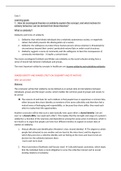
1. What different models exist to define health and how has our definition of health changed over
time?
Models to define health and their strengths and limitations
Health can have medical, social, economic, spiritual and many other components, so it is hard to
define it. The way the politics are managed defines what sort of model the country uses. How we
organise health, influences how health is delivered.
Development over time
The Medical model
Definition health according to model: ‘the absence of disease or disability’. Wood (1986) observed
that the medical model distinguishes between disease, illness, and health:
Nog in literatuur kijken
Disease: a condition of the body in which its structure or function is disturbed or deranged.
Illness: an individual perception that one is suffering from a disease. Someone is suffering from an
illness. ‘How ill you are’.
Health: virtually undefinable and relative rather than absolute.
Medicine is health
You are healthy when….
Strengths:
Most dominant model of health in US. It focuses on disease and disability; their causes, prevention
and cure.
Highly productive to see the body as a system
Specialization in medical process
Clear distinction between health and not health you can compare different health system
Limitations:
1. The difficulty of adapting it to emotional and psychiatric disorders.
2. It deemphasizes preventive medicine.
- doesn’t include prevention
3. It ignores the social causes of disease and social customs in defining disease.
, 4. It does not take into account that one can be ill without having a disease (perceiving symptoms
without pathology) or one can have a disease without being ill (having disease in presymptomatic
stage).
5. Fragmentation, as a consequence of specialization (negative)
6. a person can be ill without having a disease
The WHO model/holistic model
Definition health according to model: ‘a state of complete physical, mental and social well-being and
not merely the absence of disease or infirmity’. Health became a fundamental right of all persons
more political. Diseases went from acute to chronic, this does not fit the definition, because it would
declare people with chronic diseases definitely ill.
Focus on complete well-being
Strengths:
Most popular and most comprehensive
Improve medical research by developing more practical norms for mental and social well-being.
Limitations:
1. The WHO definition includes social health as a factor to define one’s personal health status, while
social health are external factors and circumstances, which should not be used to define personal
health status.
2. There is no agreement on the meaning of ‘social well-being’ in the definition (is it the environment
of society or the functional status of individuals?).
3. The definition is too bread, because health is defined differently in different cultures.
4. It doesn’t define which states of health are better than others.
5. The euphoric definition of health as a state of complete wellbeing is readily falsified. The average
person experiences four symptoms in a 14-day period, so we are all sick then. Chronic patients are
then always ill.
6. The definition is too abstract and oversimplified; it is an ultimate goals more than a guideline for
action
According to this model a lot of people are not able to achieve full health anymore. Leads to
medicalization.
Politics in literature!
Environmental factors which influent health Dalcran and….
- Individual lifestyle factors
Health promotion if you put this social factors they can prevent things
Add a social aspect which makes it political
Main difference looking at health medical health actors are professionals. In Who it it more
political that the government has to be promote in health promotion. Health professionals can play a
role as well but it is most on the government.
Narrow and comprehensive boundaries from case 1 is here mentioned as well
After the implementation of this model, there is more focus on prevention and anti-depressant (in
media) medicalization in phycological field. Every problem should be fixed (and diagnosed).