Problem 4 2.4
Perception of colour
Basic principles of colour
Humans see a narrow wavelength of The electromagnetic spectrum between the
wavelengths of about 400 and 700 nanometres
- the colour of a piece of the visible world is correlated with the wavelength of the
light Rays reaching the eye from that bit of the world
Most of the light that we see is refracted light, light sources like the sun or light bulb,
amid a broad spectrum of wavelengths that hit surfaces in the world around us
- some wavelengths are absorbed by the services they hit
- the more light is absorbed, the darker the surface will appear
- other wavelengths are reflected, and some of that reflected light reaches the
eyes
the colour of the surface depends on the mix of wavelengths that reached the eye
from the surface
Colour is the result of the interaction of a physical stimulus with a part of the
nervous system, it is incorrect to think of specific wavelengths of light as being
specific colours
three steps to colour perception
Detection – wavelengths must be
detected
Discrimination - must be able to tell the
difference between one wavelength and
another
appearance - we want to assign perceived
colours to lights and surfaces around the
world and we want those perceived
colours to go with the object and not to
change dramatically as the viewing
conditions change e.g. The Rose should
remain red in the sun and in a shadow
step 1. colour detection
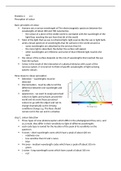
Three types of cone photoreceptors which differ in the photopigment they carry, and
as a result, they differ in their sensitivity to light of different wavelengths
each code type is named for the location of the peak of its sensitivity on the
spectrum
S-cones - short wavelength cones which have a peak of about 420 nm
- relatively rare
- less sensitive than M and L cones
- blue
M-cones - medium wavelength codes which have a peak off about 535 nm
- green
L-cones - long wavelength cones which have a peak of about 565 nm
- red
, cones are not exclusively sensitive to different parts of the spectrum i.e. even though
the L-cone is maximally sensitive to about 565 nm, the M-cone can detect that
wavelength as well
- their spectral sensitivities overlap
the combination of sensitivities of the three types of cones gives us our overall ability
to detect wavelengths from about 400 nm to about 700 nm
Spectral sensitivity - the sensitivity of the cell were devised to different wavelengths
on the electromagnetic spectrum
Photopic- light intensities there's a bright enough to stimulate the cone receptors
and bright enough to saturate the rod receptors
scotopic - referring to light intensities that are bright enough to stimulate the rod
receptors but too dim to stimulate cone receptors
step 2. Colour discrimination
the principle of univariance
Because the property is over photopigment in the
photoreceptor cell, 400nm light produces when is small
response in each cell of this type
- 500 nm light produces a greater response and 550nm
light even more
- 600 nm light however produces less than the maximum
response and 650 nm light produces a minimal response
- light of 625 nm produces a response of moderate
strength
- the varying responses of this photoreceptor to different
wavelengths could provide a basis for colour vision
When it comes to seeing colour, the output of a single photoreceptor is completely
ambiguous
principle of univariance – there is an infinite set of different wavelength intensity
combinations can elicit exactly the same response, so the output of a single
photoreceptor cannot by itself tell us anything about the wavelengths stimulating it
- Explains the lack of colour in dimly lit scenes as There is only one type of rod
receptor and they each contain the same type of photopigment molecule
(rhodopsin) and thus have the same sensitivity to light
- Night time colour blindness is 1 hint that colour is psychophysical and not
physical
Wavelengths that produce colour perception during the day remain present in the
dark, but we failed to see colours Under dim illuminations because it only stimulates
the rods, and the output of that single variety of
photoreceptor does not permit colour vision
The trichromatic solution
We can detect differences between wavelengths
or mixtures of wavelengths because we have
more than one type of cone receptor
Perception of colour
Basic principles of colour
Humans see a narrow wavelength of The electromagnetic spectrum between the
wavelengths of about 400 and 700 nanometres
- the colour of a piece of the visible world is correlated with the wavelength of the
light Rays reaching the eye from that bit of the world
Most of the light that we see is refracted light, light sources like the sun or light bulb,
amid a broad spectrum of wavelengths that hit surfaces in the world around us
- some wavelengths are absorbed by the services they hit
- the more light is absorbed, the darker the surface will appear
- other wavelengths are reflected, and some of that reflected light reaches the
eyes
the colour of the surface depends on the mix of wavelengths that reached the eye
from the surface
Colour is the result of the interaction of a physical stimulus with a part of the
nervous system, it is incorrect to think of specific wavelengths of light as being
specific colours
three steps to colour perception
Detection – wavelengths must be
detected
Discrimination - must be able to tell the
difference between one wavelength and
another
appearance - we want to assign perceived
colours to lights and surfaces around the
world and we want those perceived
colours to go with the object and not to
change dramatically as the viewing
conditions change e.g. The Rose should
remain red in the sun and in a shadow
step 1. colour detection
Three types of cone photoreceptors which differ in the photopigment they carry, and
as a result, they differ in their sensitivity to light of different wavelengths
each code type is named for the location of the peak of its sensitivity on the
spectrum
S-cones - short wavelength cones which have a peak of about 420 nm
- relatively rare
- less sensitive than M and L cones
- blue
M-cones - medium wavelength codes which have a peak off about 535 nm
- green
L-cones - long wavelength cones which have a peak of about 565 nm
- red
, cones are not exclusively sensitive to different parts of the spectrum i.e. even though
the L-cone is maximally sensitive to about 565 nm, the M-cone can detect that
wavelength as well
- their spectral sensitivities overlap
the combination of sensitivities of the three types of cones gives us our overall ability
to detect wavelengths from about 400 nm to about 700 nm
Spectral sensitivity - the sensitivity of the cell were devised to different wavelengths
on the electromagnetic spectrum
Photopic- light intensities there's a bright enough to stimulate the cone receptors
and bright enough to saturate the rod receptors
scotopic - referring to light intensities that are bright enough to stimulate the rod
receptors but too dim to stimulate cone receptors
step 2. Colour discrimination
the principle of univariance
Because the property is over photopigment in the
photoreceptor cell, 400nm light produces when is small
response in each cell of this type
- 500 nm light produces a greater response and 550nm
light even more
- 600 nm light however produces less than the maximum
response and 650 nm light produces a minimal response
- light of 625 nm produces a response of moderate
strength
- the varying responses of this photoreceptor to different
wavelengths could provide a basis for colour vision
When it comes to seeing colour, the output of a single photoreceptor is completely
ambiguous
principle of univariance – there is an infinite set of different wavelength intensity
combinations can elicit exactly the same response, so the output of a single
photoreceptor cannot by itself tell us anything about the wavelengths stimulating it
- Explains the lack of colour in dimly lit scenes as There is only one type of rod
receptor and they each contain the same type of photopigment molecule
(rhodopsin) and thus have the same sensitivity to light
- Night time colour blindness is 1 hint that colour is psychophysical and not
physical
Wavelengths that produce colour perception during the day remain present in the
dark, but we failed to see colours Under dim illuminations because it only stimulates
the rods, and the output of that single variety of
photoreceptor does not permit colour vision
The trichromatic solution
We can detect differences between wavelengths
or mixtures of wavelengths because we have
more than one type of cone receptor