Problem 6 2.4
The third dimension
Space perception and binocular vision
The ability to perceive and interact with the structure of space is one of the
fundamental goals of the visual system
Realism – a philosophical position arguing that there is a real world to sense i.e. the
external world we live in exists
Positivism – a philosophical position arguing that all we really have to go
on is the evidence of the senses
- So, the world might be nothing more than an elaborate hallucination
Euclidean – refers to the geometry of the world.
- Parallel lines remain parallel as they are extended in space
- objects maintain the same size and shape as they move around in
space
- the internal angles of triangles always add to a18 degrees etc.
although the real world is Euclidean, the geometry of retinal images of
that world is non-Euclidean
- it becomes non-Euclidean when the 3d world is projected onto the
curved 2d surface of the retina
- parallel lines in the real world do not necessarily remain parallel in
the retinal image
- the angles of triangles don’t always add up to 180 degrees
- the retinal area occupied by an object gets smaller as the object
moves further away from the eyeball
we reconstruct the world from 2 non-Euclidean inputs: the 2
distinct retinal images
- the two retinal images always differ slightly because the retinas
are in slightly different places
binocular – with two eyes
binocular summation- the combination (or summation) of signals
from each eye in ways that make performance on many tasks
better with both eyes than with either eye alone
binocular disparity – the differences between the two retinal images of the same
scene
- disparity is the basis for stereopsis, a vivid perception of the three-dimensionality
of the world that is not available with monocular vision
monocular – with one eye
stereopsis – ability to use binocular disparity as a cue to depth
- not a necessary condition for depth perception or space perception
- does add a richness to perception of the 3d world
depth cues – information about the 3rd dimension (depth) of visual space
- may be monocular or binocular
monocular depth cue – a depth cue that is available even when the world is viewed
with one eye alone
binocular depth cue – depth cue that relies on information from both eyes
- stereopsis is the primary example in humans
, - convergence and the ability of two eyes to see more of an object than one eye
sees are also binocular depth cues
occlusion – a cue to relative depth order in which, for example, one object obstructs
the view of part of another object
monocular cues to 3d space
it is geometrically impossible (not to mention computationally infeasible) for the
visual system to create a perfectly faithful reconstruction of Euclidean space, given
the non-Euclidean input we receive through our eyes
- the best we can do is to use depth cues to infer aspects of the 3d world from our
2d retinal images
- on the bases of these retinal images and an implicit understanding of physics and
geometry, each cue provides a hint about the likely structure of the space in
front of us and the disposition of objects in that space
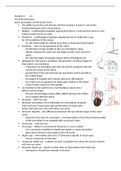
occlusion
occlusion gives information about the relative position of objects
- we infer a circle in front of a square in front of a triangle
it is wrong only in the case of accidental viewpoints
- the retinal image shown could be produced by a circle and two oddly shaped
puzzle pieces
we don’t know from this cue along whether the red square is in front of a small
green triangle, a larger but more distant triangle (maybe a tree), or even a larger but
even more distant green mountain
occlusion is a nonmetrical depth cue – it gives us the relative orderings of occluders
and occludes
metrical depth cue – a depth cue that provides quantitative information about
distance in the third dimension
nonmetrical depth cue – depth cue that provides information about the depth order
(relative depth) but not depth magnitude (e.g. his nose is in front of his face)
size and position cues
the image on the retina formed by an object gets smaller as the object gets
further away
projective geometry – the geometry that describes the
transformations that occur when the 3d world is projected onto a
two-dimensional surface
- e.g. parallel lines do not converge in the real world, but they
do in the 2d projection of that world
Relative size - a comparison of size between items without
knowing the absolute size of either one
- the plasticine balls may appear to lie in different depth planes
Texture gradient – a depth cue based on the geometric fact that
items of the same size form smaller images when they are further
away
- an array of items that change in size smoothly across the
image will appear to form a surface tilted in depth
The third dimension
Space perception and binocular vision
The ability to perceive and interact with the structure of space is one of the
fundamental goals of the visual system
Realism – a philosophical position arguing that there is a real world to sense i.e. the
external world we live in exists
Positivism – a philosophical position arguing that all we really have to go
on is the evidence of the senses
- So, the world might be nothing more than an elaborate hallucination
Euclidean – refers to the geometry of the world.
- Parallel lines remain parallel as they are extended in space
- objects maintain the same size and shape as they move around in
space
- the internal angles of triangles always add to a18 degrees etc.
although the real world is Euclidean, the geometry of retinal images of
that world is non-Euclidean
- it becomes non-Euclidean when the 3d world is projected onto the
curved 2d surface of the retina
- parallel lines in the real world do not necessarily remain parallel in
the retinal image
- the angles of triangles don’t always add up to 180 degrees
- the retinal area occupied by an object gets smaller as the object
moves further away from the eyeball
we reconstruct the world from 2 non-Euclidean inputs: the 2
distinct retinal images
- the two retinal images always differ slightly because the retinas
are in slightly different places
binocular – with two eyes
binocular summation- the combination (or summation) of signals
from each eye in ways that make performance on many tasks
better with both eyes than with either eye alone
binocular disparity – the differences between the two retinal images of the same
scene
- disparity is the basis for stereopsis, a vivid perception of the three-dimensionality
of the world that is not available with monocular vision
monocular – with one eye
stereopsis – ability to use binocular disparity as a cue to depth
- not a necessary condition for depth perception or space perception
- does add a richness to perception of the 3d world
depth cues – information about the 3rd dimension (depth) of visual space
- may be monocular or binocular
monocular depth cue – a depth cue that is available even when the world is viewed
with one eye alone
binocular depth cue – depth cue that relies on information from both eyes
- stereopsis is the primary example in humans
, - convergence and the ability of two eyes to see more of an object than one eye
sees are also binocular depth cues
occlusion – a cue to relative depth order in which, for example, one object obstructs
the view of part of another object
monocular cues to 3d space
it is geometrically impossible (not to mention computationally infeasible) for the
visual system to create a perfectly faithful reconstruction of Euclidean space, given
the non-Euclidean input we receive through our eyes
- the best we can do is to use depth cues to infer aspects of the 3d world from our
2d retinal images
- on the bases of these retinal images and an implicit understanding of physics and
geometry, each cue provides a hint about the likely structure of the space in
front of us and the disposition of objects in that space
occlusion
occlusion gives information about the relative position of objects
- we infer a circle in front of a square in front of a triangle
it is wrong only in the case of accidental viewpoints
- the retinal image shown could be produced by a circle and two oddly shaped
puzzle pieces
we don’t know from this cue along whether the red square is in front of a small
green triangle, a larger but more distant triangle (maybe a tree), or even a larger but
even more distant green mountain
occlusion is a nonmetrical depth cue – it gives us the relative orderings of occluders
and occludes
metrical depth cue – a depth cue that provides quantitative information about
distance in the third dimension
nonmetrical depth cue – depth cue that provides information about the depth order
(relative depth) but not depth magnitude (e.g. his nose is in front of his face)
size and position cues
the image on the retina formed by an object gets smaller as the object gets
further away
projective geometry – the geometry that describes the
transformations that occur when the 3d world is projected onto a
two-dimensional surface
- e.g. parallel lines do not converge in the real world, but they
do in the 2d projection of that world
Relative size - a comparison of size between items without
knowing the absolute size of either one
- the plasticine balls may appear to lie in different depth planes
Texture gradient – a depth cue based on the geometric fact that
items of the same size form smaller images when they are further
away
- an array of items that change in size smoothly across the
image will appear to form a surface tilted in depth