Problem 1 – A Keen Eye
Block 2.4 Perception
Learning goal A
How is the eye structured?
What are the anatomical parts?
Retina, yellow spot, blindspot
What is the structure and function of each part of the eye?
Learning goal B
How does the eye work?
How do we perceive things?
Do we need light to see?
Why do we see flipped?
How does our eye perceive objects and light?
How does light enter the eye?
How does vision work? How does the light reflect?
How does the lens, pupil, iris work?
How is the image of an object reflected on the retina?
What might be the problems, diseases, conditions
How do glasses work the same way as a lens?
Yellow spot, blindspot
Learning goal C
How and why does our perception fool us?
Illusion
Why do we see optical illusions? How do they work?
Could optical illusions be limitations?
Is the brain tricking us?
How does the enhancement of the edges occur? Why do we see the small grey squares in
the middle? Why do you feel that the grey squares have a different luminance even though
they are the same?
What processes take place in the retina? Which part of the eye is responsible?
Lateral inhibition
Source 1
Goldstein pg. 44 – Introduction to vision
Focusing light onto the retina
Light: the stimulus for vision
• Visible light is a band of energy within the electromagnetic spectrum
• the electromagnetic spectrum is a continuum of electromagnetic energy produced
by electric charges and is radiated as waves
• wavelength – distance between the peaks of electromagnetic waves
- gamma rays – extremely short wavelength
- radio waves – very long wavelength
- visible light – 400-700 nanometres (range for humans)
, o photons – small packets of energy that make up light, with one photon being
the smallest possible packet of light energy
the eye
• light reflected from objects enters the eye through the pupil
- it is focused by the cornea and lens to form sharp images of objects on the retina
which contains the receptors for vision
• rods and cones – two kinds of visual receptors that contain light-sensitive chemicals
called visual pigments
- visual pigments react to light and trigger electrical signals
- these signals flow through the network of neurons that make up the retina
- the signals emerge from the back of the eye in the optic nerve, which conducts
signals towards the brain
• the cornea and lens at the front of the eye and the receptors and neurons in the
retina lining the back of the eye shape what we see by creating transformations that
occur at the beginning of the perceptual process
Light is focused by the eye
• light is reflected from an object into the eye and it needs to be focused onto the
retina
• the cornea is the transparent covering of the front of the eye and accounts for about
80% of the focusing power
- it is fixed in place so can’t adjust its focus
• the lens supplies the remaining 20% of the focusing power and can change shape to
adjust the eye’s focus according to stimuli located at different distances
o when the eye is relaxed and we view a small object that is far away, the light
rays that reach the eye are essentially parallel
- these rays are brought to a focus on the retina at point A
o if the object moves closer to the eye, the light rays reflected from this object
enter the eye at more of an angle, pushing the focus point back to point B
- the light is stopped by the back of the eye before it reaches point B however –
the image on the retina is out of focus
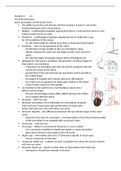
, o accommodation- the ciliary muscles at the
front of the eye tighten and increase the
curvature of the lens so that it gets thicker and
thus we don’t see the image as being blurred
- this curvature bends the light rays passing
through the lens to pull the focus point back to
A to create a sharp image on the retina
accommodation/pencil demonstration
• accommodation is unconscious, it enables you to
bring both near and far objects into focus at
different times
• near point - the distance at which your lens can no
longer adjust to bring the pencil into focus
• presbyopia (old eye) - the distance of the near
point increases as a person gets older
- occurs because the lens hardens with age and
the ciliary muscles become weaker making it
more difficult to change its shape for close
vision
• myopia/near-sightedness – inability to see distant objects
clearly
- the myopic eye brings parallel rays of light into focus
at a point in front of the retina so that the image
reaching the retina is blurred
- can be caused by either:
1. refractive myopia – the cornea and/or lens bends
the light too much
2. axial myopia – the eyeball is too long
- to correct this one needs glasses which cause the light
to enter the eye at exactly the same angle as light
coming from the far point
- or laser-assisted in situ keratomileusis (LASIK) –
involves sculpting the cornea with a type of laser
called an excimer laser
▪ a small flap is cut into the surface of the cornea
so that the cornea can be sculpted by the laser
in order for it to focus light onto the retina
▪ the flap is folded back into place
• far point – the distance at which the spot of light becomes focused on the retina
Block 2.4 Perception
Learning goal A
How is the eye structured?
What are the anatomical parts?
Retina, yellow spot, blindspot
What is the structure and function of each part of the eye?
Learning goal B
How does the eye work?
How do we perceive things?
Do we need light to see?
Why do we see flipped?
How does our eye perceive objects and light?
How does light enter the eye?
How does vision work? How does the light reflect?
How does the lens, pupil, iris work?
How is the image of an object reflected on the retina?
What might be the problems, diseases, conditions
How do glasses work the same way as a lens?
Yellow spot, blindspot
Learning goal C
How and why does our perception fool us?
Illusion
Why do we see optical illusions? How do they work?
Could optical illusions be limitations?
Is the brain tricking us?
How does the enhancement of the edges occur? Why do we see the small grey squares in
the middle? Why do you feel that the grey squares have a different luminance even though
they are the same?
What processes take place in the retina? Which part of the eye is responsible?
Lateral inhibition
Source 1
Goldstein pg. 44 – Introduction to vision
Focusing light onto the retina
Light: the stimulus for vision
• Visible light is a band of energy within the electromagnetic spectrum
• the electromagnetic spectrum is a continuum of electromagnetic energy produced
by electric charges and is radiated as waves
• wavelength – distance between the peaks of electromagnetic waves
- gamma rays – extremely short wavelength
- radio waves – very long wavelength
- visible light – 400-700 nanometres (range for humans)
, o photons – small packets of energy that make up light, with one photon being
the smallest possible packet of light energy
the eye
• light reflected from objects enters the eye through the pupil
- it is focused by the cornea and lens to form sharp images of objects on the retina
which contains the receptors for vision
• rods and cones – two kinds of visual receptors that contain light-sensitive chemicals
called visual pigments
- visual pigments react to light and trigger electrical signals
- these signals flow through the network of neurons that make up the retina
- the signals emerge from the back of the eye in the optic nerve, which conducts
signals towards the brain
• the cornea and lens at the front of the eye and the receptors and neurons in the
retina lining the back of the eye shape what we see by creating transformations that
occur at the beginning of the perceptual process
Light is focused by the eye
• light is reflected from an object into the eye and it needs to be focused onto the
retina
• the cornea is the transparent covering of the front of the eye and accounts for about
80% of the focusing power
- it is fixed in place so can’t adjust its focus
• the lens supplies the remaining 20% of the focusing power and can change shape to
adjust the eye’s focus according to stimuli located at different distances
o when the eye is relaxed and we view a small object that is far away, the light
rays that reach the eye are essentially parallel
- these rays are brought to a focus on the retina at point A
o if the object moves closer to the eye, the light rays reflected from this object
enter the eye at more of an angle, pushing the focus point back to point B
- the light is stopped by the back of the eye before it reaches point B however –
the image on the retina is out of focus
, o accommodation- the ciliary muscles at the
front of the eye tighten and increase the
curvature of the lens so that it gets thicker and
thus we don’t see the image as being blurred
- this curvature bends the light rays passing
through the lens to pull the focus point back to
A to create a sharp image on the retina
accommodation/pencil demonstration
• accommodation is unconscious, it enables you to
bring both near and far objects into focus at
different times
• near point - the distance at which your lens can no
longer adjust to bring the pencil into focus
• presbyopia (old eye) - the distance of the near
point increases as a person gets older
- occurs because the lens hardens with age and
the ciliary muscles become weaker making it
more difficult to change its shape for close
vision
• myopia/near-sightedness – inability to see distant objects
clearly
- the myopic eye brings parallel rays of light into focus
at a point in front of the retina so that the image
reaching the retina is blurred
- can be caused by either:
1. refractive myopia – the cornea and/or lens bends
the light too much
2. axial myopia – the eyeball is too long
- to correct this one needs glasses which cause the light
to enter the eye at exactly the same angle as light
coming from the far point
- or laser-assisted in situ keratomileusis (LASIK) –
involves sculpting the cornea with a type of laser
called an excimer laser
▪ a small flap is cut into the surface of the cornea
so that the cornea can be sculpted by the laser
in order for it to focus light onto the retina
▪ the flap is folded back into place
• far point – the distance at which the spot of light becomes focused on the retina