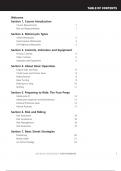
Table of Contents
Lecture 1: The study of consumer behavior. Irrationality. ...................................................................... 2
Lecture 2: Research strategies................................................................................................................. 5
Lecture 3: Scientific Method. Theoretical framework & hypotheses. Experimental research (A). ...... 10
Lecture 4: Experimental research (B). Factorial designs (A). .............................................................. 17
Lecture 5: Overview of consumer decision making. ............................................................................ 23
Lecture 6: Consumer Perception. .......................................................................................................... 27
Lecture 7: Product consideration, evaluation & choice. Behavioural decision theory.......................... 31
Lecture 8: Persuasion: Attitude and Judgement. Metacognitive Difficulty........................................... 36
Lecture 9: Learning and Memory.......................................................................................................... 46
Lecture 10: Motivation. ........................................................................................................................ 55
Lecture 11: Automatic Information Processing. ................................................................................... 63
Lecture 12: The Self.............................................................................................................................. 68
BONUS: Exam Prep ............................................................................................................................. 72
,Lecture 1: The study of consumer behavior. Irrationality.
We are always consuming something:
• Present (e.g. the premaster course)
• Past (e.g. last night’s movie: we enjoy the memory of past consumption)
• Future (e.g. planning a coffee date: we plan future consumption)
Consumer Behavior (≠ choice) = the process involved in selecting, buying, using or
disposing of products, services, ideas and experiences to satisfy needs and wants.
Customer (buys) ≠ Consumer (uses)
Consumer factors (age / gender / feelings /motivations /attitudes / knowledge/ culture /
subculture / social/ environment / group influences) & Marketing factors (brand names and
reputations / WOM / advertising / promotions / price / service / packaging / store
atmospherics) influence consumer behavior, affect and cognition into how they obtain,
consume and dispose of products, services, ideas or experiences.
Consumer behavior is difficult to predict, because of:
• False Consensus/Understanding: we are all different. We often overestimate
that our beliefs are also the beliefs of others (projection bias)
• Affective Forecasting: issues with predicting even our own actions or why we
do them
• Intuition Trap: we infer causality from correlation. We are often wrong
(confirmation bias, resistance to changing prior beliefs, overconfidence)
Intuitive ideas are easy, vivid, well-remembered. Scientific ideas are complex, situational.
Why study consumer behavior?
Marketers: to understand & predict it, with the aim of influencing it.
Public Policy: to regulate & encourage behavior. (e.g. how will consumers react to
regulations on smoking)
Studying consumer behaviour is not easy, as consumers often act irrational!
, How to study consumer behavior?
Methods for studying consumer behaviour:
1. Interviews (qualitative data): exploratory. (e.g. in-depth interviews, focus groups)
2. Surveys (quantitative data): generalized. (e.g. mall intercepts, mail questionnaires,
internet/ phone/ longitudinal surveys)
!Problems : self-selection, self-reporting, sensitivity to wording & order.
Surveys may turn out inaccurate results because:
• Not knowing the cause of own behaviour
• Memories are inaccurate
• People are not good at predicting future behaviour
• People don’t transparently disclose information (social desirability bias, demand
characteristics, privacy issues)
But! Experiments are an excellent way to study actual behaviour.
3. Experimental research: understanding the nature of the relationship (causal or
correlational?)
It is best to combine methods. The research question determines which methods are most
appropriate.
Consumer research key takeaways:
, • Beware of common sense (intuition trap)
• Understand the nature of the relationship (correlation or causation)
• Consumer research is a social science (reduce uncertainty, rather than establish
certainty)
Compromise effect = the share of a product increases when it is in the intermediate option,
but decreases when it is in the extreme option.
Endowment effect = owners assign greater value to a product than non-owners.
Malleability of preferences
Preferences are typically constructed, not revealed:
1. Reference dependence = every evaluation is relative.
2. Context dependence = people don’t know what they want until they see it in context.
3. Description dependence = preferences change depending on how options are being
presented.
The only assumption we can make about consumers is that they act predictably irrational.
…and in opposition with the standard economic model, which assumes:
• People are rational -> (assumption) they have full internal knowledge
• Are aware of all their options -> (assumption) they have full external knowledge
• Always choose the option they like best -> (assumption) they maximise utility
Lecture 1: The study of consumer behavior. Irrationality. ...................................................................... 2
Lecture 2: Research strategies................................................................................................................. 5
Lecture 3: Scientific Method. Theoretical framework & hypotheses. Experimental research (A). ...... 10
Lecture 4: Experimental research (B). Factorial designs (A). .............................................................. 17
Lecture 5: Overview of consumer decision making. ............................................................................ 23
Lecture 6: Consumer Perception. .......................................................................................................... 27
Lecture 7: Product consideration, evaluation & choice. Behavioural decision theory.......................... 31
Lecture 8: Persuasion: Attitude and Judgement. Metacognitive Difficulty........................................... 36
Lecture 9: Learning and Memory.......................................................................................................... 46
Lecture 10: Motivation. ........................................................................................................................ 55
Lecture 11: Automatic Information Processing. ................................................................................... 63
Lecture 12: The Self.............................................................................................................................. 68
BONUS: Exam Prep ............................................................................................................................. 72
,Lecture 1: The study of consumer behavior. Irrationality.
We are always consuming something:
• Present (e.g. the premaster course)
• Past (e.g. last night’s movie: we enjoy the memory of past consumption)
• Future (e.g. planning a coffee date: we plan future consumption)
Consumer Behavior (≠ choice) = the process involved in selecting, buying, using or
disposing of products, services, ideas and experiences to satisfy needs and wants.
Customer (buys) ≠ Consumer (uses)
Consumer factors (age / gender / feelings /motivations /attitudes / knowledge/ culture /
subculture / social/ environment / group influences) & Marketing factors (brand names and
reputations / WOM / advertising / promotions / price / service / packaging / store
atmospherics) influence consumer behavior, affect and cognition into how they obtain,
consume and dispose of products, services, ideas or experiences.
Consumer behavior is difficult to predict, because of:
• False Consensus/Understanding: we are all different. We often overestimate
that our beliefs are also the beliefs of others (projection bias)
• Affective Forecasting: issues with predicting even our own actions or why we
do them
• Intuition Trap: we infer causality from correlation. We are often wrong
(confirmation bias, resistance to changing prior beliefs, overconfidence)
Intuitive ideas are easy, vivid, well-remembered. Scientific ideas are complex, situational.
Why study consumer behavior?
Marketers: to understand & predict it, with the aim of influencing it.
Public Policy: to regulate & encourage behavior. (e.g. how will consumers react to
regulations on smoking)
Studying consumer behaviour is not easy, as consumers often act irrational!
, How to study consumer behavior?
Methods for studying consumer behaviour:
1. Interviews (qualitative data): exploratory. (e.g. in-depth interviews, focus groups)
2. Surveys (quantitative data): generalized. (e.g. mall intercepts, mail questionnaires,
internet/ phone/ longitudinal surveys)
!Problems : self-selection, self-reporting, sensitivity to wording & order.
Surveys may turn out inaccurate results because:
• Not knowing the cause of own behaviour
• Memories are inaccurate
• People are not good at predicting future behaviour
• People don’t transparently disclose information (social desirability bias, demand
characteristics, privacy issues)
But! Experiments are an excellent way to study actual behaviour.
3. Experimental research: understanding the nature of the relationship (causal or
correlational?)
It is best to combine methods. The research question determines which methods are most
appropriate.
Consumer research key takeaways:
, • Beware of common sense (intuition trap)
• Understand the nature of the relationship (correlation or causation)
• Consumer research is a social science (reduce uncertainty, rather than establish
certainty)
Compromise effect = the share of a product increases when it is in the intermediate option,
but decreases when it is in the extreme option.
Endowment effect = owners assign greater value to a product than non-owners.
Malleability of preferences
Preferences are typically constructed, not revealed:
1. Reference dependence = every evaluation is relative.
2. Context dependence = people don’t know what they want until they see it in context.
3. Description dependence = preferences change depending on how options are being
presented.
The only assumption we can make about consumers is that they act predictably irrational.
…and in opposition with the standard economic model, which assumes:
• People are rational -> (assumption) they have full internal knowledge
• Are aware of all their options -> (assumption) they have full external knowledge
• Always choose the option they like best -> (assumption) they maximise utility