BIO 210 Final Exam Study Guide: Questions & Answers: Complete Solution
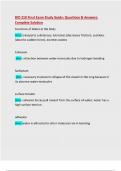
Functions of Water in the Body (Ans- transports substances, lubricates (decreases friction), cushions (absorbs sudden force), excretes wastes Cohesion (Ans- attraction between water molecules due to hydrogen bonding Surfactant (Ans- necessary to prevent collapse of the alveoli in the lung because in its absence water molecules surface tension (Ans- cohesive forces pull inward from the surface of water; water has a high surface tension. adhesion (Ans- water is attracted to other molecules via H-bonding specific heat (Ans- amount of E required to raise the temperature of a substance 1 Celsius; water has a high specific heat heat of vaporization (Ans- Heat required for release of molecules from a liquid phase into a gaseous phase for 1 gram of a substance Water's value very high due to hydrogen bonding. Example: sweating Solute (Ans- they dissolve in SOLVENTS to make SOLUTIONS hydrophilic (Ans- love water -may be charged or polar Hydrophobic (Ans- Water fearing dissociate (Ans- to break the ties between, separate from, stop associating with. NaCl dissociates into Na+ and Cl- ions. Acid (Ans- substance that releases H+ in water. pH7. Strong acid (Ans- When a strong acid is placed in water, it dissolves and dissociates Example: Hydrochloric acid in the stomach base (Ans- substance that accepts H+ or releases OH- in water. pH 7. (Strong base is ammonia or bleach) pH scale (Ans- measures (H+) range between 0 and 14 Neutral (Ans- Plain Water, pH is 7 neutralization (Ans- occurs when a solution that is either acidic or basic is returned to neutral (7). The *???* of an acidic solution is accomplished by adding a base, whereas a basic solution is neutralized by adding an acid Suspension (Ans- material larger in size than 1 mm mixed with water E.g., blood cells within plasma or sand in water Does not remain mixed unless in motion Appears cloudy or opaque; scatters light Solute particles can be separated by filters colloid (Ans- smaller particles than a suspension, but larger than those in a solution E.g., fluid in cell cytosol and fluid in blood plasma Remains mixed when not in motion Scatters light, appears cloudy Solute particles cannot be separated by filters emulsion (Ans- A suspension of small globules of one liquid in a second liquid with which the first will not mix: Ex. Mixture of oil and water Solution (Ans- homogeneous mixture in which the substance is smaller than 1 nanometer and it dissolves in water. Sugar water, salt water biological macromolecules (Ans- usually very large and important for living organisms Always contain C, H & O 4 classes: lipids, carbs, nucleic acids, amino acids Polymers (Ans- chains of monomers dehydration synthesis (Ans- A chemical reaction in which two molecules are bonded together with the removal of a water molecule. Water lost Hydrolysis (Ans- Breaking down complex molecules by the chemical addition of water. Adding Water lipids (Ans- *non polar diverse molecules -all are HYDROPHOBIC Water insoluble Classes: triglycerides, phospholipids, steroids, eicosanoids Triglycerides (Ans- Most common lipd in the body "fats"; long-term energy storage -made of 1 polar glycerol head and 3 nonpolar fatty acid (FA) chains fatty acids (Ans- are nonpolar and do not dissolve in water saturated fatty acid (Ans- lacks double bond in animal products and are solid at room temp
Geschreven voor
- Instelling
- Portage Learning
- Vak
- BIO 210
Documentinformatie
- Geüpload op
- 17 juli 2025
- Aantal pagina's
- 128
- Geschreven in
- 2024/2025
- Type
- Tentamen (uitwerkingen)
- Bevat
- Vragen en antwoorden
Onderwerpen
-
cohesion
-
surfactant
-
functions of water in the body

Ook beschikbaar in voordeelbundel