

Multinational Strategic Planning
CHAPTER 1: CONCEPTUAL FOUNDATIONS OF INTERNATIONAL BUSINESS STRATEGY Very important!
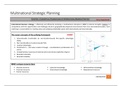
International business strategy = effectively and efficiently matching a multinational enterprise’s (MNE’s) internal strengths (relative to
competitors) with the opportunities and challenges found in geographically dispersed environments that cross international borders. Such
matching is a precondition to creating value and satisfying stakeholder goals, both domestically and internationally.
The seven concepts of the unifying framework EXAM!
1. Internationally transferable (or non-location-bound) firm-specific advantages
(FSAs)
2. Non-transferable (or location-bound) FSAs
3. Location advantages
4. Investment in – and value creation through – recombination (combination of 2
and 3)
5. Complementary resources of external actors (not shown explicitly in figure)
6. Bounded rationality
7. Bounded reliability
MNE’s unique resource base
§ Physical resources § Upstream knowledge § Administrative knowledge
§ Financial resources § Downstream knowledge § Reputational resources
§ Human resources
KIM NGUYEN 1
,Building upon its resource base, as well as its access to location advantages, the MNE will develop stand-alone FSAs (e.g., brand names, patents)
and routines, and will also engage in resources recombination. => non-transferable, location-bound FSAs
Stand-alone FSAs Routines Resource recombination
reflect the firm’s distinct strengths relative to are stable patterns of decisions and actions Artful orchestration of resources, especially
rivals and are the source of competitive that coordinate the productive use of knowledge bundles, as a response to
advantage in the marketplace. resources, and thereby generate value, differences between national and foreign
whether domestically or internationally. The environments, and to satisfy new stakeholder
combination ability expressed in routines is a demands in these foreign environments.
higher-order FSA.
ð Entrepreneurial judgment!
International transferability of FSAs? => Paradox:
§ Codifiable knowledge => cheaply transferred abroad but easily imitated by other firms
§ Tacit knowledge => expensive and time-consuming, but difficult to imitate
Four main types of location-bound, non-transferable FSAs
1. Stand-alone resources linked to location advantages 3. Local best practices (i.e. routines)
2. Local marketing knowledge and reputational resources (such as 4. Domestic recombination capability
brand names)
Location advantages = entire set of strengths of a location, and accessible by firms in that location (always relative to the strengths of other
locations)
KIM NGUYEN 2
,Motivation for foreign expansion
1. Natural resource seeking 2. Market seeking (search of 3. Strategic resource seeking 4. Efficiency seeking
(cheap labour, energy, …) customers in host (access to know hows) (restructuring of MNE)
countries)
Need for developing new LB FSAs in
host country
EXAM!
KIM NGUYEN 3
, Four MNE archetypes EXAM!
1. Centralized exporter 2. International projector 3. International coordinator 4. Multi-centered MNE
1. Centralized exporter
a. Standardized products manufactured at home embody
the firm’s FSAs (because of favourable home country
environment)
b. = market seeker
c. Direct link between home country NLB FSAs and the host
country LAs without developing new LB FSAs in host
country (because of product’s desirability in host)
d. Multinational activities occur primarily in downstream
(marketing, distribution, …)
e. See Motion Picture Studios
2. International projector
a. Knowledge-based FSAs developed in the home
country are transferred to subsidiaries in host
countries.
b. Projecting the home country success recipes
abroad. Lack of development of LB FSAs of the
international projector (because of product’s
desirability in host)
c. Use of expatriates
d. See Ford or Disney
KIM NGUYEN 4
CHAPTER 1: CONCEPTUAL FOUNDATIONS OF INTERNATIONAL BUSINESS STRATEGY Very important!
International business strategy = effectively and efficiently matching a multinational enterprise’s (MNE’s) internal strengths (relative to
competitors) with the opportunities and challenges found in geographically dispersed environments that cross international borders. Such
matching is a precondition to creating value and satisfying stakeholder goals, both domestically and internationally.
The seven concepts of the unifying framework EXAM!
1. Internationally transferable (or non-location-bound) firm-specific advantages
(FSAs)
2. Non-transferable (or location-bound) FSAs
3. Location advantages
4. Investment in – and value creation through – recombination (combination of 2
and 3)
5. Complementary resources of external actors (not shown explicitly in figure)
6. Bounded rationality
7. Bounded reliability
MNE’s unique resource base
§ Physical resources § Upstream knowledge § Administrative knowledge
§ Financial resources § Downstream knowledge § Reputational resources
§ Human resources
KIM NGUYEN 1
,Building upon its resource base, as well as its access to location advantages, the MNE will develop stand-alone FSAs (e.g., brand names, patents)
and routines, and will also engage in resources recombination. => non-transferable, location-bound FSAs
Stand-alone FSAs Routines Resource recombination
reflect the firm’s distinct strengths relative to are stable patterns of decisions and actions Artful orchestration of resources, especially
rivals and are the source of competitive that coordinate the productive use of knowledge bundles, as a response to
advantage in the marketplace. resources, and thereby generate value, differences between national and foreign
whether domestically or internationally. The environments, and to satisfy new stakeholder
combination ability expressed in routines is a demands in these foreign environments.
higher-order FSA.
ð Entrepreneurial judgment!
International transferability of FSAs? => Paradox:
§ Codifiable knowledge => cheaply transferred abroad but easily imitated by other firms
§ Tacit knowledge => expensive and time-consuming, but difficult to imitate
Four main types of location-bound, non-transferable FSAs
1. Stand-alone resources linked to location advantages 3. Local best practices (i.e. routines)
2. Local marketing knowledge and reputational resources (such as 4. Domestic recombination capability
brand names)
Location advantages = entire set of strengths of a location, and accessible by firms in that location (always relative to the strengths of other
locations)
KIM NGUYEN 2
,Motivation for foreign expansion
1. Natural resource seeking 2. Market seeking (search of 3. Strategic resource seeking 4. Efficiency seeking
(cheap labour, energy, …) customers in host (access to know hows) (restructuring of MNE)
countries)
Need for developing new LB FSAs in
host country
EXAM!
KIM NGUYEN 3
, Four MNE archetypes EXAM!
1. Centralized exporter 2. International projector 3. International coordinator 4. Multi-centered MNE
1. Centralized exporter
a. Standardized products manufactured at home embody
the firm’s FSAs (because of favourable home country
environment)
b. = market seeker
c. Direct link between home country NLB FSAs and the host
country LAs without developing new LB FSAs in host
country (because of product’s desirability in host)
d. Multinational activities occur primarily in downstream
(marketing, distribution, …)
e. See Motion Picture Studios
2. International projector
a. Knowledge-based FSAs developed in the home
country are transferred to subsidiaries in host
countries.
b. Projecting the home country success recipes
abroad. Lack of development of LB FSAs of the
international projector (because of product’s
desirability in host)
c. Use of expatriates
d. See Ford or Disney
KIM NGUYEN 4


