made by Maria O (rug)
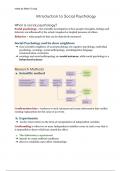
Introduction to Social Psychology
What is social psychology?
Social psychology = the scientific investigation of how people’s thoughts, feelings and
behavior are influenced by the actual, imagined or implied presence of others.
Behavior = what people do that can be objectively measured.
Social Psychology and its close neighbors
➔ close scientific neighbors of social psychology are cognitive psychology, individual
psychology, sociology, social anthropology, sociolinguistics language
communication, economics
➔ sociology and social anthropology are social sciences, while social psychology is a
behavioral science
Research Methods
a. Scientific method
;
Confirmation bias = tendency to seek, interpret and create information that verifies
existing explanations for the cause of an event.
b. Experiments
➔ involve intervention in the form of manipulation of independent variables
Confounding is when two or more independent variables covary in such a way that it
is impossible to know which has caused the effect.
1. The laboratory experiment
➔ intends to create artificial conditions
➔ allows to establish cause-effect relationships
,made by Maria O (rug)
2. The field experiment
➔ conducted in more naturalistic settings
➔ has high external validity and no demand characteristics
fMRI (functional Magnetic Resonance Imaging) = method used in social
neuroscience to measure where electrochemical activity in the brain is occurring.
Demand characteristics = features of an experiment that seem to ‘demand’ a certain
response.
Experimenter effects = effects produced or influenced by clues to the hypotheses
under examination, inadvertently communicated by the experimenter.
➔ can be minimized by a double-blind experiment
c. Non-experimental methods
● Archival research
● Case study
● Qualitative research and discourse analysis
● Survey research
● Field studies
Research ethics
● protection from harm
● deception
● informed consent
● right to privacy
● debriefing
Theories and theorizing
a. Theories in social psychology
Metatheory = a set of interrelated concepts and principles concerning which theories
or types of theory are appropriate.
1. Behaviorism
➔ radical behaviorists explain observable behavior in terms of reinforcement
➔ neo-behaviorists attempt to explain observable behavior in terms of contextual
factors and unobservable intervening such as beliefs, feelings and motives
2. Cognitive psychology
➔ cognitive theories are explanations of behavior in terms of the way people
actively interpret and represent their experiences and then plan action
,made by Maria O (rug)
3. Neuroscience and biochemistry
➔ social neuroscience is the exploration of brain activity associated with social
cognition and social psychological processes and phenomena
4. Evolutionary social psychology
➔ views complex social behavior as adaptive, helping the individual, kin and the
species as a whole to survive
5. Personality and individual differences
➔ social psychologists have often explained social behavior in terms of enduring
(sometimes innate) personality differences between people
6. Collectivist theories
➔ focus on people as a product of their location in the matrix of social categories and
groups that make up society
b. Reductionism and levels of explanation
➔ reductionism is the practice of explaining a phenomenon with the language
and concepts of a lower level of analysis
➔ if the level of explanation does not match the level of the question, then the
question remind effectively unanswered
c. Positivism and post-positivism
➔ positivism is the non-critical acceptance of science as the only way to arrive at
true knowledge: science as religion
➔ operational definitions define a theoretical term in a way that allows it to be
manipulated or measured (helps combat criticism of positivism)
Historical context
➔ Völkerpsychologie is an early precursor of social psychology, as the study of the
collective mind, in Germany in the mid to late nineteenth century
➔ at Indiana University was where Norman Triplett conducted a study on social
facilitation that is often cited as the first experiment
Social psychology in europe
➔ although psychology and social psychology were born in Europe, the field was
quickly dominated by the United States - a process accelerated by the rise of fascism
in Europe during the 1930s
➔ since the 1960s, there has been a renaissance of European social psychology and it
focused on making social psychology more social.
, made by Maria O (rug)
Social Cognition and Social Thinking
Social psychology and cognition
➔ thought = internal language and symbols we use (often consciously)
➔ cognition = also refers to mental processing that can be largely automatic
Social cognition = the cognitive processes and structures that influence and are
influenced by social behavior.
➔ the cognitive emphasis on social psychology had at least four forms:
● cognitive consistency = people try to reduce inconsistency among their
cognitions, because they find inconsistency unpleasant
● naive scientist = characterizes people as using rational, scientific-like,
cause-effect analyses to understand their world (supports the attribution theory)
● cognitive miser = characterizes people as using the least complex and
demanding cognitions that generally produce adaptive behaviors
● motivated tactician = characterizes people as having multiple cognitive
strategies available, which they choose from based on personal goals and needs
Forming Impressions of other people
a. What information is important?
The configural model = Arch’s gestalt-based model of impression formation, in
which central traits play a disproportionate role in configuring the final impression.
➔ central traits have a disproportionate influence on the configuration of final
impressions
➔ peripheral traits have an insignificant influence on the configuration of final
impressions
➔ Asch argued that warm/cold is a central trait dimension
b. Biases in forming impressions
● Primacy and recency
➔ primacy effect: the traits presented first disproportionately influence the final
impression
➔ a recency effect can also emerge: might happen when distracted or when there’s
little motivation to attend someone
● Positivity and negativity
➔ in the absence of information we tend to assume the best, but negative information
attracts our attention
● Personal constructs and implicit personality theories
➔ personal constructs are idiosyncratic and personal ways of characterizing people
Introduction to Social Psychology
What is social psychology?
Social psychology = the scientific investigation of how people’s thoughts, feelings and
behavior are influenced by the actual, imagined or implied presence of others.
Behavior = what people do that can be objectively measured.
Social Psychology and its close neighbors
➔ close scientific neighbors of social psychology are cognitive psychology, individual
psychology, sociology, social anthropology, sociolinguistics language
communication, economics
➔ sociology and social anthropology are social sciences, while social psychology is a
behavioral science
Research Methods
a. Scientific method
;
Confirmation bias = tendency to seek, interpret and create information that verifies
existing explanations for the cause of an event.
b. Experiments
➔ involve intervention in the form of manipulation of independent variables
Confounding is when two or more independent variables covary in such a way that it
is impossible to know which has caused the effect.
1. The laboratory experiment
➔ intends to create artificial conditions
➔ allows to establish cause-effect relationships
,made by Maria O (rug)
2. The field experiment
➔ conducted in more naturalistic settings
➔ has high external validity and no demand characteristics
fMRI (functional Magnetic Resonance Imaging) = method used in social
neuroscience to measure where electrochemical activity in the brain is occurring.
Demand characteristics = features of an experiment that seem to ‘demand’ a certain
response.
Experimenter effects = effects produced or influenced by clues to the hypotheses
under examination, inadvertently communicated by the experimenter.
➔ can be minimized by a double-blind experiment
c. Non-experimental methods
● Archival research
● Case study
● Qualitative research and discourse analysis
● Survey research
● Field studies
Research ethics
● protection from harm
● deception
● informed consent
● right to privacy
● debriefing
Theories and theorizing
a. Theories in social psychology
Metatheory = a set of interrelated concepts and principles concerning which theories
or types of theory are appropriate.
1. Behaviorism
➔ radical behaviorists explain observable behavior in terms of reinforcement
➔ neo-behaviorists attempt to explain observable behavior in terms of contextual
factors and unobservable intervening such as beliefs, feelings and motives
2. Cognitive psychology
➔ cognitive theories are explanations of behavior in terms of the way people
actively interpret and represent their experiences and then plan action
,made by Maria O (rug)
3. Neuroscience and biochemistry
➔ social neuroscience is the exploration of brain activity associated with social
cognition and social psychological processes and phenomena
4. Evolutionary social psychology
➔ views complex social behavior as adaptive, helping the individual, kin and the
species as a whole to survive
5. Personality and individual differences
➔ social psychologists have often explained social behavior in terms of enduring
(sometimes innate) personality differences between people
6. Collectivist theories
➔ focus on people as a product of their location in the matrix of social categories and
groups that make up society
b. Reductionism and levels of explanation
➔ reductionism is the practice of explaining a phenomenon with the language
and concepts of a lower level of analysis
➔ if the level of explanation does not match the level of the question, then the
question remind effectively unanswered
c. Positivism and post-positivism
➔ positivism is the non-critical acceptance of science as the only way to arrive at
true knowledge: science as religion
➔ operational definitions define a theoretical term in a way that allows it to be
manipulated or measured (helps combat criticism of positivism)
Historical context
➔ Völkerpsychologie is an early precursor of social psychology, as the study of the
collective mind, in Germany in the mid to late nineteenth century
➔ at Indiana University was where Norman Triplett conducted a study on social
facilitation that is often cited as the first experiment
Social psychology in europe
➔ although psychology and social psychology were born in Europe, the field was
quickly dominated by the United States - a process accelerated by the rise of fascism
in Europe during the 1930s
➔ since the 1960s, there has been a renaissance of European social psychology and it
focused on making social psychology more social.
, made by Maria O (rug)
Social Cognition and Social Thinking
Social psychology and cognition
➔ thought = internal language and symbols we use (often consciously)
➔ cognition = also refers to mental processing that can be largely automatic
Social cognition = the cognitive processes and structures that influence and are
influenced by social behavior.
➔ the cognitive emphasis on social psychology had at least four forms:
● cognitive consistency = people try to reduce inconsistency among their
cognitions, because they find inconsistency unpleasant
● naive scientist = characterizes people as using rational, scientific-like,
cause-effect analyses to understand their world (supports the attribution theory)
● cognitive miser = characterizes people as using the least complex and
demanding cognitions that generally produce adaptive behaviors
● motivated tactician = characterizes people as having multiple cognitive
strategies available, which they choose from based on personal goals and needs
Forming Impressions of other people
a. What information is important?
The configural model = Arch’s gestalt-based model of impression formation, in
which central traits play a disproportionate role in configuring the final impression.
➔ central traits have a disproportionate influence on the configuration of final
impressions
➔ peripheral traits have an insignificant influence on the configuration of final
impressions
➔ Asch argued that warm/cold is a central trait dimension
b. Biases in forming impressions
● Primacy and recency
➔ primacy effect: the traits presented first disproportionately influence the final
impression
➔ a recency effect can also emerge: might happen when distracted or when there’s
little motivation to attend someone
● Positivity and negativity
➔ in the absence of information we tend to assume the best, but negative information
attracts our attention
● Personal constructs and implicit personality theories
➔ personal constructs are idiosyncratic and personal ways of characterizing people