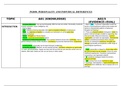
PS2050: PERSONALITY AND INDIVIDUAL DIFFERENCES
TOPIC A01 (KNOWLEDGE) A02/3
(EVIDENCE+EVAL)
- Individual differences: how we psychologically differ but also are similar. Personality constructs - Allport, 1961: “a dynamic organisation inside the
INTRODUCTION include motivation, mood, intelligence, etc. person of psychophysical systems that creates the
- Trait Vs State: person’s characteristic patterns of behaviour,
= Trait: relatively enduring disposition that exert a consistent influence on behaviours. thoughts and feelings.”
= State: the response or reaction to a situation an individual is in at that given time. = There are physical systems (biological), inside the
- Nature Vs Nurture: person (internal storage of patterns supporting idea
= Nature: biological and family factors that personality influences behaviour), dynamic
= Nurture: social and environmental factors organisation (not static but adjustable), characteristic
- Implications of describing personality: how a person behaves across time (continuity), how a pattern (consistency/continuity which uniquely
person behaves across similar situations (consistency) & personal distinctiveness (uniqueness). identify an individual) & behaviour, thoughts and
feelings (personality encompasses a wide range of
- Learning theory: personality can be learnt through conditioning. psychological experience).
- Humanistic approach (Maslow): we are wanting animals; motivation underpins our personality.
To reach self-actualization. Argues we have free will and that we can exercise control over our - Freud: personality is shaped by forces deep within
desires. After basic needs are met, we can focus on other needs. the mind of which we are unaware. Driven by early
childhood experiences. Conscious, preconscious,
unconscious, and repressed material.
= Id: transforms biological needs into tension,
pleasure principle.
= Ego: evolves from id and controls its urges.
= Superego: internalization of approved/disapproved
behaviours from childhood- tries to impose will on Id
and Ego.
, - Personality theory assumptions: limited set of adjectives to describe individuals, there are - Lexical Hypothesis: (Galton) we have single words
PERSONALITY qualities of personality that are universal and there is individual variance. for the most meaningful personality descriptors.
- Trait: a person will differ along a continuum, there will be a degree of variability. = Importance of frequency (high frequency: shy, low
TRAITS
- Type: usually regarded as a category that is distinct & discontinuous; there is no variability. frequency: timid)
- Jingle fallacy: assuming that two diff things are the same because they bear the same name = Importance of trait reflected by number of terms
(eg. anxiety for fear and anxiety). (honest has upstanding, virtious, principled, etc.)
- Jangle fallacy: assuming that two things that refer to the same phenomenon are different
because they have different names (eg. chatty, outgoing, decisive, assertive). - (Catell, 1965): traits are stable, long-lasting building
- General factors of personality measures the factors that are cross culturally highly valued. blocks of personality. Modified the 12 factors from
= Stability: conforming/being stable factor analysis to 16 personality factors.
= Plasticity: being open and having the capacity to change - (Tupes & Christal) proposed a five-factor solution.
- Eysenck, 3 basic traits: sociability, neuroticism &
- Measuring personality: psychoticism.
= Self-report: quick, easy, cheap. You have the best insight arguably. Biases in responding, no - Costa & McCrae: Openess Conscientiousness
biological basis. Extraversion Agreeableness Neuroticism
= Other report: quick, easy, cheap, close peer has good insight. Peer has no acess to inner - Ashton & Lee (2007), a sixth factor: honesty
thoughts, some traits much harder to judge externally.
= Behaviour observation: - Mischel (1968): traits didn’t necessarily predict
= Physiology: behaviour. Problems arise when looking for cross-
- Traits theorists: Behaviour may be the manifestation of many traits ‘working in unison’. situational consistency of behaviour that can be
TOPIC A01 (KNOWLEDGE) A02/3
(EVIDENCE+EVAL)
- Individual differences: how we psychologically differ but also are similar. Personality constructs - Allport, 1961: “a dynamic organisation inside the
INTRODUCTION include motivation, mood, intelligence, etc. person of psychophysical systems that creates the
- Trait Vs State: person’s characteristic patterns of behaviour,
= Trait: relatively enduring disposition that exert a consistent influence on behaviours. thoughts and feelings.”
= State: the response or reaction to a situation an individual is in at that given time. = There are physical systems (biological), inside the
- Nature Vs Nurture: person (internal storage of patterns supporting idea
= Nature: biological and family factors that personality influences behaviour), dynamic
= Nurture: social and environmental factors organisation (not static but adjustable), characteristic
- Implications of describing personality: how a person behaves across time (continuity), how a pattern (consistency/continuity which uniquely
person behaves across similar situations (consistency) & personal distinctiveness (uniqueness). identify an individual) & behaviour, thoughts and
feelings (personality encompasses a wide range of
- Learning theory: personality can be learnt through conditioning. psychological experience).
- Humanistic approach (Maslow): we are wanting animals; motivation underpins our personality.
To reach self-actualization. Argues we have free will and that we can exercise control over our - Freud: personality is shaped by forces deep within
desires. After basic needs are met, we can focus on other needs. the mind of which we are unaware. Driven by early
childhood experiences. Conscious, preconscious,
unconscious, and repressed material.
= Id: transforms biological needs into tension,
pleasure principle.
= Ego: evolves from id and controls its urges.
= Superego: internalization of approved/disapproved
behaviours from childhood- tries to impose will on Id
and Ego.
, - Personality theory assumptions: limited set of adjectives to describe individuals, there are - Lexical Hypothesis: (Galton) we have single words
PERSONALITY qualities of personality that are universal and there is individual variance. for the most meaningful personality descriptors.
- Trait: a person will differ along a continuum, there will be a degree of variability. = Importance of frequency (high frequency: shy, low
TRAITS
- Type: usually regarded as a category that is distinct & discontinuous; there is no variability. frequency: timid)
- Jingle fallacy: assuming that two diff things are the same because they bear the same name = Importance of trait reflected by number of terms
(eg. anxiety for fear and anxiety). (honest has upstanding, virtious, principled, etc.)
- Jangle fallacy: assuming that two things that refer to the same phenomenon are different
because they have different names (eg. chatty, outgoing, decisive, assertive). - (Catell, 1965): traits are stable, long-lasting building
- General factors of personality measures the factors that are cross culturally highly valued. blocks of personality. Modified the 12 factors from
= Stability: conforming/being stable factor analysis to 16 personality factors.
= Plasticity: being open and having the capacity to change - (Tupes & Christal) proposed a five-factor solution.
- Eysenck, 3 basic traits: sociability, neuroticism &
- Measuring personality: psychoticism.
= Self-report: quick, easy, cheap. You have the best insight arguably. Biases in responding, no - Costa & McCrae: Openess Conscientiousness
biological basis. Extraversion Agreeableness Neuroticism
= Other report: quick, easy, cheap, close peer has good insight. Peer has no acess to inner - Ashton & Lee (2007), a sixth factor: honesty
thoughts, some traits much harder to judge externally.
= Behaviour observation: - Mischel (1968): traits didn’t necessarily predict
= Physiology: behaviour. Problems arise when looking for cross-
- Traits theorists: Behaviour may be the manifestation of many traits ‘working in unison’. situational consistency of behaviour that can be