

KBK-Fabry Loranne den Otter
Orthopedic disorders in children
1. Foot and lower limb disorders
Survey
Feet: Causes of pain in the foot congenital foot disorders
Lower limb: rotational and axial deformities
1.1. Pain in the foot
1.1.1. Pes Planus – Flatfoot
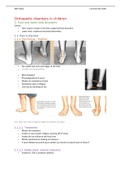
No medial foot arch and valgus of the heel
15-20% van de bevolking
Most frequent
Physiologically till 4 years
Mostly no complaints of pain
Sometimes pain or fatigue
Corrects by standing on toe
Van 2jaar kan nog corrigeren tegen de leeftijd van 6jaar
1.1.1.1. Treatment
Mostly no treatment
Insoles in case of pain, fatigue, wearing off of shoes
Insoles do not influence the foot form
Mostly spontaneous healing not always!
If sever flatfeet around 8 years, better use insole to prevent pain in future?
1.1.1.2. Pedes plani: natural evolution
Incidence: 14% ( canadese soldiers)
,KBK-Fabry Loranne den Otter
Footarch is being formed between 0 and 6 years of age
1.1.1.3. Rigid flatfeet
Seldom
Mostly painful
Causes : congenital synostoses
– infection
– reuma
– post-traumatic…
Needs more often operation
Tarsal coalition -> is vaak de oorzaak
Talo-calcaneaire synostoses: difficult to treat
1.1.1.4. Pedes plani: operatieve behandeling
1.1.1.5. Freiberg: avasculair necrosis metatarsal 2 (or 3)
, KBK-Fabry Loranne den Otter
Pijn in de middenvoet, behandeling met zool, geneest meestal vanzelf
1.1.1.6. Kohler
= necrosis os naviculare
Toddlers
treatment: symptomatic (ev. insole)
– ontlasting van os naviculare
1.1.1.7. Calcaneair apophysitis - Sever’s disease
Inflammation of the growth plate of the calcaneus
9 - 14 jaar
– Vooral bij sportieve kinderen en vooral sporten waarbij veel gesprongen wordt
Bilat. 60% - 80%
Behandeling: tijdelijke sportstop en steunzolen
1.1.2. Pes Cavus
High arch of the footh
Mostly no pain
Sometimes hereditary
Can give pressure on heel and metarsal head: insole
Be aware of progressieve cavus
And varus: neurological disease
1.1.3. Progressive cavovarus
Mostly neurological disease
– Charcot-Marie Tooth (fib.spieratr.)
– Polio
– Spinal dysraphisme tethered cord
Orthopedic disorders in children
1. Foot and lower limb disorders
Survey
Feet: Causes of pain in the foot congenital foot disorders
Lower limb: rotational and axial deformities
1.1. Pain in the foot
1.1.1. Pes Planus – Flatfoot
No medial foot arch and valgus of the heel
15-20% van de bevolking
Most frequent
Physiologically till 4 years
Mostly no complaints of pain
Sometimes pain or fatigue
Corrects by standing on toe
Van 2jaar kan nog corrigeren tegen de leeftijd van 6jaar
1.1.1.1. Treatment
Mostly no treatment
Insoles in case of pain, fatigue, wearing off of shoes
Insoles do not influence the foot form
Mostly spontaneous healing not always!
If sever flatfeet around 8 years, better use insole to prevent pain in future?
1.1.1.2. Pedes plani: natural evolution
Incidence: 14% ( canadese soldiers)
,KBK-Fabry Loranne den Otter
Footarch is being formed between 0 and 6 years of age
1.1.1.3. Rigid flatfeet
Seldom
Mostly painful
Causes : congenital synostoses
– infection
– reuma
– post-traumatic…
Needs more often operation
Tarsal coalition -> is vaak de oorzaak
Talo-calcaneaire synostoses: difficult to treat
1.1.1.4. Pedes plani: operatieve behandeling
1.1.1.5. Freiberg: avasculair necrosis metatarsal 2 (or 3)
, KBK-Fabry Loranne den Otter
Pijn in de middenvoet, behandeling met zool, geneest meestal vanzelf
1.1.1.6. Kohler
= necrosis os naviculare
Toddlers
treatment: symptomatic (ev. insole)
– ontlasting van os naviculare
1.1.1.7. Calcaneair apophysitis - Sever’s disease
Inflammation of the growth plate of the calcaneus
9 - 14 jaar
– Vooral bij sportieve kinderen en vooral sporten waarbij veel gesprongen wordt
Bilat. 60% - 80%
Behandeling: tijdelijke sportstop en steunzolen
1.1.2. Pes Cavus
High arch of the footh
Mostly no pain
Sometimes hereditary
Can give pressure on heel and metarsal head: insole
Be aware of progressieve cavus
And varus: neurological disease
1.1.3. Progressive cavovarus
Mostly neurological disease
– Charcot-Marie Tooth (fib.spieratr.)
– Polio
– Spinal dysraphisme tethered cord


