Engels
1. Business fundamentals
Business organisation
Type of business
Sole trader/Sole proprietorship: The business is owned by one person who is responsible for
any debts
Partnership: Two or more people run the business together. All partners share profits and
losses
Limited company (Ltd)/ Limited liabilty company (LLC): The company is responsible for any
losses, not the owners. The company is private, that means that shared cannot be sold in
public = BV
Public limited company (Plc)/ Corporation (Corp/Inc): The company is owned by
shareholders who receive dividends and who may gain or lose money if the share price goes
up or down = NV
Business model
B2B: companies sell to companies
B2C: Companies sell to individuals
C2C: individuals sell to inividuals
B2B2C: Third-party vendors or consultants sell a company's products to consumers
Management structure
The Board: Chairman, CEO, CFO, Non-executive directors
CEO: Chief Executive Officer
CFO: Chief Financial Officer
The Management Committee/top management: CEO, CFO, directors of marketing, HR, IT…
Middle management: Managers of divisions, departments, branches,…
Supervisory/first line management: Supervisors, team leaders…
Economic cycles
The business cycle
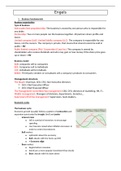
Economic growth (usually) follows a pattern of contraction and
expansion punctuated by troughs [trof] and peaks
- Interest rates
o fall in a period of recession: to encourage
spending
o rise/ become raised when inflation increases: in
order to control investments
- Bull market:
o optimistic about the economy
o Bull: attacks with the horns up (NY)
o = Economy stijgt
- Bear market:
o begins before recession
o bonds are a more popular investment than stocks
o Bear: attacks with his claws down
, o = Economy daalt
The investment cycle
Fase 1: accumulation
After the markt has bottomed, innovators and early adopters
begin to buy at attractive prices In a market which is still
bearish
Fase 2: mark-up phase
Fear of (majority) investors: losing money
o Becomes weaker than the desire to make a profit
Investors become bullish excited euphoric
Fase 3: Distribution phase
Value investors begin to sell
Prices can remain high
Greater fool investors continue to buy, hoping for further rises
o Eventually: prices drop and sellers set for a breakeven or a small loss
Fase 4: Mark-down
most painful
only when the market has plunged 50% or more that many investors first panic, then give in
Early adopters: willing to take risks
Innovators: don’t buy when market is bullish and don’t sell when it bearish
2. Building a career
Tijden zie tijdlijn in wit schrift
Comparative forms
+ beautiful More beautiful
+ good + good Better and better
= positive As positive as
+ rapidly More rapidly
+ quick + quick More and more quickly
+ slow Slower
+ bulky Bulkier
- generous Less generous
+ high Higher than
- expensive Less expensive
+ - +-
Durable Cracked Disposable (+: medical sect
Heavy-duty Flawed (komende 2 hieronder zijn synoniemen) Tough
Reliable Flimsy
Shoddy
Poorly-designed
Fragile
Scratched
1. Business fundamentals
Business organisation
Type of business
Sole trader/Sole proprietorship: The business is owned by one person who is responsible for
any debts
Partnership: Two or more people run the business together. All partners share profits and
losses
Limited company (Ltd)/ Limited liabilty company (LLC): The company is responsible for any
losses, not the owners. The company is private, that means that shared cannot be sold in
public = BV
Public limited company (Plc)/ Corporation (Corp/Inc): The company is owned by
shareholders who receive dividends and who may gain or lose money if the share price goes
up or down = NV
Business model
B2B: companies sell to companies
B2C: Companies sell to individuals
C2C: individuals sell to inividuals
B2B2C: Third-party vendors or consultants sell a company's products to consumers
Management structure
The Board: Chairman, CEO, CFO, Non-executive directors
CEO: Chief Executive Officer
CFO: Chief Financial Officer
The Management Committee/top management: CEO, CFO, directors of marketing, HR, IT…
Middle management: Managers of divisions, departments, branches,…
Supervisory/first line management: Supervisors, team leaders…
Economic cycles
The business cycle
Economic growth (usually) follows a pattern of contraction and
expansion punctuated by troughs [trof] and peaks
- Interest rates
o fall in a period of recession: to encourage
spending
o rise/ become raised when inflation increases: in
order to control investments
- Bull market:
o optimistic about the economy
o Bull: attacks with the horns up (NY)
o = Economy stijgt
- Bear market:
o begins before recession
o bonds are a more popular investment than stocks
o Bear: attacks with his claws down
, o = Economy daalt
The investment cycle
Fase 1: accumulation
After the markt has bottomed, innovators and early adopters
begin to buy at attractive prices In a market which is still
bearish
Fase 2: mark-up phase
Fear of (majority) investors: losing money
o Becomes weaker than the desire to make a profit
Investors become bullish excited euphoric
Fase 3: Distribution phase
Value investors begin to sell
Prices can remain high
Greater fool investors continue to buy, hoping for further rises
o Eventually: prices drop and sellers set for a breakeven or a small loss
Fase 4: Mark-down
most painful
only when the market has plunged 50% or more that many investors first panic, then give in
Early adopters: willing to take risks
Innovators: don’t buy when market is bullish and don’t sell when it bearish
2. Building a career
Tijden zie tijdlijn in wit schrift
Comparative forms
+ beautiful More beautiful
+ good + good Better and better
= positive As positive as
+ rapidly More rapidly
+ quick + quick More and more quickly
+ slow Slower
+ bulky Bulkier
- generous Less generous
+ high Higher than
- expensive Less expensive
+ - +-
Durable Cracked Disposable (+: medical sect
Heavy-duty Flawed (komende 2 hieronder zijn synoniemen) Tough
Reliable Flimsy
Shoddy
Poorly-designed
Fragile
Scratched