
NRMS 5190 (NRMS5190)
State University Of New York - Downstate Medical Center
Aquí están los mejores recursos para pasar NRMS 5190 (NRMS5190). Encuentra NRMS 5190 (NRMS5190) guías de estudio, notas, tareas, y mucho más.
Examen
NRMS 5190 Advanced Pathophysiology Final Exam Review 2026 | 100 Questions and Answers with Rationales | SUNY Downstate.
NuevoNRMS 5190 Advanced Pathophysiology Final Exam Review 2026 | 100 Questions and Answers with Rationales | SUNY Downstate.
 Wiseman
Otro
Downstate Medical Center NRMS 5190/ NMRS5190: Health Assessment and Differential Diagnosis Exam 2, A+ guide.
NuevoDownstate Medical Center NRMS 5190/ NMRS5190: Health Assessment and Differential Diagnosis Exam 2, A+ guide. Exam: Preform less invasive manuevers early and potentially distressing manuevers near the nd of the examination If child reports pain in one area examine that area last Four Principles of Child Development: 1. Child development proceeds along a predictable pathway 2. The range of normal development is wide 3. Various physical, social and environmental factors as well as disease ...
 MindCraft
Otro
NRMS 5190 Advanced Pathophysiology Final Exam Study Guide 2026 | SUNY Downstate | Comprehensive Review.
NuevoNRMS 5190 Advanced Pathophysiology Final Exam Study Guide 2026 | SUNY Downstate | Comprehensive Review.
Wiseman
Otro
Advanced Pathophyisology NRMS 5190/ NRMS5190: Exam 2 A+ Complete Study Guide ~ Latest Updated Fall 2025/26.
NuevoAdvanced Pathophyisology NRMS 5190/ NRMS5190: Exam 2 A+ Complete Study Guide ~ Latest Updated Fall 2025/26. Chapter 30 Respiratory Disorder The movement of air between the atmosphere and the lungs follows the laws of physics as they relate to gases. The air in the alveoli contains a mixture of gases, including nitrogen, oxygen, carbon dioxide, and water vapor.. The pressure inside the airways and alveoli of the lungs is called intrapulmonary (or alveolar) pressure; the pressure in the pleu...
MindCraft
Examen
NRMS 5190 Advanced Pathophysiology Exam 3 Comprehensive Review | Questions and Answers with Rationales | 2026/27 Update | 100% Correct -SUNY Downstate Medical Center
NuevoNRMS 5190 Advanced Pathophysiology — Exam 3 Comprehensive Review | Questions and Answers with Rationales | 2026/27 Update | 100% Correct -SUNY Downstate Medical Center
Wiseman
Otro
NRMS 5190 Advanced Pathophysiology Exam 3 Study Guide | 2026/27 Update with complete solutions - SUNY Downstate Medical Center.
NuevoNRMS 5190 Advanced Pathophysiology Exam 3 Study Guide | 2026/27 Update with complete solutions - SUNY Downstate Medical Center.
Wiseman
Examen
NRMS 5190 Advanced Pathophysiology Exam 2 Review Questions and Answers with Rationales | 2026/27 Update | 100% Correct -SUNY Downstate Medical Center
NuevoNRMS 5190 Advanced Pathophysiology Exam 2 Review Questions and Answers with Rationales | 2026/27 Update | 100% Correct -SUNY Downstate Medical Center
Wiseman
Otro
NRMS 5190 Advanced Pathophysiology Exam 2 Study Guide | 2026/27 Update with complete solutions - SUNY Downstate Medical Center.
NuevoNRMS 5190 Advanced Pathophysiology Exam 2 Study Guide | 2026/27 Update with complete solutions - SUNY Downstate Medical Center.
Wiseman
Examen
NRMS 5190 Advanced Pathophysiology Exam 1 Review Questions and Answers with Rationales | 2026/27 Update | 100% Correct -SUNY Downstate Medical Center
NuevoNRMS 5190 Advanced Pathophysiology Exam 1 Review Questions and Answers with Rationales | 2026/27 Update | 100% Correct -SUNY Downstate Medical Center
Wiseman
Otro
NRMS 5190 Pathophysiology Exam 1 Study Guide | 2026/27 Update with complete solutions | A+ Guide | SUNY Downstate Medical Center.
NuevoNRMS 5190 Pathophysiology Exam 1 Study Guide | 2026/27 Update with complete solutions | A+ Guide | SUNY Downstate Medical Center.
Wiseman
Examen
SUNY Downstate NRMS 5190 Advanced Pathophysiology – Exam 2 Comprehensive Review | Questions & Answers | Latest Fall 2026.
NuevoNRMS 5190 Exam 2 – Advanced Pathophysiology | Complete Q&A Review Guide | SUNY Downstate Medical Center | Updated Fall 2026/2027. **1. Which alveolar cell type produces surfactant that reduces surface tension and increases lung compliance?** A. Bronchial smooth muscle cells B. Type I alveolar cells C. Type II alveolar cells D. Pulmonary capillary endothelial cells **2. What does tidal volume (VT) represent?** A. The amount of air that moves into and out of the lungs during normal brea...
MindCraft
Otro
SUNY Downstate Medical Center NRMS 5190/ NRMS5190 | Pathophysiology Final Exam Study Guide - A+ 100% updated Fall 2026.
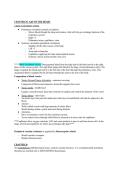
NuevoSomatosensory function Somatosensory Component of the Nervous System ● Function → provides an awayness of the body sensations such as touch, temperature, limb position, and pain ● Information is transmitted over 1st, 2nd, and 3rd order neurons Pathways from the Spinal Cord to the Thalamic Level of Sensation ● Discriminative Pathway → relays precise information regarding spatial orientation. There is input from multiple receptors. ○ Used for perception, arousal, and motor cont...
MindCraft
Otro
SUNY Downstate Medical Center NRMS 5190 | Cardiac Patho Chapter 25-28 Study Guide ~ Updated 100% Latest fall 2025/2026.
NuevoSUNY Downstate Medical Center NRMS 5190 | Cardiac Patho Chapter 25-28 Study Guide ~ Updated 100% Latest fall 2025/2026.
MindCraft
Examen
SUNY Downstate Medical Center NRMS 5190 | Pathophysiology Exam 1 (V2) Answered | 100% Updated fall 2026/27, A+ Guide.
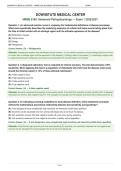
NuevoExam 1 Advanced Pathophyisology (NRMS 5190)- Downstate Medical Center. 1. An advanced practice nurse is reviewing the fundamental definitions of disease processes. Which term specifically describes the underlying sequence of cellular and tissue events taking place from the time of initial contact with an etiologic agent until the ultimate expression of the disease? A. Morphologic changes B. Clinical course C. Etiology D. Pathogenesis 2. A diagnostic laboratory test is evaluat...
MindCraft
Examen
Downstate Medical Center NRMS 5190 Advanced Pathophysiology – Exam 1 Review Guide | Complete Answered review A+, Fall 2026/2027.
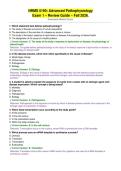
NuevoNRMS 5190 Advanced Pathophysiology Exam 1 – Complete Review Guide | Downstate Medical Center | Updated Fall 2026 1. Which statement best defines pathophysiology? A. The study of disease occurrence in human populations B. The description of the evolution of a disease as acute or chronic C. The study of the body's response to dysfunction or disease; the physiology of altered health D. The designation of the cause of a health problem 2. In the disease process, which term re...
MindCraft
Examen
NRMS 5190 Exam 2 – Advanced Pathophysiology | Complete Q&A Review Guide (Set 2)| SUNY Downstate Medical Center | Updated Fall 2026/2027.
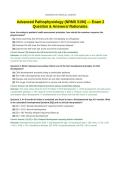
NuevoAdvanced Pathophyisology (NRMS 5190): Exam 2. 1. knee. According to pediatric health assessment principles, how should the examiner sequence the physical exam? A. Avoid examining the left knee and refer immediately to orthopedics B. Perform a complete head-to-toe examination in strict chronological order C. Examine the left knee first before the child becomes fatigued D. Examine the left knee last at the end of the examination 2. Which statement accurately reflects one of the...
MindCraft
Otro
Pathophysiology Exam 3 Study Guide | Complete Updated 100% Fall 2025/26 | A+ Guide.
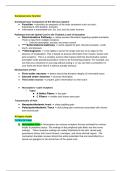
Somatosensory function Somatosensory Component of the Nervous System ● Function → provides an awayness of the body sensations such as touch, temperature, limb position, and pain ● Information is transmitted over 1st, 2nd, and 3rd order neurons Pathways from the Spinal Cord to the Thalamic Level of Sensation ● Discriminative Pathway → relays precise information regarding spatial orientation. There is input from multiple receptors. ○ Used for perception, arousal, and motor cont...
MindCraft
Otro
SUNY Downstate Medical Center NRMS 5190 | Pathophysiology Exam 1 Study Guide | 100% Updated fall 2025/26, A+ Guide.
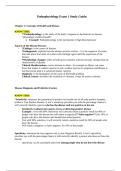
Pathophysiology Exam 1 Study Guide: Chapter 1: Concepts of Health and Disease KNOW THIS: - **Pathophysiology: is the study of the body’s response to dysfunction or disease; “physiology of altered health” o Example: Pathophysiology is the mechanism of high blood pressure Aspects of the Disease Process: - *Etiology: is the causes of disease - *Pathogenesis: explains how the disease process evolves – it is the sequence of events that take place from time of contact with etiologic a...
MindCraft