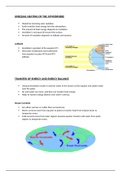
community
Population studies group of organisms of the same species
takes
inhabiting
place
a defined area so close to each
other that random
interbreeding
SCIENTIFIC POPULATION
same species
ecosystem
same defined LlMlTAT Biome
area
species
able to breed with each other
°
Same characteristics
able to breed fertile
→
offspring
•
natural )
/Birth
open population
hat ionality
/death )
mortality
factors
Parameters
,a n immigration
µ emigration
closed population
POPULATION SIZE
chances of surviving high when
young
K-strate④
10W When Old
'
eg : mammals /birds
tgy Eg ( fish / insects
.
few offspring
•
.
large numbers of offspring
•
hig level parental care .
Do not look after them
good chance of survival few of
offspring
"
.
survive
large body size unstable environment
•
•
long life expectancy high 1¥11 reproduce many
'
•
reproduction STRATEGIES
N =
number of population
r growth rate (exponential) born minus death
-
_
K
carrying capacity
=
number
A
graph showing three examples of survivorship curves
to
¥
I 000 -
É curve I = r -
strategy animals .
death rate at
very early stages
Of animals lives
'
is
very high
g[
750 -
3
500 _
2
Curve 2 =
Pattern shown by animals where their age / size doesn't
0
¥ affect their survivorship death constant
'
. rate =
≤ ,
In 250 -
a
or
-
Curve 3 = K -
strategy . few animals die
young
E
Z
oÉ
◦
o of maximum life span
, Population density A =
Population density
•
number of individuals of species per unit area of B =
distribution of individuals within the population
habitat .
f =
growth rate of individuals
•
need to know the no of individuals
.
in habitat b. total area of habitat DETERMINING POPULATION SIZE
-
either direct /indirect techniques
Indirect Direct techniques
i. techniques .
•
sample
=
lot that
.
represent a whole area
•
cercus = count number of individuals in a
Cpeople )
-
estimating Population
-
line called -
transect =
Quadrat
counting arie A
large animals photography
.
→
accuracy depends on :
•
counting the number of individuals in a
quadrat accurately
Knowing the area of each quadrat
•
•
random distribution of each quadrat
large enough
'
mobile animals
MARK RECAPTURE TECHNIQUE
The procedure
-
mark out a well -
defined area
-
capture as
many individuals as possible } mark them
•
release individuals back
-
recapture as
many as possible
Petersen index
Count total population size →
using
'
1M)
marked indiv . in sample (R) marked individuals in whole popular
=
total sample size (c) Total population ( N)
Population studies group of organisms of the same species
takes
inhabiting
place
a defined area so close to each
other that random
interbreeding
SCIENTIFIC POPULATION
same species
ecosystem
same defined LlMlTAT Biome
area
species
able to breed with each other
°
Same characteristics
able to breed fertile
→
offspring
•
natural )
/Birth
open population
hat ionality
/death )
mortality
factors
Parameters
,a n immigration
µ emigration
closed population
POPULATION SIZE
chances of surviving high when
young
K-strate④
10W When Old
'
eg : mammals /birds
tgy Eg ( fish / insects
.
few offspring
•
.
large numbers of offspring
•
hig level parental care .
Do not look after them
good chance of survival few of
offspring
"
.
survive
large body size unstable environment
•
•
long life expectancy high 1¥11 reproduce many
'
•
reproduction STRATEGIES
N =
number of population
r growth rate (exponential) born minus death
-
_
K
carrying capacity
=
number
A
graph showing three examples of survivorship curves
to
¥
I 000 -
É curve I = r -
strategy animals .
death rate at
very early stages
Of animals lives
'
is
very high
g[
750 -
3
500 _
2
Curve 2 =
Pattern shown by animals where their age / size doesn't
0
¥ affect their survivorship death constant
'
. rate =
≤ ,
In 250 -
a
or
-
Curve 3 = K -
strategy . few animals die
young
E
Z
oÉ
◦
o of maximum life span
, Population density A =
Population density
•
number of individuals of species per unit area of B =
distribution of individuals within the population
habitat .
f =
growth rate of individuals
•
need to know the no of individuals
.
in habitat b. total area of habitat DETERMINING POPULATION SIZE
-
either direct /indirect techniques
Indirect Direct techniques
i. techniques .
•
sample
=
lot that
.
represent a whole area
•
cercus = count number of individuals in a
Cpeople )
-
estimating Population
-
line called -
transect =
Quadrat
counting arie A
large animals photography
.
→
accuracy depends on :
•
counting the number of individuals in a
quadrat accurately
Knowing the area of each quadrat
•
•
random distribution of each quadrat
large enough
'
mobile animals
MARK RECAPTURE TECHNIQUE
The procedure
-
mark out a well -
defined area
-
capture as
many individuals as possible } mark them
•
release individuals back
-
recapture as
many as possible
Petersen index
Count total population size →
using
'
1M)
marked indiv . in sample (R) marked individuals in whole popular
=
total sample size (c) Total population ( N)