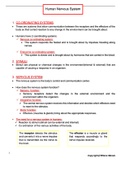
Human Nervous System
1. CO-ORDINATING SYSTEMS
• These are systems that allow communication between the receptors and the effectors of the
body so that correct reaction to any change in the environment can be brought about.
• Humans have 2 coordinating systems:
✓ Nervous co-ordinating system:
➢ This system responds the fastest and is brought about by impulses traveling along
nerves.
✓ Endocrine co-ordinating system:
➢ This system is slower and is brought about by hormones that are carried in the blood.
2. STIMULI
• Stimuli are physical or chemical changes in the environment(internal & external) that are
capable of causing a response in an organism.
3. NERVOUS SYSTEM
• The nervous system is the body’s control and communication center.
• How does the nervous system function?
✓ Sensory function:
➢ Sensory receptors detect the changes in the external environment and the
environment within the organism.
✓ Integrative function:
➢ The central nervous system receives this information and decides which effectors need
to react to the stimulus.
✓ Motor function:
➢ Effectors (muscles & glands) bring about the appropriate responses.
• The need for a nervous system in humans:
✓ Reaction to stimuli (stimuli can be external and internal)
✓ Co-ordination of the various activities of the body.
The receptor detects the stimulus The effector is a muscle or gland
and converts it into a nerve impulse that responds accordingly to the
that is transmitted via the nerve to nerve impulse received.
the brain.
1
Copyright@Wilene Marais
,2
Copyright@Wilene Marais
, 4. CENTRAL NERVOUS SYSTEM (CNS)
• Is made up of a concentrated mass of interconnected neurons, grouped together to form the:
✓ Brain
✓ Spinal cord
• The brain and spinal cord are protected by:
✓ Cranium:
➢ A strong, dome-shaped structure that protects the brain against mechanical injuries.
✓ Meninges:
➢ Three connective tissue membranes (Pia mater, Arachnoid membrane, Dura mater)
✓ Cerebro-spinal fluid:
➢ A fluid formed from blood plasma in special areas in the walls of the ventricles.
➢ It acts as a cushion and protects the CNS against shock and damage.
✓ Vertebral column:
➢ Made up of 33, irregularly shaped vertebrae. It surrounds the spinal cord and protects
it against mechanical injury.
3
Copyright@Wilene Marais
, 5. BRAIN
6. LOCATION AND FUNCTIONS OF VARIOUS PARTS OF THE BRAIN:
Location Functions
Cerebrum (largest part)
✓ Divided into two cerebral hemispheres by a ✓ Controls voluntary movements.
longitudinal fissure. ✓ Receives and interprets impulses from the
✓ The surface is made up of grooves and folds sense organs ( hear, taste, smell, sight,
that enlarge the surface area. touch)
✓ Ventricles in the centre of the brain are filled ✓ Higher thought processes.
with cerebro-spinal fluid.
Cerebellum (Tree of life)
✓ Lies behind and below the Cerebrum. ✓ Coordinates voluntary movements.
✓ Made up of two hemispheres. ✓ Responsible for controlling muscle tension.
✓ Exists out of white and grey matter. ✓ Helps to maintain posture and balance.
Corpus Callosum
✓ Located in the white matter of the Cerebrum. ✓ Connects the left and right hemispheres of
the brain, allowing communication between
both hemispheres.
Hypothalamus
✓ Lies just above the pituitary gland. ✓ Control center for hunger, thirst, sleep, body
temperature, and emotions.
Medulla Oblongata
✓ Forms the lowest part of the brain stem. ✓ Serves as a pathway for impulses to and
from the brain.
✓ Acts as a reflex center, controlling
involuntary actions such as breathing,
heartbeat, and blood pressure.
4
Copyright@Wilene Marais
1. CO-ORDINATING SYSTEMS
• These are systems that allow communication between the receptors and the effectors of the
body so that correct reaction to any change in the environment can be brought about.
• Humans have 2 coordinating systems:
✓ Nervous co-ordinating system:
➢ This system responds the fastest and is brought about by impulses traveling along
nerves.
✓ Endocrine co-ordinating system:
➢ This system is slower and is brought about by hormones that are carried in the blood.
2. STIMULI
• Stimuli are physical or chemical changes in the environment(internal & external) that are
capable of causing a response in an organism.
3. NERVOUS SYSTEM
• The nervous system is the body’s control and communication center.
• How does the nervous system function?
✓ Sensory function:
➢ Sensory receptors detect the changes in the external environment and the
environment within the organism.
✓ Integrative function:
➢ The central nervous system receives this information and decides which effectors need
to react to the stimulus.
✓ Motor function:
➢ Effectors (muscles & glands) bring about the appropriate responses.
• The need for a nervous system in humans:
✓ Reaction to stimuli (stimuli can be external and internal)
✓ Co-ordination of the various activities of the body.
The receptor detects the stimulus The effector is a muscle or gland
and converts it into a nerve impulse that responds accordingly to the
that is transmitted via the nerve to nerve impulse received.
the brain.
1
Copyright@Wilene Marais
,2
Copyright@Wilene Marais
, 4. CENTRAL NERVOUS SYSTEM (CNS)
• Is made up of a concentrated mass of interconnected neurons, grouped together to form the:
✓ Brain
✓ Spinal cord
• The brain and spinal cord are protected by:
✓ Cranium:
➢ A strong, dome-shaped structure that protects the brain against mechanical injuries.
✓ Meninges:
➢ Three connective tissue membranes (Pia mater, Arachnoid membrane, Dura mater)
✓ Cerebro-spinal fluid:
➢ A fluid formed from blood plasma in special areas in the walls of the ventricles.
➢ It acts as a cushion and protects the CNS against shock and damage.
✓ Vertebral column:
➢ Made up of 33, irregularly shaped vertebrae. It surrounds the spinal cord and protects
it against mechanical injury.
3
Copyright@Wilene Marais
, 5. BRAIN
6. LOCATION AND FUNCTIONS OF VARIOUS PARTS OF THE BRAIN:
Location Functions
Cerebrum (largest part)
✓ Divided into two cerebral hemispheres by a ✓ Controls voluntary movements.
longitudinal fissure. ✓ Receives and interprets impulses from the
✓ The surface is made up of grooves and folds sense organs ( hear, taste, smell, sight,
that enlarge the surface area. touch)
✓ Ventricles in the centre of the brain are filled ✓ Higher thought processes.
with cerebro-spinal fluid.
Cerebellum (Tree of life)
✓ Lies behind and below the Cerebrum. ✓ Coordinates voluntary movements.
✓ Made up of two hemispheres. ✓ Responsible for controlling muscle tension.
✓ Exists out of white and grey matter. ✓ Helps to maintain posture and balance.
Corpus Callosum
✓ Located in the white matter of the Cerebrum. ✓ Connects the left and right hemispheres of
the brain, allowing communication between
both hemispheres.
Hypothalamus
✓ Lies just above the pituitary gland. ✓ Control center for hunger, thirst, sleep, body
temperature, and emotions.
Medulla Oblongata
✓ Forms the lowest part of the brain stem. ✓ Serves as a pathway for impulses to and
from the brain.
✓ Acts as a reflex center, controlling
involuntary actions such as breathing,
heartbeat, and blood pressure.
4
Copyright@Wilene Marais