
- Study guides, Class notes & Summaries
Looking for the best study guides, study notes and summaries about ? On this page you'll find 9 study documents about .
Exam (elaborations)
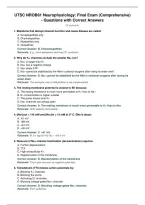
UTSC NROB61 Neurophysiology: Final Exam (Comprehensive)- Questions with Correct Answers
NewUTSC NROB61 Neurophysiology: Final Exam (Comprehensive)- Questions with Correct Answers 50 questions 1. Mutations that disrupt channel function and cause disease are called: A. Synaptopathies only B. Channelopathies C. Myopathies only D. Gliopathies Correct Answer: B. Channelopathies Rationale: E.g., some epilepsies and long QT syndrome. 2. Why do K+ channels exclude the smaller Na+ ion? A. Na+ is larger than K+ B. Na+ has a negative charge C. Na+ binds ATP D. Na+ cannot be stabiliz...
 TheePlug
Exam (elaborations)
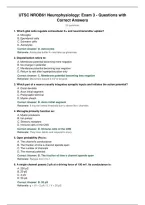
UTSC NROB61 Neurophysiology: Exam 3 - Questions with Correct Answers
PopularUTSC NROB61 Neurophysiology: Exam 3 - Questions with Correct Answers 50 questions 1. Which glial cells regulate extracellular K+ and neurotransmitter uptake? A. Microglia B. Ependymal cells C. Schwann cells D. Astrocytes Correct Answer: D. Astrocytes Rationale: Astrocytes buffer K+ and take up glutamate. 2. Depolarization refers to: A. Membrane potential becoming more negative B. No change in potential C. Membrane potential becoming less negative D. Return to rest after hyperpolari...
TheePlug
Package deal
Full Package-;;UTSC NROB61 Neurophysiology Exams with CORRECT Answers
NewExam (elaborations) UTSC NROB61 Neurophysiology: Exam 3 - Questions with Correct Answers 3 Exam (elaborations) UTSC NROB61 Neurophysiology: Final Exam (Comprehensive)- Questions with Correct Answers 4 Exam (elaborations) UTSC NROB61 Neurophysiology: Midterm Exam (Units 1-7) Questions with Correct Answers 5 Exam (elaborations) UTSC NROB61 Neurophys
TheePlug
Package deal
Package Deal-;;UTSC NROB61 Neurophysiology Exams (Midterm, Exam 1-3 & Final Exam)
NewUTSC NROB61 Neurophysiology: Final Exam (Comprehensive)- Questions with Correct Answers 4 Exam (elaborations) UTSC NROB61 Neurophysiology: Midterm Exam (Units 1-7) Questions with Correct Answers 5 Exam (elaborations) UTSC NROB61 Neurophysiology: Exam 1 - Questions with Correct Answers
TheePlug
Exam (elaborations)
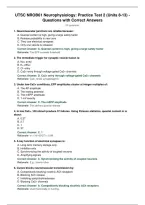
UTSC NROB61 Neurophysiology: Practice Test 2 (Units 8-13) Questions with Correct Answers
NewUTSC NROB61 Neurophysiology: Practice Test 2 (Units 8-13) Questions with Correct Answers 50 questions 1. Neuromuscular junctions are reliable because: A. Quantal content is high, giving a large safety factor B. Release probability is near zero C. They use electrical synapses D. Only one vesicle is released Correct Answer: A. Quantal content is high, giving a large safety factor Rationale: The EPP exceeds threshold. 2. The immediate trigger for synaptic vesicle fusion is
TheePlug
Exam (elaborations)
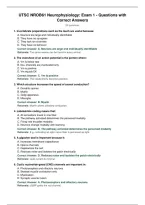
UTSC NROB61 Neurophysiology: Exam 1 - Questions with Correct Answers
NewUTSC NROB61 Neurophysiology: Exam 1 - Questions with Correct Answers 50 questions 1. Invertebrate preparations such as the leech are useful because: A. Neurons are large and individually identifiable B. They have no synapses C. They lack ion channels D. They have no behavior Correct Answer: A. Neurons are large and individually identifiable
TheePlug
Exam (elaborations)
UTSC NROB61 Neurophysiology: Practice Test 1 (Units 1-7) Questions with Correct Answers
NewUTSC NROB61 Neurophysiology: Practice Test 1 (Units 1-7) Questions with Correct Answers 50 questions 1. Which glial cells form myelin in the peripheral nervous system? A. Oligodendrocytes B. Astrocytes C. Schwann cells D. Microglia Correct Answer: C. Schwann cells Rationale: Oligodendrocytes myelinate in the CNS. 2. Which property most clearly distinguishes neurons from most other cells? A. Having a nucleus B. Using ATP C. Having a plasma membrane D. Excitable membranes that gener...
TheePlug
Exam (elaborations)
UTSC NROB61 Neurophysiology: Midterm Exam (Units 1-7) Questions with Correct Answers
NewUTSC NROB61 Neurophysiology: Midterm Exam (Units 1-7) Questions with Correct Answers 50 questions 1. Which ion's gradient is most important for the resting potential? A. Na+ B. Ca2+ C. Mg2+ D. K+ Correct Answer: D. K+ Rationale: Resting membranes are mostly K+-permeable. 2. Which signal decreases in amplitude as it spreads along the membrane? A. Propagated action potential B. Graded (local) potential C. Saltatory action potential D. Regenerative calcium spike in an ax
TheePlug
Exam (elaborations)
UTSC NROB61 Neurophysiology: Exam 2 - Questions with Correct Answers
NewUTSC NROB61 Neurophysiology: Exam 2 - Questions with Correct Answers 50 questions 1. Divergence in neural circuits means: A. Many neurons converge on one neuron B. Neurons fire in isolation C. One neuron sends output to many neurons D. Signals travel backward Correct Answer: C. One neuron sends output to many neurons Rationale: Convergence is the opposite. 2. An electrode placed inside a neuron records:
TheePlug