
- Study guides, Class notes & Summaries
Looking for the best study guides, study notes and summaries about ? On this page you'll find 79 study documents about .
Exam (elaborations)
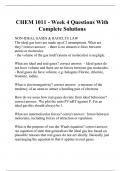
CHEM 1011 - Week 4 Questions With Complete Solutions
NON-IDEAL GASES & RAOULTS LAW The ideal gas laws are made up of 2 assumptions. What are they? correct answer: - there is no attractive force between atoms or molecules. - the volume of the gas itself (atoms or molecules) is negligle. What are ideal and real gases? correct answer: - Ideal gases do not have volume and there are no forces between gas molecules. - Real gases do have volume, e.g. halogens Florine, chlorine, bromine, iodine. What is electronegativity? correct answer: a mea...
 Demetrius
Exam (elaborations)
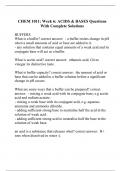
CHEM 1011: Week 6: ACIDS & BASES Questions With Complete Solutions
BUFFERS What is a buffer? correct answer: - a buffer resists change in pH when a small amounts of acid or base are added to it. - any solution that contains equal amounts of a weak acid and its conjugate base will act as a buffer. What is acetic acid? correct answer: ethanoic acid. Gives vinegar its distinctive taste. What is buffer capacity? correct answer: the amount of acid or base that can be added to a buffer solution before a significant change in pH occurs What are some ways...
Demetrius
Exam (elaborations)
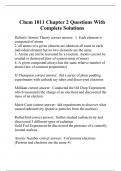
Chem 1011 Chapter 2 Questions With Complete Solutions
Dalton's Atomic Theory correct answer: 1. Each element is composed of atoms 2. all atoms of a given element are identical all same in each individual element but no two elements are the same 3. Atoms can not be recreated by a reaction. Atoms can not be created or destroyed (law of conservation of mass) 4. A given compound always has the same relative number of atoms (law of constant proportions) JJ Thompson correct answer: did a series of plum pudding experiments with cathode ray tubes ...
Demetrius
Exam (elaborations)
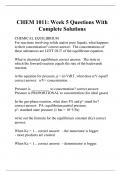
CHEM 1011: Week 5 Questions With Complete Solutions
CHEM 1011: Week 5 Questions With Complete Solutions
Demetrius
Exam (elaborations)
CHEM1011 Week 9 Questions And Answers
Standard enthalpy of formation correct answer: enthalpy change when it is made from the stable form of its elements at standard condition combustion enthalpy correct answer: exothermic, so always negative atomisation enthalpy correct answer: endothermic, so always positive ∆H(rxn)= correct answer: ∑∆Hºf(products) - ∑∆Hºf(reactants) standard enthalpy of formation correct answer: change of enthalpy during the formation of one mole of the substance from its constituent ...
Demetrius
Exam (elaborations)
UNE week 1/2 chem review, UNE week chem 1011 3-4 review, UNE Chem 1011 week 5-7 review Questions With Complete Solutions
UNE week 1/2 chem review, UNE week chem 1011 3-4 review, UNE Chem 1011 week 5-7 review Questions With Complete Solutions
Demetrius
Exam (elaborations)
CHEM 1011 Quiz 2 Questions With Complete Solutions
What concentration of phosphate would give you a percent transmittance of 35%? correct answer: To find this we turn %T into an absorbance value, then we plug into the equation A = k * c. We know k from the slope of our line (in this case we will use the sample given 1245) and we calculate A from the %T. We then divide to find C, which is our concentration aka molarity. In this case it comes out to 3.7 x 10⁻⁴ = M. A worker dumps 20 grams of detergent that is 30% by weight phosphate ion in...
Demetrius
Exam (elaborations)
UNE Chem 1011 Questions With Complete Solutions
UNE Chem 1011 Questions With Complete Solutions
Demetrius
Exam (elaborations)
CHM1011 – Exam Questions With Complete Solutions
Kinetics correct answer: The rate or speed of a reaction. A rapid reaction does not mean it goes to completion Equilibrium correct answer: The extent of a reaction Why is the rate of reaction important? correct answer: Industrial, biochemical, environmental, health What sort of factors effect the rate of a reaction? correct answer: Concentration of reactants, physical states of reactants, temperature, the use of a catalyst Effect of concentration correct answer: RATE OF REACTION...
Demetrius
Exam (elaborations)
Chem 1011 Final Questions And Answers With Complete Solutions
Chem 1011 Final Questions And Answers With Complete Solutions
Demetrius
Exam (elaborations)
UNE Chem 1011 week 5-7 review Questions With Complete Solutions
For the reaction F2(g) ⇌ 2 F(g), the equilibrium constant at 223 °C is 7.3 x 10⁻¹³. If a sample of F2 is heated to 223 °C and allowed to reach equilibrium correct answer: nearly all of F2 will remain unreacted, with a very small amount of F present At equilibrium correct answer: the rate of the forward reaction is equal to the rate of the reverse reaction and the concentration of the reactants and products can be very different For the reaction 2 BrCl(g) ⇌ Br2(g) + Cl2(g), the equi...
Demetrius
Exam (elaborations)
chem 1011 final Questions With Complete Solution
chem 1011 final Questions With Complete Solution
Demetrius
Exam (elaborations)
une chem 1011 final week 11 & 12 Questions With Complete Solutions
Which of the following is always true? -Spontaneous changes cause an increase in the entropy of the universe -Heat will flow from a cooler object to a hotter object -Processes that involve an increase in entropy of the system are spontaneous -The change in entropy of the universe is the same as the change in entropy of the surroundings correct answer: Spontaneous changes cause an increase in the entropy of the universe A pure, perfectly crystalline solid at 0 K correct answer: has zero ...
Demetrius
Exam (elaborations)
UNE chem 1011 final Questions With Complete Solutions
UNE chem 1011 final Questions With Complete Solutions
Demetrius
Exam (elaborations)
CHEM 1011 Midterm Questions With Complete Solutions
CHEM 1011 Midterm Questions With Complete Solutions
Demetrius
Exam (elaborations)
Week 13 chem 1011 Questions With Complete Solutions
Representative Elements correct answer: Groups 1, 2, 13-18 The outer e- belongs to 's' or 'p' groups Metals correct answer: Elements that readily lose electrons (form cation), giving them a high heat and electrical conductivity levels, high luster and variety of hardness Nonmetals correct answer: Readily gain e-, do not generally conduct heat/electricity Usually liquids and gases, some soft solids Metalloids correct answer: Elements that may accept or donate electrons readily ...
Demetrius
Exam (elaborations)
CHEM 1011 CU Boulder Questions With Complete Solutions
What are the 3 largest components of our atmosphere? correct answer: Nitrogen - 78% Oxygen - 21% Argon - 1% How is the periodic table arranged? correct answer: By how elements bond What row are the Halogens? correct answer: 7A - Second from the right What row are the Noble Gases? correct answer: 8A - Far right What is unique about the Noble Gases? correct answer: They are stable and don't like to bond What row are the Alkali Metals correct answer: 1A - Far left What ar...
Demetrius
Exam (elaborations)
UNE CHEM 1011 Exam 1 Questions With Complete Solutions
pure substance correct answer: A sample of matter, either a single element or a single compound, that has definite chemical and physical properties Examples of pure substances correct answer: elements, compounds, water, table salt (sodium chloride), ethanol, gold, bronze, etc. Mixture correct answer: A combination of two or more substances that are not chemically combined homogeneous mixture correct answer: A mixture in which substances are evenly distributed throughout the mixture ...
Demetrius
Exam (elaborations)
UNE 1011 midterm| 189 Questions| With Complete Solutions
Strong electrolytes: ciate almost completely into ions in solution b. only yield a small fraction of ions in solution c. are always dissolved ionic compound d. Can not be covalent compounds correct answer: a. dissociate almost completely into ions in solution Hexane is commonly used in labs as solvent for non polar compounds. what is the molality of 22.3 mg of vitamin D (C27H44O, 384.6 g/mol) in 50 mL of hexane? Hexane has a density of 0.661 g/mol correct answer: 1.75 X 10^-3 m A...
Demetrius