
- Study guides, Class notes & Summaries
Looking for the best study guides, study notes and summaries about ? On this page you'll find 265 study documents about .
Exam (elaborations)
Telemetry Exam Latest Versions Real Exam Questions and Correct Answers Graded A+
Telemetry Exam Latest Versions Real Exam Questions and Correct Answers Graded A+ Sinus tachycardia causes - Answer common in normal healthy heart -cardiac response to increase O2 demand, exercise -response to: hypovolemia, hypoxia, hyperthyroidism, anemia, pain, fever, CHF, stress sinus tachycardia significance - Answer -benign in healthy individuals -increased O2 requirements may lead to: chest pain, extension of myocardial infarction, pump failure sinus tachycardia treatment - Answer...
 Scholarsstudyguide
Exam (elaborations)
Telemetry Exam With Correct Answers
Pace Maker of the Heart -Answer The Sino Atrial node is also known as the 100/60 -138/89 -Answer Normal BP range is -0.1 eV for each box in the vertical direction -typically there are 10 boxes in the vertical direction for QRS complexes, adding up to 1.0 eV -Answer The vertical lines in each of the boxes indicate: Coreg and epinephrine -Answer What medication can change Atrial fibrillation to a sinus rhythm? 140-250 bpm -Answer What is the heart rate with a SVT? -Stimulate t...
sussy7576
Exam (elaborations)
Automation, Telemetry And Scada Study Guide 2024 -2025 Update
Automation, Telemetry And Scada Study Guide Update
 LENNYJAST
Exam (elaborations)
Telemetry Exam questions and answers 100% verified.
Telemetry Exam questions and answers 100% verified. Pace iMaker iof ithe iHeart i- i icorrect ianswer. i i iThe iSino iAtrial inode iis ialso iknown ias ithe 100/60 i-138/89 i- i icorrect ianswer. i i iNormal iBP irange iis -0.1 ieV ifor ieach ibox iin ithe ivertical idirection -typically ithere iare i10 iboxes iin ithe ivertical idirection ifor iQRS icomplexes, iadding iup ito i1.0 ieV i- i icorrect ianswer. i i iThe ivertical ilines iin ieach iof ithe iboxes iindicate: Coreg...
 Lectsadh

Exam (elaborations)
Telemetry Test
Each small box on the monitoring EKG paper is how man seconds? - answer-0.04 seconds Paroxysmal means? - answer-sudden onset and sudden termination Unique waveform characteristics of: Sinus Arrythmia - answer-Regularly Irregular Sinus rhythm Unique waveform characteristics of: Atrial Fib - answer-irregularly irregular with no p wave Unique waveform characteristics of: Atrial Flutter - answer-prominent f waves/saw tooth pattern atrial kick is responsible for how much cardiac output...
 TOPDOCTOR
Exam (elaborations)
Telemetry Exam Questions And Answers
Pace Maker of the Heart - Answer-The Sino Atrial node is also known as the 100/60 -138/89 - Answer-Normal BP range is -0.1 eV for each box in the vertical direction -typically there are 10 boxes in the vertical direction for QRS complexes, adding up to 1.0 eV - Answer-The vertical lines in each of the boxes indicate: Coreg and epinephrine - Answer-What medication can change Atrial fibrillation to a sinus rhythm? 140-250 bpm - Answer-What is the heart rate with a SVT? -Stimulate t...
 GEEKA
Exam (elaborations)
Telemetry Quiz Questions And Answers
Rule of 1500 Calculate rate by counting the number of small boxes between 2 consecutive beats and divide into 1500 8 small boxes: rate = 188 9 small boxes: rate = 167 11 small boxes: rate = 136 17 small boxes= rate 88 10 small boxes: rate = 150 Normal sinus rhythm (NSR) Rhythm initiated in sinus node and travels through the conduction system within normal times frames normal sinus rhythm (NSR) Sinus bradycardia Rate is less than 60. Rhythm is regular. P wave, PR interval, P:QR...
GEEKA
Other
Telemetry Exam Study Guide
electrical properties of the heart - Answer-1-automaticity 2-excitability 3-conductivity 4-contractility automaticity - Answer-=the ability of cardiac cells to depolarize spontaneously w/o external stimuli -cells able to modify membrane to pull in Na+ while K+ exits -rapid depolarization when threshold potential is reached -only certain cells have property of automaticity: SA node, AV node, bundle of HIS, purkinje network influence of the nervous system - Answer-SYMPATHETIC: affects ...
GEEKA
Other
Telemetry Exam Questions And Answers
Telemetry is an observation tool that allows continuous ECG, RR, SpO2 monitoring while the patient remains active without the restriction of being attached to a bedside cardiac monitor ECG Electrocardiogram is a diagnostic tool that measures and records the electrical activity of the heart via electrodes placed on the skin Electrode The patch that is placed onto the patient and attaches to the lead wire Lead wire The lead that connects the electrodes to the telemetry unit Arrythmia A rh...
GEEKA
Other
Telemetry Practice Questions And Answers
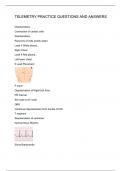
Depolarization Contraction of cardiac cells Repolarization Recovery of cells (ready state) Lead II White placed... Right Chest Lead II Red placed... Left lower chest 5 Lead Placement P wave Depolarization of Right/Left Atria PR Interval SA node to AV node QRS Ventricuar depolarization form bundle of HIS T segment Repolarization of ventricles Normal Sinus Rhythm Sinus Bradycardia Less than 60 beats/min Sinus Tachycardia 101-150 rate Artifact
GEEKA
Other
Telemetry Exam Study Guide
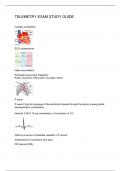
Cardiac conduction ECG components Heart auscultation All people enjoy time magazine Aortic, pulmonic, Erb's point, tricuspid, mitral P wave P wave= time for passage of the electrical impulse through the atrium causing atrial depolarization (contraction) Normal: 0.06-0.12 sec (remember, p for preteen: 6-12) What is a source of possible variation in P wave? disturbance in conduction w/in atria PR interval (PRI) -Measured from beginning of P wave to beginning of QRS comple...
GEEKA
Other
Telemetry Strips Questions And Answers
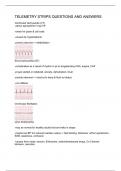
Ventricular tachycardia (VT) -admin epinephrine 1mg IVP -check for pulse & call code -caused by hyperkalemia -priority intervent--> defibrillation Sinus tachycardia (ST) -complication as a result of rhythm in pt w/ longstanding CAD, angina, CHF -pt just started on Adderall, anxiety, dehydration, fever -priority intervent--> check pt's temp & fluid vol status -cut caffeine Ventricular fibrillation sinus bradycardia -may be normal for healthy adults th...
GEEKA
Other
Telemetry Test Questions
Telemetry Test Questions
GEEKA
Exam (elaborations)
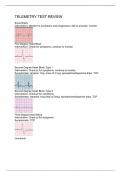
Telemetry Test Review
TELEMETRY TEST REVIEW Sinus Brady Intervention: Monitor for symptoms and progression, talk to provider, monitor First Degree Heart Block Intervention: Check for symptoms, continue to monitor Second Degree Heart Block Type 1 Intervention: Check pt for symptoms, continue to monitor. Symptomatic: atropine 1mg, (max of 3 mg), epinephrine/dopamine drips, TCP Second Degree Heart Block Type 2 Intervention: Check pt for symptoms. Symptomatic: Atropine 1mg (max of 3mg), epinephrine/d...
GEEKA
Exam (elaborations)
Telemetry UPDATED Test Questions And CORRECT Answers
electrical properties of the heart1-automaticity 2-excitability 3-conductivity 4-contractility automaticity=the ability of cardiac cells to depolarize spontaneously w/o external stimuli -cells able to modify membrane to pull in Na+ while K+ exits -rapid depolarization when threshold potential is reached -only certain cells have property of automaticity: SA node, AV node, bundle of HIS, purkinje network influence of the nervous systemSYMPATHETIC: affects atria and ventricles. increase...
WIZGrades
Exam (elaborations)
Telemetry TOP Exam Questions And CORRECT Answers
atrium collects blood ventricle pumps blood to the rest of the body where is pulmonary circulation? right side of the heart where is systemic circulation? left side of the heart Electrical function of the heart needs stimulation before contraction can occur systole electrical actions activation, excitation, depolarization diastole electrical actions recovery, recovery, repolarization
WIZGrades
Exam (elaborations)
Telemetry KeY Compulsory Questions And CORRECT Answers
Sinus bradycardia strip Sinus bradycardia characteristics Conduction pathway is the same as in normal sinus, but heart rate <60 Sinus bradycardia clinical associations -Athletes -Sleep -Carotid sinus massage -Valsalva maneuver or vagal stimulation -Hypothermia -Increased intraocular pressure -Certain drugs (beta blockers, Ca2+ channel blockers) -Hypothyroidism, increased ICP, hypoglycemia, MI Sinus bradycardia symptoms -Pale, cool skin
WIZGrades
Exam (elaborations)
Telemetry KeY Compulsory Questions And CORRECT Answers
Sinus bradycardia strip Sinus bradycardia characteristics Conduction pathway is the same as in normal sinus, but heart rate <60 Sinus bradycardia clinical associations -Athletes -Sleep -Carotid sinus massage -Valsalva maneuver or vagal stimulation -Hypothermia -Increased intraocular pressure -Certain drugs (beta blockers, Ca2+ channel blockers) -Hypothyroidism, increased ICP, hypoglycemia, MI
 STANFORDGRADESS

Exam (elaborations)
Telemetry UPDATED Test Questions And CORRECT Answers
electrical properties of the heart1-automaticity 2-excitability 3-conductivity 4-contractility automaticity=the ability of cardiac cells to depolarize spontaneously w/o external stimuli -cells able to modify membrane to pull in Na+ while K+ exits -rapid depolarization when threshold potential is reached -only certain cells have property of automaticity: SA node, AV node, bundle of HIS, purkinje network
STANFORDGRADESS
Exam (elaborations)
Telemetry TOP Exam Questions And CORRECT Answers
atrium collects blood ventricle pumps blood to the rest of the body where is pulmonary circulation? right side of the heart where is systemic circulation? left side of the heart Electrical function of the heart needs stimulation before contraction can occur systole electrical actions activation, excitation, depolarization diastole electrical actions recovery, recovery, repolarization
STANFORDGRADESS