
- Study guides, Class notes & Summaries
Looking for the best study guides, study notes and summaries about ? On this page you'll find 5 study documents about .

Exam (elaborations)
PALS version A Questions & Answers 2023(A+GRADED 100%VERIFIED)
PALS version A Questions & Answers 2023(A+GRADED 100%VERIFIED)
 carrington

Exam (elaborations)
PALS Exam A – Latest Practice Questions and Answers Study Guide 2026/2027 – Pediatric Advanced Life Support Exam Preparation Material
PopularThis document contains PALS Exam A practice questions and answers designed to help healthcare professionals and students prepare for Pediatric Advanced Life Support (PALS) assessments during the 2026/2027 exam cycle. It reviews essential topics such as pediatric emergency assessment, resuscitation algorithms, airway management, cardiac rhythms, pharmacology, and team-based emergency response.
 LECPOPC

Exam (elaborations)
PALS Version A Exam Prep 2026/2027 – Complete Verified Edition
Newcontains a comprehensive set of PALS (Pediatric Advanced Life Support) Version A questions and answers for the 2026/2027 certification year. It covers essential topics including pediatric resuscitation, airway management, emergency interventions, and critical care protocols. Designed to help learners prepare effectively, this material reinforces key concepts and supports achieving an A+ grade.
LECPOPC
Exam (elaborations)
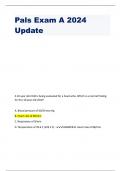
Pals Exam A 2024 Update
Pals Exam A 2024 Update A 10 year old child is being evaluated for a head ache. Which is a normal finding for this 10 year old child? A. Blood pressure of 60/50 mm Hg B. Heart rate of 88/min C. Respiratory of 8/min D. Temperature of 39.6 C (103.2 F) - ANSWER-B. Heart rate of 88/min
 NURSING2EXAM
Exam (elaborations)
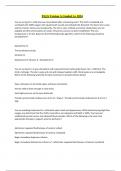
PALS Version A Graded A+ 2024
PALS Version A Graded A+ 2024 You are caring for a child who was resuscitated after a drowning event. The child is intubated and ventilated with 100% oxygen with equal breath sounds and exhaled CO2 detected. The heart rate is slow and the monitor shows sinus bradycardia. The skin is cool, mottled, and moist; distal pulses are not palpable and the central pulses are weak. Intravenous access has been established. The core temperature is 37.3oC. Based on the PALS bradycardia algorithm, wh...
 CertifiedGrades