
- Study guides, Class notes & Summaries
Looking for the best study guides, study notes and summaries about ? On this page you'll find 6 study documents about .
Exam (elaborations)
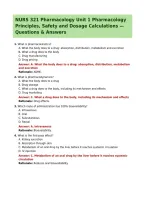
NURS 321 Pharmacology Unit 1 Pharmacology Principles, Safety and Dosage Calculations — Questions & Answers
NewNURS 321 Pharmacology Unit 1 Pharmacology Principles, Safety and Dosage Calculations — Questions & Answers 1. What is pharmacokinetics? A. What the body does to a drug: absorption, distribution, metabolism and excretion B. What a drug does to the body C. Drug manufacturing D. Drug pricing Answer: A. What the body does to a drug: absorption, distribution, metabolism and excretion Rationale: ADME. 2. What is pharmacodynamics? A. What the body does to a drug B. Drug storage C. What ...
 ARVEX

Exam (elaborations)
NURS 321 Pharmacology Unit 3 Cardiovascular, Renal and Hematologic Medications — Questions & Answers
PopularNURS 321 Pharmacology Unit 3 Cardiovascular, Renal and Hematologic Medications — Questions & Answers 1. What is the mechanism of ACE inhibitors like lisinopril? A. Blocking beta receptors B. Blocking calcium channels C. Blocking angiotensin II receptors D. Blocking conversion of angiotensin I to angiotensin II Answer: D. Blocking conversion of angiotensin I to angiotensin II Rationale: RAAS. 2. What is a common side effect of ACE inhibitors? A. Dry, persistent cough B. Bradycardia ...
ARVEX

Exam (elaborations)
NURS 321 Pharmacology Unit 6 Pain, Inflammation, Musculoskeletal, Oncology and Emergency Medications — Questions & Answers
NewNURS 321 Pharmacology Unit 6 Pain, Inflammation, Musculoskeletal, Oncology and Emergency Medications — Questions & Answers 1. What is the WHO analgesic ladder? A. A surgical guide B. A vaccine schedule C. A dosing chart for antibiotics D. A stepwise approach from nonopioids to weak then strong opioids, with adjuvants as needed Answer: D. A stepwise approach from nonopioids to weak then strong opioids, with adjuvants as needed Rationale: Pain management. 2. What is multimodal analge...
ARVEX

Exam (elaborations)
NURS 321 Pharmacology Unit 5 Respiratory, Gastrointestinal and Endocrine Medications — Questions & Answers
NewNURS 321 Pharmacology Unit 5 Respiratory, Gastrointestinal and Endocrine Medications — Questions & Answers 1. What is albuterol? A. A long-acting controller B. An inhaled corticosteroid C. A leukotriene blocker D. A short-acting beta-2 agonist used as a rescue inhaler Answer: D. A short-acting beta-2 agonist used as a rescue inhaler Rationale: SABA. 2. What are common side effects of albuterol? A. Tachycardia, tremor and nervousness B. Bradycardia C. Sedation D. Hypoglycemia only...
ARVEX

Exam (elaborations)
NURS 321 Pharmacology Unit 4 Anti-Infective and Immunologic Medications — Questions & Answers
NewNURS 321 Pharmacology Unit 4 Anti-Infective and Immunologic Medications — Questions & Answers 1. What is the difference between bactericidal and bacteriostatic antibiotics? A. They're the same B. Bacteriostatic drugs kill viruses C. Bactericidal drugs kill bacteria, while bacteriostatic drugs stop their growth D. Bactericidal drugs only treat fungi Answer: C. Bactericidal drugs kill bacteria, while bacteriostatic drugs stop their growth Rationale: Definitions. 2. Why should cultu...
ARVEX

Exam (elaborations)
NURS 321 Pharmacology Unit 2 Autonomic, Neurologic and Psychiatric Medications — Questions & Answers
NewNURS 321 Pharmacology Unit 2 Autonomic, Neurologic and Psychiatric Medications — Questions & Answers 1. Which neurotransmitter does the sympathetic nervous system mainly release at target organs? A. Acetylcholine B. Dopamine only C. Norepinephrine D. Serotonin Answer: C. Norepinephrine Rationale: Adrenergic. 2. Which neurotransmitter does the parasympathetic nervous system release at target organs? A. Norepinephrine B. Acetylcholine C. Epinephrine D. Dopamine Answer: B. Acetyl...
ARVEX