- Study guides, Class notes & Summaries

Looking for the best study guides, study notes and summaries about ? On this page you'll find 8 study documents about .

All 8 results

Sort by:

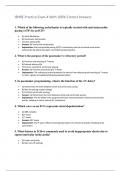
IBHRE Practice Test Questions Latest Update 2024-2025 Actual Exam from Credible Source with 200 Questions and 100% Verified Detailed Correct Answers Guaranteed
  • Exam (elaborations)

    IBHRE Practice Test Questions Latest Update 2024-2025 Actual Exam from Credible Source with 200 Questions and 100% Verified Detailed Correct Answers Guaranteed

  • IBHRE Practice Test Questions Latest Update Actual Exam from Credible Source with 200 Questions and 100% Verified Detailed Correct Answers Guaranteed
  • Tutordiligent
    $20.99 More Info
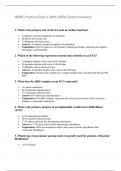
IBHRE PRACTICE EXAM #1 QUESTIONS AND ANSWERS 2024
  • Exam (elaborations)

    IBHRE PRACTICE EXAM #1 QUESTIONS AND ANSWERS 2024

  • IBHRE PRACTICE EXAM #1 QUESTIONS AND ANSWERS 2024
  • Teacher101
    $13.49 More Info
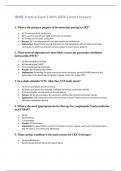
IBHRE Practice Exam 2 With 100% Correct Answers
  • Exam (elaborations)

    IBHRE Practice Exam 2 With 100% Correct Answers

  • What is the most likely consequence of prolonged QT interval on an ECG? • A) Atrial flutter • B) Torsades de Pointes • C) Sinus bradycardia • Answer: B) Torsades de Pointes • Explanation: A prolonged QT interval predisposes patients to Torsades de Pointes, a type of polymorphic ventricular tachycardia.
  • UndisputedPundit
    $8.99 More Info
IBHRE Practice Exam 1 With 100% Correct Answers
  • Exam (elaborations)

    IBHRE Practice Exam 1 With 100% Correct Answers

  • What is the primary role of the SA node in cardiac function? • A) Initiates electrical impulses for heartbeat • B) Slows down heart rate • C) Regulates blood pressure • Answer: A) Initiates electrical impulses for heartbeat • Explanation: The SA node acts as the heart's natural pacemaker, initiating the impulse that begins each heartbeat.
  • UndisputedPundit
    $8.99 More Info
IBHRE Practice Exam 4 With 100% Correct Answers
  • Exam (elaborations)

    IBHRE Practice Exam 4 With 100% Correct Answers

  • Which of the following arrhythmias is typically treated with anti-tachycardia pacing (ATP) by an ICD? • A) Atrial fibrillation • B) Ventricular tachycardia • C) Sinus tachycardia • Answer: B) Ventricular tachycardia • Explanation: Anti-tachycardia pacing (ATP) is commonly used to terminate ventricular tachycardia by delivering rapid, controlled pacing impulses.
  • UndisputedPundit
    $8.99 More Info
IBHRE Practice Exam 3 With 100% Correct Answers
  • Exam (elaborations)

    IBHRE Practice Exam 3 With 100% Correct Answers

  • What is the primary purpose of biventricular pacing in CRT? • A) To increase atrial contraction • B) To synchronize left and right ventricular contraction • C) To improve AV node conduction • Answer: B) To synchronize left and right ventricular contraction • Explanation: Biventricular pacing improves the timing between left and right ventricular contractions, which can enhance cardiac output in heart failure patients.
  • UndisputedPundit
    $8.99 More Info
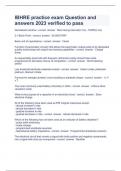
IBHRE practice exam Question and answers 2023 verified to pass
  • Exam (elaborations)

    IBHRE practice exam Question and answers 2023 verified to pass

  • IBHRE practice exam Question and answers 2023 verified to pass Wenkebach window - correct answer Max tracing interval(in ms) - TARP(in ms) 2:1 Block Point - correct answer 60,000/TARP Basic unit of capacitance - correct answer Farad Function of pacemaker circuitry that allows the pacemaker output pulse to be dissipated quickly maximizing both output and sensing capabilities - correct answer Charge dump
  • STUVIAMAESTRO254
    $13.99 More Info
Make study stress less painful
Study stress? For sellers on Stuvia, these are actually golden times. KA-CHING! Earn from your study resources too and start uploading now.