
- Study guides, Class notes & Summaries
Looking for the best study guides, study notes and summaries about ? On this page you'll find 148 study documents about .
Exam (elaborations)
ENV101 chapter 1 questions and answers Graded A+
NewENV101 chapter 1 questions and answers Graded A+ Define environmental science. - Environmental science is the study of the interactions between the physical, chemical, and biological components of the environment, including the effects of human activity on these systems. What are the eight characteristics of life? - The eight characteristics of life are: 1) Cellular organization, 2) Metabolism, 3) Homeostasis, 4) Growth and development, 5) Reproduction, 6) Response to stimuli, 7) A...
 Wisegrades
Exam (elaborations)
ENV101 chapter 2 questions and answers Graded A+
NewENV101 chapter 2 questions and answers Graded A+ What three particles are atoms made of? - Atoms are made of protons, neutrons, and electrons. The proton defines the specific atom and is found in the nucleus. Describe protons. - Protons are positively charged particles located in the nucleus of an atom and determine the atomic number. Describe neutrons. - Neutrons are neutral particles located in the nucleus of an atom and contribute to the atomic mass. Describe electrons. - El...
Wisegrades
Exam (elaborations)
ENV101 chapter 3 study guide questions and answers Graded A+
NewENV101 chapter 3 study guide questions and answers Graded A+ Define soil and humus. How is the term soil applied in common usage? - Soil is a natural resource composed of minerals, organic matter, water, and air that supports plant life. Humus is the dark, organic material in soil formed from decomposed plant and animal matter. In common usage, 'soil' often refers to the top layer of the earth's surface where plants grow. What are the three phases of soil? - The three phas...
Wisegrades
Exam (elaborations)
ENV101 chapter 4 study guide questions and answers Graded A+
NewENV101 chapter 4 study guide questions and answers Graded A+ When was agriculture estimated to have been developed? - Agriculture is estimated to have been developed around 10,000 years ago during the Neolithic Revolution. What was the Green Revolution? - The Green Revolution refers to a period in the mid-20th century when agricultural production worldwide increased significantly due to new technologies, high-yield crop varieties, and the use of chemical fertilizers and pesticide...
Wisegrades
Exam (elaborations)
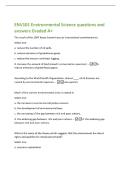
ENV101 Environmental Science questions and answers Graded A+
NewENV101 Environmental Science questions and answers Graded A+ The result of the 1997 Kyoto Summit was an international commitment to Select one: a. reduce the number of oil spills. b. reduce emissions of greenhouse gases. c. reduce the amount rainforest logging. d. increase the amount of land placed in conservation easement. - b. reduce emissions of greenhouse gases. According to the World Health Organization, almost ____ of all diseases are caused by environmental exposure. -...
Wisegrades
Exam (elaborations)
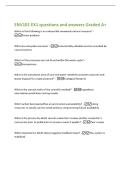
ENV101 EX1 questions and answers Graded A+
NewENV101 EX1 questions and answers Graded A+ Which of the following is an exhaustible renewable natural resource? - Forest products What are ecosystem services? - Economically valuable services provided by natural systems Which of the processes are not found within the water cycle? - Homeostasis What is the cumulative area of land and water needed to provide resources and waste disposal for a typical person? - Ecological footprint What is the correct order of the scientific m
Wisegrades
Exam (elaborations)
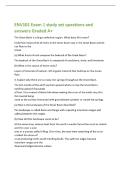
ENV101 Exam 1 study set questions and answers Graded A+
NewENV101 Exam 1 study set questions and answers Graded A+ The Great Basin is a large endorheic region. What does this mean? Endorheic means that all rivers in the Great Basin stay in the Great Basin and do not flow to the ocean (a) What kinds of rock compose the bedrock of the Great Basin? The bedrock of the Great Basin is composed of sandstone, shale, and limestone (b) What is the source of these rocks? Layers of minerals of calcium-rich organic material that build up on the oce...
Wisegrades
Exam (elaborations)
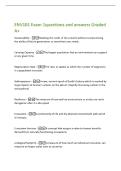
ENV101 Exam 1questions and answers Graded A+
NewENV101 Exam 1questions and answers Graded A+ Sustainability - Meeting the needs of the present without compromising the ability of future generations to meet their own needs Carrying Capacity - The largest population that an environment can support at any given time Regeneration Rate - The rate, or speed, at which the number of organisms in a population increases Anthropecene - A new, current epoch of Earth's history which is marked by large impacts of human's actions on ...
Wisegrades
Exam (elaborations)
ENV101 Final questions and answers Graded A+
NewENV101 Final questions and answers Graded A+ There was a backlash against environmental laws and regulations in the 1980's that was led by some who argued that environmental laws were hindering economic growth. - True Natural resources are considered natural capital, whereas ecosystem services are not. - False Sustainability is the capacity of the earth's natural system and human cultural systems to survive, flourish, and adapt to changing environmental conditions is the ...
Wisegrades
Exam (elaborations)
ENV101 Global Climate Change questions and answers Graded A+
NewENV101 Global Climate Change questions and answers Graded A+ What can be said about using computer models in climate change research? - Computer models can be used to forecast future climate change. Which of these countries do you suppose produces the most carbon dioxide per person? - United States What will be the effect of global warming on global species diversity? - Overall, biodiversity will drop. Why is the greenhouse effect necessary for life on Earth? - It heats the Ear...
Wisegrades
Exam (elaborations)
ENV101 lecure 3 questions and answers Graded A+
NewENV101 lecure 3 questions and answers Graded A+ What is natural selection? A process that favors certain inherited characteristics over others, leading to their increased frequency in a population. Define a species. A classification of organisms whose members can interbreed and produce fertile offspring. What is a population? A group of individuals within a species that live in the same geographic area. What does the biological species concept state? A species is a group of...
Wisegrades
Exam (elaborations)
ENV101 Part @ questions and answers Graded A+
NewENV101 Part @ questions and answers Graded A+ What is an ecosystem? - A community of living organisms interacting with nonliving components of their environment. What must an ecosystem maintain? - A continuous flow of energy. Name three examples of ecosystems. - Grassland, wetland, desert, aquatic ecosystem. Who is Thomas Cole? - An artist known for his work 'The Oxbow' which relates to sustainability.
Wisegrades
Exam (elaborations)
ENV 101 Exam # 1 questions and answers Graded A+
NewENV 101 Exam # 1 questions and answers Graded A+ Steps of the scientific method 1)Observation, 2)questions, 3)hypothesis, 4)Predictions, 5)Test, 7)Results Describe how to develop a hypothesis about an environmental problem (e.g., how to learn more about a problem) • Review existing studies • Talk with colleagues • Investigate what is known about the problem What is a hypothesis? a statement that attempts to explain a phenomenon - an "educated guess" about a phen...
Wisegrades
Exam (elaborations)
ENV 101 exam 3 questions and answers Graded A+ -energy sources-
NewENV 101 exam 3 questions and answers Graded A+ -energy sources- Primary energy: - energy contained in natural resources ex: coal, oil, sunlight, wind, uranium -energy sources- Secondary energy: - when primary energy is converted into another form. ex: electricity -forms of primary energy- nonrenewable vs renewable - nonrenewable: derived from sources that exist in limited quantities. ex: fossil fuels, curde oil, coal, natural gas, nuclear renewable: sources that are not deplete...
Wisegrades

Exam (elaborations)
ENV 101 exam 1questions and answers Graded A+
NewENV 101 exam 1questions and answers Graded A+ Law of conservation of energy - Whenever evergy is converted from one form to another in a physical or chemical change, no energy is created or destroyed. This law does not apply to nuclesr changes, im which large amounts of energy can be produced from small amounts of matter. Scientific principles of sustainability - Principles by which life on the earth has sustained itself for billions of years through its reliance on solar energy, ...
Wisegrades
Exam (elaborations)
ENV 101 Exam 1 Study Guide questions and answers Graded A+
NewENV 101 Exam 1 Study Guide questions and answers Graded A+ Sustainable development - promoting a viable economy while maintaining a viable environment and meeting social needs Members of the ________________ movement would be very concerned about the unequal exposure of members of a certain race to pollution - Environmental Justice A(n) _________________ expresses environmental impact in terms of the cumulative area of land and water required to provide the resources a person c...
Wisegrades
Exam (elaborations)
ENV 101 EXAM 1 questions and answers Graded A+
NewENV 101 EXAM 1 questions and answers Graded A+ mutualism - both species benefit (lichen) predation - one benefits, other is harmed (deer & wolves) parasitism - one benefits, host is harmed (intestinal worms) competition - both species are negatively affected (weeds & crops) food chain diagram - 1. producers 2. primary consumers 3. secondary consumers 4. tertiary consumers producers - photosynthetic, high
Wisegrades
Exam (elaborations)
ENV 101 Environmental Science Key Concepts and Study Guide questions and answers Graded A+
NewENV 101 Environmental Science Key Concepts and Study Guide questions and answers Graded A+ What are the steps of the scientific method? Observations → Questions → Hypothesis → Predictions → Test → Results How can you develop a hypothesis about an environmental problem? Review existing studies, talk with colleagues, investigate what is known about the problem. What causes algae growth in lakes? Excess nutrients (nitrogen and phosphorous) from sources like agricultural ...
Wisegrades
Exam (elaborations)
ENV 101 C.8 questions and answers Graded A+
NewENV 101 C.8 questions and answers Graded A+ Species that are found only in specific environments or have restricted localities are said to be ________. endemic rich structurally complex diverse evenness - endemic The total number of plant and animal species that a field biologist identifies along a mountain trail is an example of ________. genetic diversity
Wisegrades
Exam (elaborations)
ENV 101 Book chapter review questions and answers Graded A+
NewENV 101 Book chapter review questions and answers Graded A+ Prisoners Dilemma - An allegorical description of a game theoretical situation in which multiple individuals making decisions in pursuit of their own interest tend to create collective outcomes that are non-optimal for everyone. Game Theory - A form of applied mathematics used to model and predict people's behavior in strategic situations where people's choices are predicated on predicting the behavior of others. C...
Wisegrades