- Study guides, Class notes & Summaries

Looking for the best study guides, study notes and summaries about ? On this page you'll find 9 study documents about .

All 9 results

Sort by

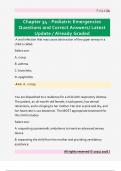
Chapter 34 - Pediatric Emergencies  Questions and Correct Answers/ Latest  Update / Already Graded
  • Chapter 34 - Pediatric Emergencies Questions and Correct Answers/ Latest Update / Already Graded

  • Exam (elaborations) • 62 pages • 2025
  • A viral infection that may cause obstruction of the upper airway in a child is called: Select one: A. croup. B. asthma. C. bronchitis. D. epiglottitis Ans: A. croup. You are dispatched to a residence for a child with respiratory distress. The patient, an 18-month-old female, is tachypneic, has sternal retractions, and is clinging to her mother. Her skin is pink and dry, and her heart rate is 120 beats/min. The MOST appropriate treatment for this child includes: Select o...
    (0)
  • $13.99
  • + learn more
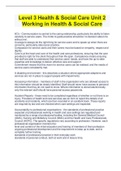
Level 3 Health & Social Care Unit 2  Working in Health & Social Care
  • Level 3 Health & Social Care Unit 2 Working in Health & Social Care

  • Exam (elaborations) • 18 pages • 2023
  • Available in package deal
  • 6C's - Communication is central to the caring relationship, particularly the ability to listen carefully to service users. The motto to guide practice should be 'no decision about me without me'. Courage to always do the right thing for service users and to speak up when there are concerns, particularly about poor practice. Compassion for service users and their carers must be based on empathy, respect and dignity. Care is at the heart and core of the health and care professions...
    (0)
  • $12.49
  • + learn more
Chapter 34 Exam Prep  Questions
  • Chapter 34 Exam Prep Questions

  • Exam (elaborations) • 1 pages • 2023
  • Although often taken at an office visit, which of the following is not considered a vital sign? - Weight - Respiration - Pulse - Temperature - Blood pressure - Weight An abnormally slow pulse rate is: - Bradycardia An increase in pulse rate may be caused by: - Fever If a patient has a normal oral temperature, what is the patient's rectal temperature reading? - 99.6 degree F If pulse is taken at the wrist, the artery used is the: - Radial Normal pulse rate for an adult is: - 60-10...
    (0)
  • $7.99
  • + learn more
Chapter 34 Exam Prep  Questions
  • Chapter 34 Exam Prep Questions

  • Exam (elaborations) • 1 pages • 2023
  • Although often taken at an office visit, which of the following is not considered a vital sign? - Weight - Respiration - Pulse - Temperature - Blood pressure - Weight An abnormally slow pulse rate is: - Bradycardia An increase in pulse rate may be caused by: - Fever If a patient has a normal oral temperature, what is the patient's rectal temperature reading? - 99.6 degree F If pulse is taken at the wrist, the artery used is the: - Radial Normal pulse rate for an adult is: - 60-10...
    (0)
  • $7.99
  • + learn more
Exam Prep  Questions
  • Exam Prep Questions

  • Exam (elaborations) • 1 pages • 2023
  • Although often taken at an office visit, which of the following is not considered a vital sign? - Weight - Respiration - Pulse - Temperature - Blood pressure - Weight An abnormally slow pulse rate is: - Bradycardia An increase in pulse rate may be caused by: - Fever If a patient has a normal oral temperature, what is the patient's rectal temperature reading? - 99.6 degree F If pulse is taken at the wrist, the artery used is the: - Radial Normal pulse rate for an adult is: - 60-10...
    (0)
  • $9.99
  • + learn more
Chapter 34: Nursing Care of the High Risk Newborn Lowdermilk:  Maternity & Women's Health Care, 12th Edition
  • Chapter 34: Nursing Care of the High Risk Newborn Lowdermilk: Maternity & Women's Health Care, 12th Edition

  • Exam (elaborations) • 11 pages • 2022
  • 1. An infant at 36 weeks of gestation has increasing respirations (80 to 100 breaths per minute with significant substernal retractions). The infant is given oxygen by continuous nasal positive airway pressure (CPAP). What level of partial pressure of arterial oxygen (PaO2) indicates hypoxia? a. 67 mm Hg b. 89 mm Hg c. 45 mm Hg d. 73 mm Hg - ANS: C The laboratory value of PaO2 of 45 mm Hg is below the range for a normal neonate and indicates hypoxia in this infant. The normal r...
    (0)
  • $13.49
  • + learn more