

- Study guides, Class notes & Summaries
Looking for the best study guides, study notes and summaries about ? On this page you'll find 4 study documents about .
Exam (elaborations)
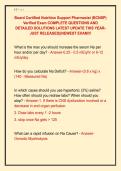
Board Certified Nutrition Support Pharmacist (BCNSP) Verified Exam COMPLETE QUESTIONS AND DETAILED SOLUTIONS LATEST UPDATE THIS YEAR JUST RELEASED||NEWEST EXAM!!!
Board Certified Nutrition Support Pharmacist (BCNSP) Verified Exam COMPLETE QUESTIONS AND DETAILED SOLUTIONS LATEST UPDATE THIS YEAR JUST RELEASED||NEWEST EXAM!!!
 CertifiedExaminations
Exam (elaborations)
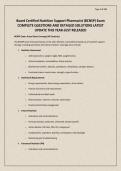
Board Certified Nutrition Support Pharmacist (BCNSP) Exam COMPLETE QUESTIONS AND DETAILED SOLUTIONS LATEST UPDATE THIS YEAR-JUST RELEASED
PopularTap on AVAILABLE IN BUNDLE / PACKAGE DEAL to unlock free bonus exams — save more while getting everything you need! You’ll be glad you did! The Board Certified Nutrition Support Pharmacist (BCNSP) Exam – COMPLETE QUESTIONS AND DETAILED SOLUTIONS LATEST UPDATE THIS YEAR – JUST RELEASED delivers a fully updated and comprehensive study resource designed to help pharmacists confidently prepare for nutrition support certification. This in-depth exam guide covers all essential topics typ...
 STUVIAGRADES
Exam (elaborations)
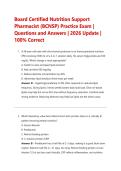
Board Certified Nutrition Support Pharmacist (BCNSP) Practice Exam | Questions and Answers | 2026 Update | 100% Correct
1. A 58-year-old male with short bowel syndrome is on home parenteral nutrition (PN) receiving 2500 mL of a 2-in-1 solution daily. His serum triglycerides are 650 mg/dL. Which change is most appropriate? A. Switch to olive oil-based lipid emulsion B. Add carnitine 500 mg/day C. Reduce dextrose concentration by 20% D. Administer lipid emulsion three times per week Answer: D – Hypertriglyceridemia on PN often responds to reduced lipid frequency. Giving lipids 3 times weekly lowers daily ...
 Brainarium
Exam (elaborations)
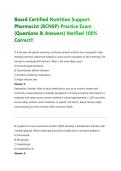
Board Certified Nutrition Support Pharmacist (BCNSP) Practice Exam (Questions & Answers) Verified 100% Correct!!
1. A 58-year-old patient receiving continuous enteral nutrition via a nasogastric tube develops diarrhea, abdominal distension, and a serum osmolality of 285 mOsm/kg. The formula is osmolarity 450 mOsm/L. What is the most likely cause? A) Formula hyperosmolarity B) Clostridioides difficile infection C) Sorbitol-containing medications D) Rapid infusion rate Answer: C Explanation: Sorbitol, often in liquid medications, acts as an osmotic laxative and commonly causes diarrhea in enterally ...
Brainarium