
- Study guides, Class notes & Summaries
Looking for the best study guides, study notes and summaries about ? On this page you'll find 12 study documents about .
Exam (elaborations)
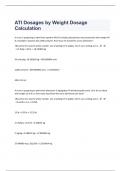
ATI Dosages by Weight Dosage Calculation |50 Questions And Answers| Success Guaranteed
A nurse is preparing to administer epoetin alfa 50 units/kg subcutaneous toa preschooler who weighs 40 lb. Available is epoetin alfa 2,000 units/ml. How many ml should the nurse administer? (Round to the nearest whole number. Use a leading 0 if it applies. Don't use a trailing zero.) - ️️2.2 lb/kg = 40 lb -> 18.181818 kg 50 units/kg x 18.181818 kg = 909.090909 units 2,000 units/ml = 909.090909 units -> 0.454545ml ANS: 0.45 ml A nurse is preparing to administer phenytoin...
 jackline98
Exam (elaborations)
ATI Dosages by Weight Dosage Calculation 3.0 Dosage by Weight Test| Questions with 100% Correct Answers | Verified
PopularA nurse is preparing to administer epoetin alfa 50 units/kg subcutaneous toa preschooler who weighs 40 lb. Available is epoetin alfa 2,000 units/ml. How many ml should the nurse administer? (Round to the nearest whole number. Use a leading 0 if it applies. Don't use a trailing zero.) - 2.2 lb/kg.
 Pharmacia
Exam (elaborations)
ATI Dosages by Weight – Dosage Calculation 3.0 Dosage by Weight Test
NewReview weight-based medication calculations with ATI Dosage Calculation 3.0 Dosage by Weight Test. Explore essential calculation principles involving patient weight, kilograms and pounds, prescribed doses, dosage per kilogram, and safe medication administration. This resource supports practice with dosage calculation methods and reinforces accuracy when determining appropriate medication amounts for patients. Use it alongside official ATI materials, nursing textbooks, and course guidelines to st...
 amelyn
Exam (elaborations)
ATI Dosages by Weight – Dosage Calculation 3.0 Practice Test with Answe
NewThis study guide provides comprehensive practice questions and verified answers for the ATI Dosages by Weight Dosage Calculation 3.0 Test. It focuses on accurate medication dosage calculations based on patient weight, including pediatric and adult dosing, unit conversions, and safe administration principles. Designed for nursing students preparing for ATI assessments, this guide helps strengthen medication calculation skills, critical thinking, and test-taking confidence. It is ideal for cour...
tbsm9177
Exam (elaborations)
ati dosages by weight test (A+ Solutions )
ati dosages by weight test (A+ Solutions )
 DoctorHkane
Exam (elaborations)
ATI Dosages by Weight Dosage Calculation 3.0 Dosage by Weight T questions and answers latest 2024est
ATI Dosages by Weight Dosage Calculation 3.0 Dosage by Weight Test questions and answers latest 2024
DoctorHkane
Exam (elaborations)
ATI Dosage Calculation and Safe Medication Administration 3.0 - Dosages by Weight
ATI Dosage Calculation and Safe Medication Administration 3.0 - Dosages by Weight
DoctorHkane
Exam (elaborations)
ATI Dosages by Weight A+ Correct Solutions
ATI Dosages by Weight A+ Correct Solutions
DoctorHkane
Exam (elaborations)
ATI Dosage Calculations 3.0_ Dosages by Weight
ATI Dosage Calculations 3.0_ Dosages by Weight
DoctorHkane
Package deal
ATI Package Deal
ATI BUNDLED Questions with 100% Correct Answers | Updated & Verified
jackline98
Exam (elaborations)
ATI Dosages by Weight Dosage Calculation 3.0 Dosage by Weight Test| Questions with 100% Correct Answers | Verified
A nurse is preparing to administer epoetin alfa 50 units/kg subcutaneous toa preschooler who weighs 40 lb. Available is epoetin alfa 2,000 units/ml. How many ml should the nurse administer? (Round to the nearest whole number. Use a leading 0 if it applies. Don't use a trailing zero.) - 2.2 lb/kg.
PhysioTherapist
Exam (elaborations)
ATI Dosages by Weight Dosage Calculation 3.0 Dosage by Weight Test| Questions with 100% Correct Answers | Verified
A nurse is preparing to administer epoetin alfa 50 units/kg subcutaneous toa preschooler who weighs 40 lb. Available is epoetin alfa 2,000 units/ml. How many ml should the nurse administer? (Round to the nearest whole number. Use a leading 0 if it applies. Don't use a trailing zero.) - 2.2 lb/kg.
 earlystudy