
- Study guides, Class notes & Summaries
Looking for the best study guides, study notes and summaries about ? On this page you'll find 69 study documents about .

Exam (elaborations)
Ards Nclex Questions And Correct Answers
1.) You're providing care to a patient who is being treated for aspiration pneumonia. The patient is on a 100% non-rebreather mask. Which finding below is a HALLMARK sign and symptom that the patient is developing acute respiratory distress syndrome (ARDS)? A. The patient is experiencing bradypnea. B. The patient is tired and confused. C. The patient's PaO2 remains at 45 mmHg. D. The patient's blood pressure is 180/96. CORRECT ANSWER C. The answer is C. A hallmark sign and symptom ...
 cracker

Exam (elaborations)
ARDS Nursing fully solved 2024 passed
PopularARDS NursingWhat is ARDS characterized by - correct answer sudden, progressive pulmonary edema, increasing bilateral infiltrates on x-ray, hypoxemia unresponsive to O2 supplementation regardless of the amount of PEEP What do pts. demonstrate - correct answer reduced lung compliance What is the major cause of death in ARDS - correct answer non pulmonary multiple system organ failure, often with sepsis Patho of ARDS - correct answer alveolar damage, inflammation, ventilation perfusion mis...
 BravelRadon

Exam (elaborations)
ARDS NCLEX Questions with Verified Answers Rated A
NewWhich S&S distinguish hypoxemia from hypercapnic res- piratory failure? SATA a. Cyanosis b. Tachypnea c. Morning headache d. Paradoxical breathing e. Use of pursed lip breathing A nurse is reviewing the health records of five clients. Which of the following clients are at risk for developing ARDS? (SATA) a. A client who experienced a near drowning b. A client following coronary artery bypass graft surgery c. A client who has a hemoglobin of 15.1 mg/dL d. A client who has dysphagia ...
 MERCYTRISHIA

Exam (elaborations)
Ards Nclex Questions And Answers Graded A+
Which S&S distinguish hypoxemia from hypercapnic respiratory failure? SATA a. Cyanosis b. Tachypnea c. Morning headache d. Paradoxical breathing e. Use of pursed lip breathing - ANSWER - A, B, D A: Cynosis is a late sign of hypoxemia B: Tachypnea is a sign of hypoxemia D: Paradoxical
MERCYTRISHIA
Exam (elaborations)
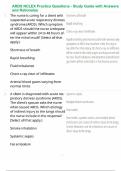
ARDS NCLEX Practice Questions - Study Guide with Answers and Rationales
Prepare for NCLEX questions on Acute Respiratory Distress Syndrome (ARDS) with this focused study guide. Includes exam-style practice questions, key respiratory concepts, and detailed rationales to help you strengthen knowledge and improve test readiness.
 writingassistunlimited

Exam (elaborations)
ARDS NCLEX Questions With 100% Verified Answers Graded A+
Which S&S distinguish hypoxemia from hypercapnic respiratory failure? SATA a. Cyanosis b. Tachypnea c. Morning headache d. Paradoxical breathing e. Use of pursed lip breathing - ANSWERS - A, B, D A: Cynosis is a late sign of hypoxemia B: Tachypnea is a sign of hypoxemia D: Paradoxical breathing is a late sign of hypoxmeia C & E are S&S o
MERCYTRISHIA

Exam (elaborations)
ARDS- NCLEX (questions n answers) graded A+
ARDS- NCLEX (questions n answers) graded A+
 7Eleven

Exam (elaborations)
Ards Nclex Practice Questions With 100% Verified Answers
ARDS NCLEX PRACTICE QUESTIONS WITH 100% VERIFIED ANSWERS 1. The nurse is caring for a client with suspected acute respiratory Shortness of breath distress syndrome (ARDS). Which Rapid breathing symptom of ARDS should the nurse anticipate will appear within 24 to 48 Chest x-ray clear of infiltrates hours after the initial insult? (Select all that apply.) Shortness of breath Rapid breathing Fluid imbalance Chest x-ray clear of infiltrates Arterial blood gases varying from normal limi...
MERCYTRISHIA

Exam (elaborations)
ARDS NCLEX Questions Answers 100% Verified with complete solution
ARDS NCLEX Questions Answers 100% Verified with complete solution
 Rudinia

Exam (elaborations)
ARDS NCLEX UPDATED ACTUAL Exam Questions and CORRECT Answers
ARDS NCLEX UPDATED ACTUAL Exam Questions and CORRECT Answers 1. It will be most important for the nurse to check pulse oximetry for which of these patients? a. A patient with emphysema and a respiratory rate of 16 b. A patient with massive obesity who is refusing to get out of bed c. A patient with pneumonia who has just been admitted to the unit d. A patient who has just received morphine sulfate for postoperative pain - CORRECT ANSWER- C Rationale: Hypoxemia and hypoxemic respiratory...
 STANFORDGRADESS

Package deal
ARDS-NCLEX BUNDLED with correct solutions
1 Exam (elaborations) Chapter 28: Acute Respiratory Distress Syndrome with correct answers 2024 2 Exam (elaborations) NCLEX Acute Respiratory Failure and ARDS questions with answers 3 Exam (elaborations) Clinical Judgement ARDS/Acute respiratory failure fully solved 4 Exam (elaborations) Pulmonary Edema/ARDS verified already passed 2024
BravelRadon

Exam (elaborations)
Chapter 28: Acute Respiratory Distress Syndrome with correct answers 2024
Chapter 28: Acute Respiratory Distress SyndromeWhich of the following materials will be found in the interalveolar walls of a patient with ARDS? 1. Leukocytes 2. Cellular debris 3. Fibrin 4. Hyaline membrane - correct answer 2,3,4 A patient has a prolonged case of ARDS. What changes would be expected in the patients alveolar cells? Development of emphysema Multiplication of the type I cells Influx of macrophages Hyperplasia and swelling of the type II cells - correct answer Hyp...
BravelRadon
Exam (elaborations)
NCLEX Acute Respiratory Failure and ARDS questions with answers
NCLEX Acute Respiratory Failure and ARDSANS: C ABG analysis is most useful in this setting because ventilatory failure causes problems with CO2 retention, and ABGs provide information about the PaCO2 and pH. The other tests also may be done to help in assessing oxygenation or determining the cause of the patient's ventilatory failure. DIF: Cognitive Level: Application REF: TOP: Nursing Process: Assessment MSC: NCLEX: Physiological Integrity - correct answer To evaluate the effectiveness ...
BravelRadon
Exam (elaborations)
Clinical Judgement ARDS/Acute respiratory failure fully solved
Clinical Judgement ARDS/Acute respiratory failureWhat are the clinical manifestations of ALI/ ARDS? - correct answer Refractory hypoxemia Dyspnea Tachypnea Restlessness Change in LOC Tachycardia crackles noncardiogenic pulmonary edema how to distinguish noncardiogenic pulmonary edema vs cardiac faliure pulmonary edema - correct answer o There is no JVD with ARDS Why do we use prone positioning? - correct answer Avoids damage to posterior areas of lung minimizes exudative secretion...
BravelRadon

Exam (elaborations)
Pulmonary Edema/ARDS verified already passed 2024
Pulmonary Edema/ARDS A patient has a decreased oncotic pressure. What can be done to increase it? a. Administer albumin b. Administer morphine sulfate c. Implement a high-salt diet d. Administer milrinone a. Administer albumin A patient has a prolonged case of ARDS. What changes would be expected in the patient's alveolar cells? a. Development of emphysema b. Hyperplasia and swelling of the type II cells c. Influx of macrophages d. Multiplication of the type I cells b. Hyper...
BravelRadon

Exam (elaborations)
ARDS/VENTS questions well answered 2024
ARDS/VENTSARDS: Medical Management - correct answer 1) PEEP 2) Positive Pressure Mechanical Ventilation 3) Position changes- prone and continuous lateral rotation 4) fluid mgt 5) meds- don't really work but still here they are: -corticosteroids -inhaled Nitric Oxide -surfactant replacement -partial liquid ventilation -neuromuscular blocking agents -nutrition with enteral formulas 6) giving carbon dioxide (hypercapnia) PEEP - correct answer positive end expiratory pressure mechani...
BravelRadon
Exam (elaborations)
RCP 140 CH 28 ARDS questions with answers 2024
RCP 140 CH 28 ARDSWhich of the following materials will be found in the interalveolar walls of a patient with ARDS? - correct answer Cellular debris. Fibrin A patient has a prolonged case of ARDS. What changes would be expected in the patient's alveolar cells? - correct answer Hyperplasia and swelling of the type II cells Which of the following pulmonary changes are associated with ARDS? - correct answer Abnormal surfactant . Interstitial edema What is the reason for the elevated risk ...
BravelRadon

Exam (elaborations)
Lewis's Chapter 67: Acute Respiratory Failure and Acute Respiratory Distress Syndrome Test Bank fully solved 2024
Lewis's Chapter 67: Acute Respiratory Failure and Acute Respiratory Distress Syndrome Test BankWhich diagnostic test will provide the nurse with the most specific information to evaluate the effectiveness of interventions for a patient with ventilatory failure? a. Chest x-ray b. O2 saturation c. Arterial blood gas analysis d. Central venous pressure monitoring - correct answer ANS: C Arterial blood gas (ABG) analysis is most useful in this setting because ventilatory failure causes probl...
BravelRadon
Exam (elaborations)
Med-Surg Sp2017 ARDS & Mechanical Ventilation questions and answers 2024
Med-Surg Sp2017 ARDS & Mechanical Ventilation Unresponsive arterial hypoxemia Explanation: Acute respiratory distress syndrome (ARDS) can be thought of as a spectrum of disease, from its milder form (acute lung injury) to its most severe form of fulminate, life-threatening ARDS. This clinical syndrome is characterized by a severe inflammatory process causing diffuse alveolar damage that results in sudden and progressive pulmonary edema, increasing bilateral infiltrates on chest x-ray, hy...
BravelRadon

Exam (elaborations)
Chapter 67: Acute Respiratory Failure and Acute Respiratory Distress Syndrome 2024/2025
Chapter 67: Acute Respiratory Failure and Acute Respiratory Distress SyndromeWhich diagnostic test will provide the nurse with the most specific information to evaluate the effectiveness of interventions for a patient with ventilatory failure? A. Chest x-ray B. O2 saturation C. Arterial blood gas analysis D. Central venous pressure monitoring - correct answer C. Arterial blood gas analysis Which actions should the nurse start to reduce the risk for ventilator-associated pneumonia (VAP)?...
BravelRadon
Exam (elaborations)
Chapter 19: Management of Patients with Chest and Lower Respiratory Tract Disorders fully solved 2024
Chapter 19: Management of Patients with Chest and Lower Respiratory Tract DisordersThe nurse is educating a patient who will be started on an antituberculosis medication regimen. The patient asks the nurse, "How long will I have to be on these medications?" What should the nurse tell the patient? 3 months 3 to 5 months 6 to 12 months 13 to 18 months - correct answer 6 to 12 months Explanation: Pulmonary tuberculosis (TB) is treated primarily with anti-TB agents for 6 to 12 months. A prol...
BravelRadon

Exam (elaborations)
Tom - Ch. 28 Des Jardins (ARDS) correctly answered 2024
Tom - Ch. 28 Des Jardins (ARDS)T or F: Regardless of etiology, ARDS pts undergo similar anatomic changes - correct answer T As ARDS progresses, the intraalveolar walls become lined with a thick, rippled _______ membrane identical to the that of newborns with RDS - correct answer Hyaline The hyaline membrane contains _____ and cellular debris - correct answer Fibrin When fibrin and exudate develop they lead to intraalveolar _______. - correct answer Fibrosis Describe the gross appeara...
BravelRadon