
- Study guides, Class notes & Summaries
Looking for the best study guides, study notes and summaries about ? On this page you'll find 11 study documents about .
Exam (elaborations)
Chapter 11—Stock Valuation and Risk
1. The price-earnings valuation method applies the ____ price-earnings ratio to ____ earnings per share in order to value the firm's stock. a. firm's; industry b. firm's; firm's c. average industry; industry d. average industry; firm's ANS: D PTS: 1 2. A firm is expected to generate earnings of $2.22 per share next year. The mean ratio of share price to expected earnings of competitors in the same industry is 15. Based on this information, the valuation of the firm's shares based ...
 Kingamor
Exam (elaborations)
Chapter 13—Financial Futures Markets
Popular1. A(n) ____ is a standardized agreement to deliver or receive a specified amount of a specified financial instrument at a specified price and date. a. option contract b. brokerage contract c. financial futures contract d. margin call ANS: C PTS: 1 2. Interest rate futures are not available on a. Treasury bonds. b. Treasury notes. c. Eurodollar CDs. d. the S&P 500 index. ANS: D PTS: 1 3. ____ take positions in futures to reduce their exposure to future movements in interest rates or...
Kingamor
Exam (elaborations)
ACCT 2011
. A(n) ____ is a standardized agreement to deliver or receive a specified amount of a specified financial instrument at a specified price and date. a. option contract b. brokerage contract c. fin ancial futures contract d. margin call ANS: C PTS: 1 2. Interest rate futures are not available on a. Treasury bonds. b. Treasury notes. c. Eurodollar CDs. d. the S&P 500 index. ANS: D PTS: 1 3. ____ take positions in futures to reduce their exposure to future movements in interest rates or stock prices...
 acetutor
Exam (elaborations)
Chapter 1—Role of Financial Markets and Institutions
1. Financial market participants who provide funds are called a. deficit units. b. surplus units. c. primary units. d. secondary units. ANS: B PTS: 1 2. The main provider(s) of funds to the U.S. Treasury is (are) a. households and businesses. b. foreign financial institutions. c. the Federal Reserve System. d. foreign nonfinancial sectors. ANS: A PTS: 1 3. The largest deficit unit is (are) a. households and businesses. b. foreign financial institutions. c. the U.S. Treasury. d. f...
Kingamor
Exam (elaborations)
Chapter 1—Role of Financial Markets and Institutions
1. Financial market participants who provide funds are called a. deficit units. b. surplus units. c. primary units. d. secondary units. ANS: B PTS: 1 2. The main provider(s) of funds to the U.S. Treasury is (are) a. households and businesses. b. foreign financial institutions. c. the Federal Reserve System. d. foreign nonfinancial sectors. ANS: A PTS: 1 3. The largest deficit unit is (are) a. households and businesses. b. foreign financial institutions. c. the U.S. Treasury. d. f...
Kingamor
Package deal
ACCT 2011 & FIN 201 Study Guide Test Banks
CC 101 Madura--Financial Markets and Institutions 10e ACCT 2011 & FIN 201 Study Guide Test Banks
Kingamor
Exam (elaborations)
Chapter 14—Options Markets
1. A ____ grants the owner the right to purchase a specified financial instrument for a specified price within a specified period of time. a. call option b. put option c. sale of a futures contract d. purchase of a futures contract ANS: A PTS: 1 2. A ____ requires a premium above and beyond the price to be paid for the financial instrument. a. futures contract b. call option c. put option d. B and C ANS: D PTS: 1 3. A call option is "in the money" when the a. market price of the ...
Kingamor
Exam (elaborations)
Chapter 10—Stock Offerings and Investor Monitoring
1. Which of the following statements is incorrect? a. A stock is a certificate representing partial ownership in a corporation. b. Like debt securities, common stock is issued by firms to obtain funds. c. Stocks are issued by corporations to raise short-term funds. d. The secondary stock market enables investors to sell stocks that they had previously purchased. ANS: C PTS: 1 2. Preferred shareholders a. typically have the same voting rights as common shareholders. b. do not share the o...
Kingamor
Exam (elaborations)
Chapter 9 - Test Bank
1. Mortgage-backed securities are commonly contained within collateralized debt obligations. a. True b. False ANS: T PTS: 1 2. Federally insured mortgages guarantee a. loan repayment to the lending financial institution. b. that the interest rate will not increase during the life of the mortgage. c. the lending financial institution a selling price for the mortgage in the secondary market. d. all of the above ANS: A PTS: 1 3. At a given point in time, the interest rate offered on a new...
Kingamor
Exam (elaborations)
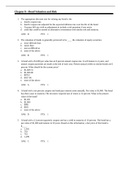
Chapter 8—Bond Valuation and Risk
1. The appropriate discount rate for valuing any bond is the a. bond's coupon rate. b. bond's coupon rate adjusted for the expected inflation rate over the life of the bond. c. Treasury bill rate with an adjustment to include a risk premium if one exists. d. yield that could be earned on alternative investments with similar risk and maturity. ANS: D PTS: 1 2. The valuation of bonds is generally perceived to be ____ the valuation of equity securities. a. more difficult than b. easier th...
Kingamor
Exam (elaborations)
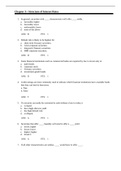
Chapter 3 -Structure of Interest Rates Test Bank
1. In general, securities with ____ characteristics will offer ____ yields. a. favorable; higher b. favorable; lower c. unfavorable; lower d. none of the above ANS: B PTS: 1 2. Default risk is likely to be highest for a. short-term Treasury securities. b. AAA corporate securities. c. long-term Treasury securities. d. BBB corporate securities. ANS: D PTS: 1 3. Some financial institutions such as commercial banks are required by law to invest only in a. junk bonds. b. corporate stock...
Kingamor