BIOL201 (BIOL201)

American Public University

Here are the best resources to pass BIOL201 (BIOL201). Find BIOL201 (BIOL201) study guides, notes, assignments, and much more.

All 130 results

Sort by:
BIOL201 (BIOL 201) A001  APEI, all quizzes 1-7: Answered latest 2025/26.
  • Exam (elaborations)

    BIOL201 (BIOL 201) A001 APEI, all quizzes 1-7: Answered latest 2025/26.

  • BIOL201 (BIOL 201) A001 APEI, all quizzes 1-7: Answered latest 2025/26.
  • MindCraft
    $24.99 More Info
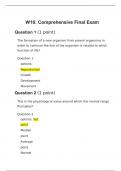
BIOL201 Week 16 Cumulative Final Exam (Winter 2023)
  • Exam (elaborations)

    BIOL201 Week 16 Cumulative Final Exam (Winter 2023)

  • 1. Question: The formation of a new organism from parent organisms in order to continue the line of the organism is related to which function of life? 2. Question: This is the physiological value around which the normal range fluctuates? 3. Question: What is the metabolic process by which larger, more complex substances are broken down into smaller, simpler molecules? 4. Question: Hydrogen, oxygen, carbon, nitrogen, calcium, and iron are all examples of what? 5. Question: What are the tiny f...
  • studyguider55
    $43.99 More Info
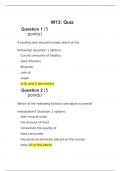
BIOL201 Week 13 Quiz 9
  • Exam (elaborations)

    BIOL201 Week 13 Quiz 9

  • 1. Question: A healthy diet should include which of the following? 2. Question: Which of the following factors contribute to overall metabolism? 3. Question: The carbohydrates, lipids, and proteins in the foods you eat are used for​. 4. Question: Fever increases the body temperature and can induce chills to help cool the temperature back down. What other mechanisms are in place to regulate the body temperature? 5. Question: Starvation sets in after 3 to 4days without food. Which hormones c...
  • studyguider55
    $20.99 More Info
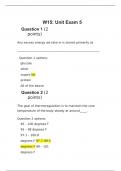
BIOL201 Week 15 Unit Exam 5
  • Exam (elaborations)

    BIOL201 Week 15 Unit Exam 5

  • 1. Question: Any excess energy we take in is stored primarily as​. 2. Question: The goal of thermoregulation is to maintain the core temperature of the body steady at around​. 3. Question: Which of the following occur(s) very soon after a meal? 4. Question: During the absorptive state, glucose levels are​and insulin levels are​. 5. Question: Fever increases the body temperature and can induce chills to help cool the temperature back down. What other mechanisms are in place to regulat...
  • studyguider55
    $35.99 More Info
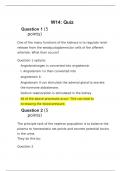
BIOL201 Week 14 Quiz 10
  • Exam (elaborations)

    BIOL201 Week 14 Quiz 10

  • 1. Question: One of the many functions of the kidneys is to regulate renin release from the weak juxta glomerular cells of the afferent arteriole. What then occurs? 2. Question: The principle task of the nephron population is to balance the plasma to homeostatic set points and excrete potential toxins in the urine. 3. Question: Renin is released in response to​. 4. Question: Mechanisms by which substances move across membranes for the absorption or secretion include​. 5. Question: The pr...
  • studyguider55
    $20.99 More Info
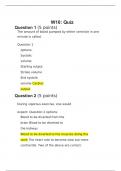
BIOL201 Week 10 Quiz 7
  • Exam (elaborations)

    BIOL201 Week 10 Quiz 7

  • 1. Question: The amount of blood pumped by either ventricle in one minute is called. 2. Question: During vigorous exercise, one would expect 3. Question: Venous return is affected by all EXCEPT: 4. Question: These control the blood flow through a capillary 5. Question: The exchange of substances between the blood vessels and the surrounding tissues can only happen in the​. 6. Question: What is the sequence of layers of the blood vessels (veins or arteries) from outside to the inside? 7. ...
  • studyguider55
    $20.99 More Info
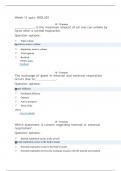
BIOL201 Week 11 Quiz 8
  • Exam (elaborations)

    BIOL201 Week 11 Quiz 8

  • 1. ____________is the maximum amount of air one can exhale by force after a normal expiration. 2. The exchange of gases in internal and external respiration occurs due to​_. 3. Which statement is correct regarding internal or external respiration? 4. The blood traveling to the lungs is generally described to be which of the following? 5. Which of the following are ways CO2 is transported in the blood? 6. The oro pharynx is a passage way for which of the following? 7. Which cell is respon...
  • studyguider55
    $10.99 More Info
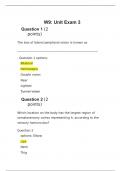
BIOL201 Week 9 Unit Exam 3
  • Exam (elaborations)

    BIOL201 Week 9 Unit Exam 3

  • 1. Question: The loss of lateral peripheral vision is known as​. 2. Question: Which location on the body has the largest region of somato sensory cortex representing it, according to the sensory homunculus? 3. Question: Axons in which tract are considered to be both ipsilateral and contralateral? 4. Question: Which region of gray matter in the spinal cord contains motor neurons that innervate skeletal muscles? 5. Question: Which region of the frontal lobe is responsible for initiating move...
  • studyguider55
    $35.99 More Info
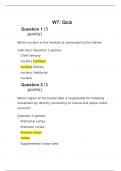
BIOL201 Week 7 Quiz 5
  • Exam (elaborations)

    BIOL201 Week 7 Quiz 5

  • W7: Quiz 1. Question: Which nucleus in the medulla is connected to the inferior colliculus? 2. Question: Which region of the front allobe is responsible for initiating movement by directly connecting to cranial and spinal motor neurons? 3. Question: The thalamus is the transfer point for most sensory tracts to reach the cerebral cortex. An exception would be which of these? 4. Question: The loss of lateral peripheral vision is known as​. 5. Question: Which location on the body has the ...
  • studyguider55
    $20.99 More Info
BIOL201 Week 12 Unit Exam 4
  • Exam (elaborations)

    BIOL201 Week 12 Unit Exam 4

  • 1. Question: Which tunic of an artery is responsible for maintaining blood pressure? 2. Question: Systolic pressure minus diastolic pressure is another term for: 3. Question: These control the blood flow through a capillary bed. 4. Question: What is the sequence of layers of the blood vessels (veins or arteries) from outside to the inside? 5. Question: During vigorous exercise, one would expect: 6. Question: Venous return is affected by all EXCEPT: 7. Question: The amount of blood pumped b...
  • studyguider55
    $35.99 More Info
BIOL201 Week 6 Unit Exam 2
  • Exam (elaborations)

    BIOL201 Week 6 Unit Exam 2

  • 1. Question: Which of the following foods is best for bone health? 2. Question: Hematopoiesis is best described as: 3. Question: With respect to their direct effects on osseous tissue, which pair of hormones has actions that oppose each other? 4. Question: Wolff's law, which describes the effect of mechanical forces in bone modeling/remodeling, would predict that​. 5. Question: Bone growth in diameter is known as: 6. Question: How many vertebrae are located in the thoracic region? 7. Qu...
  • studyguider55
    $35.99 More Info
BIOL201 Week 8 Quiz 6
  • Exam (elaborations)

    BIOL201 Week 8 Quiz 6

  • 1. Question: The alpha cells of the pancreatic is lets produce and secrete ​. 2. Question: Which of the following is an anterior pituitary hormone? 3. Question: The two major organ systems that participate in relatively "long distance" communication in order to control and coordinate actions in the body are the​system and the​system. 4. Question: Which general type of hormone can easily pass through the cell membrane and into the cytoplasm of the cell? 5. Question: The adrenal gland ...
  • studyguider55
    $20.99 More Info
BIOL201 Week 5 Quiz 4
  • Exam (elaborations)

    BIOL201 Week 5 Quiz 4

  • 1. Question: Upon skeletal muscle membrane edge polarization, what structures are triggered to open? 2. Question: Varying degrees of contractive force in a skeletal muscle are generated through the process of what? 3. Question: Which two proteins interact to cause a contraction in skeletal muscle? 4. Question: Slow oxidative (SO) muscle fibers: 5. Question: In the Sliding Filament Model of Contraction, act in and myosin filaments slide past one another using what as an energy source? 6. Que...
  • studyguider55
    $20.99 More Info
BIOL201 Week 4 Quiz 3
  • Exam (elaborations)

    BIOL201 Week 4 Quiz 3

  • 1. Questions: Bone tissue can be described as 2. Question: Which of the following goods is best for bone health? 3. Question: A person typically has 206 bones. Which classification of bone varies in number from person to person? 4. Question: Bones with a cube-like shape can be found in which part of the body? 5. Question: Bones grow in length due to activity in the 6. Question: What unites the bodies of adjacent vertebrae? 7. Question: How many vertebrae are located in the cervical region?...
  • studyguider55
    $20.99 More Info
BIOL201 Week 2 Quiz 2
  • Exam (elaborations)

    BIOL201 Week 2 Quiz 2

  • 1. Question: Together, just four elements makeup more than 95percent of the body’s mass. Which ones are they? 2. Question: When an atom donates an electron to another atom, it becomes what? 3. Question: What are organic compounds, such as carbohydrates, lipids, proteins, and nucleic acids, within the human body often referred to as? 4. Question: The characteristic that gives an element its distinctive properties is its number of what? 5. Question: Which of the following is NOT a part of th...
  • studyguider55
    $20.99 More Info
BIOL201 Week 3 Unit Exam 1
  • Exam (elaborations)

    BIOL201 Week 3 Unit Exam 1

  • 1. Question: The state of steady internal conditions maintained by living things is called this. 2. Question: What is the study of the larger structures of the body, visible WITHOUT the aid of magnification? 3. Question: Which organ system is responsible for producing sex hormones and producing milk for an infant? 4. Question: Which organ system is responsible for enabling movement and helping to maintain body temperature? 5. Question: What is the metabolic process whereby smaller, simpler m...
  • studyguider55
    $30.99 More Info
BIOL201 Week 1 Quiz 1
  • Exam (elaborations)

    BIOL201 Week 1 Quiz 1

  • 1. Question: The state of steady internal conditions maintained by living things is called this. 2. Question: What is the study of the larger structures of the body, visible WITHOUT the aid of magnification? 3. Question: Which organ system is responsible for producing sex hormones and producing milk for an infant? 4. Question: Which organ system is responsible for enabling movement and helping to maintain body temperature? 5. Question: What is the metabolic process whereby smaller, simpler m...
  • studyguider55
    $30.99 More Info
BIOL201 W16 Cumulative Final Exam (Solved)
  • Exam (elaborations)

    BIOL201 W16 Cumulative Final Exam (Solved)

  • BIOL201 W16 Cumulative Final Exam
  • Milestonee
    $63.99 More Info
BIOL201 Week 15 Unit Exam 5 (Solved)
  • Exam (elaborations)

    BIOL201 Week 15 Unit Exam 5 (Solved)

  • 1. Question: Any excess energy we take in is stored primarily as . 2. Question: The goal of thermoregulation is to maintain the core temperature of the body steady at around . 3. Question: Which of the following occur(s) very soon after a meal? 4. Question: During the absorptive state, glucose levels are and insulin levels are . 5. Question: Fever increases the body temperature and can induce chills to help cool the temperature back down. What other mechanisms are in place to regulate the b...
  • Milestonee
    $49.38 More Info
BIOL201 Week 16 Cumulative Final Exam (100% Solved)
  • Exam (elaborations)

    BIOL201 Week 16 Cumulative Final Exam (100% Solved)

  • 1. Question: The formation of a new organism from parent organisms in order to continue the line of the organism is related to which function of life? 2. Question: This is the physiological value around which the normal range fluctuates? 3. Question: What is the metabolic process by which larger, more complex substances are broken down into smaller, simpler molecules? 4. Question: Hydrogen, oxygen, carbon, nitrogen, calcium, and iron are all examples of what? 5. Question: What are the tiny f...
  • Milestonee
    $69.55 More Info
Want to regain your expenses?
How much did you already spend on Stuvia? Imagine there are plenty more of you out there paying for study notes, but this time YOU are the seller. Ka-ching!