

Southern Utah University
Latest uploads at Southern Utah University. Looking for notes at Southern Utah University? We have lots of notes, study guides and study notes available for your school.
-
102
- 0
-
6
All courses for Southern Utah University
Latest content Southern Utah University
Briefly goes through the structure of a muscle fiber and their functions. Neurons that carry signals to skeletal muscles, acetylcholine and nicotinic receptors. Excitation-coupling-contraction-relaxation process, motor units and motor unit recruitments. Twitch summation and tetanus. Concentric, eccentric, and isometric actions, muscle length to tension relationships. Creatine Phosphate system, anaerobic glycolysis, and oxidative metabolism. Atrophy, increased oxidative capacity, fiber type trans...
Goes through the motor branches of the Peripheral Nervous System, the Somatic Efferent, and the Autonomic Nervous System. Sympathetic Division and parasympathetic divisions. Somatic Motor Neurons: spinal cord reflexes, brain stem reflexes, and voluntary movement. Cholinergic receptors and neurons, adrenergic neurons and receptors. The adrenal gland is very important! Agonists in drug testing, and antagonists in drug testing. Beta 1 and alpha 1 receptors
Two different types of pathways of the Afferent Nervous System. The different types of receptors: mechanoreceptors, thermoreceptors, chemoreceptors, photoreceptors, osmoreceptors, baroreceptors, nociceptors. Where all of the type of stimuli are located and the duration of stimuli, the law of specific nerve energies (this is important!)
Goes through the central nervous system, peripheral nervous system, and how the afferent division and efferent division systems are different. The CNS act as the integration and control center, sensory cortex and motor areas of the brain, explains what the blood brain barrier is and the function, and why brian damage happens so quickly after the heart stops
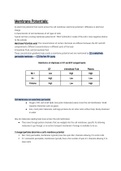
Resting cell membrane potentials, sodium and potassium pumps, goes through hyperpolarization and depolarization of the cell
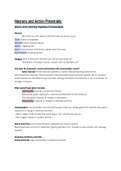
Goes through parts of an axon, what receives and what is delivered to other axons. Explains how neurons communicate with each other, through ligand-gated channels and voltage gated channels. How an action potential is generated, properties of neuronal signals, refractory and absolute refractory periods
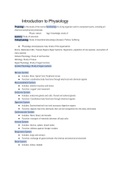
Describes the definition of Physiology, describes the systems involved within the human body, the themes of physiology, maintaining homeostasis, and positive and negative feedback loops.
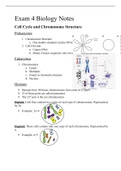
Notes for Karpels biology class and SUU.
Notes for exam 3 in biology 1610 with Karpel
Biology 1610 notes for 1610 at SUU for Karpels class