
BIO 1001 (BIO1001)
Presbyterian College
Here are the best resources to pass BIO 1001 (BIO1001). Find BIO 1001 (BIO1001) study guides, notes, assignments, and much more.
Class notes
Chapter 9 - Sexual Reproduction and Meiosis
As indicated by the title of this document, these notes cover sexual reproduction and meiosis. These notes provide a detailed description of the different Meiosis Divisions and their processes, sexual v.s. asexual reproduction, the random orientation of chromosomes during meiosis, how meiosis works and what it is, meiosis I-II, metaphase I-II, anaphase I-II, telophase I-II, variability generated by meiosis, a comparison of mitosis and meiosis, how sex is determined in humans and other species, e...
 lilliehightower
Class notes
Chapter 13- Evidence of Evolution (Unit 4)
PopularAs indicated by the title of this document, these notes cover the evidence of evolution, specifically focusing on evidence of evolution, such as Darwin's beliefs, postulates, and other various lines of evidence supporting evolution. The content of these notes covers topics like the fossil record, biogeography, comparative anatomy and embryology, molecular biology, and laboratory and field studies and experiments. These notes also delve into the process of fossilization, types of fossils, dating...
lilliehightower
Package deal
BIO 1001 - Entire Semester of Notes!
This package deal includes an entire semester's worth of biology notes. From introductory materials to Punnett Squares and Binary Fission, this package deal has it all!!
lilliehightower
Class notes
Unit 5 - Bacteria and Archaea
These notes provide information from an entire unit on various aspects of microbes, particularly bacteria, and archaea, as indicated by the title of this document. Here is an overview of the topics covered in these notes: 1. Microbial Diversity 2. Microbial Characteristics 3. Prokaryotes 4. Comparing Bacteria and Archaea 5. Cellular Components 6. Metabolic Pathways 7. Oxygen Requirements 8. Gene Transfer 9. Phylogenetic Tree of Bacteria 10. Domain Archaea 11. Role of Prokaryotes in...
lilliehightower
Class notes
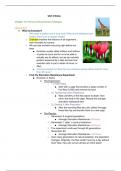
Unit 4 Notes (Chapters 12-14) - Forces of Evolutionary Changes; Evidence of Evolution; Speciation and Extinction
This document compiles an entire unit of biology notes, consisting of three chapters. These notes cover various topics regarding evolution, evolutionary changes, evidence of evolution, speciation, and extinction. Additionally, these notes include an abundance of images, equations, charts, and diagrams to assist you in your study of biology.
lilliehightower
Class notes
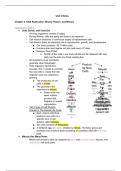
Unit 3 Notes (Chapters 8-11) - DNA Reticulation, Binary Fission, and Mitosis; Sexual Reproduction and Meiosis; and Patterns of Intelligence
This document covers an entire unit of biology notes. These notes provide information on various aspects of cell biology, cell division, and related topics. These notes also discuss various aspects of reproduction, particularly focusing on sexual reproduction, asexual reproduction, and the process of meiosis. They cover topics such as the benefits and costs of sexual reproduction, the reduction of genetic material in gametes through meiosis, and how meiosis generates genetic variability. The doc...
lilliehightower
Class notes
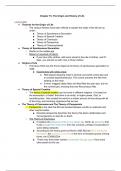
Chapter 15- The Origin and History of Life
As indicated by the title of this document, these notes cover the origin and history of life. These notes focus on the various theories regarding the origin of life, the evolution of Earth and Earth's atmosphere, the emergence of organic molecules, the first cells, and the diversity of life throughout different geological eras. The content of these notes covers various scientific theories, experiments, and key milestones in the study of the evolution of life on Earth. These notes also delve int...
lilliehightower
Class notes
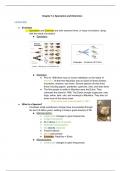
Chapter 14- Speciation and Extinction
As indicated by the title of this document, these notes describe, in detail, speciation and extinction. These notes provide you with an abundance of charts, images, diagrams, etc. to further your understanding of the topic. Some of the topics covered in these notes include Prezygotic Reproductive Barriers, reproductive barriers, plant hybridization, spatial patterns and how they define three types of speciation, the pace of speciation, mass extinction, and so much more!
lilliehightower
Class notes
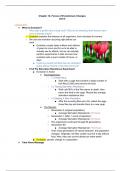
Chapter 12 - Forces of Evolutionary Changes (Unit 4)
As indicated by the title of this document, these notes cover the forces and processes of evolution and evolutionary changes. These notes begin with an explanation of evolution and what it is, as well as various experiments that have been conducted. This chapter discusses various topics such as allele frequency and descent with modification. These notes provide the equations needed to solve problems that use those terms, as well as an abundance of diagrams, examples, and charts! Some of the topi...
lilliehightower
Class notes
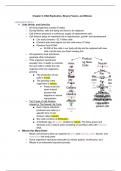
Chapter 8 - DNA Replication, Binary Fission, and Mitosis
As indicated by the title of this document, these notes cover DNA replication, binary fission, and mitosis, detailing the process and key terms for each. There are in-depth descriptions of the DNA Replication Process, the roles of mitosis, the two types of cell division that interact in the sexual life cycle, the structural basis of DNA replication, the different packings of prokaryotic and eukaryotic chromosomes, binary fission, the cell cycle for various cells (such as the eukaryotic cell cycl...
lilliehightower
Class notes
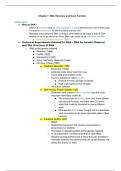
Chapter 7 - DNA Structure and Gene Function
As the title indicates, these notes cover DNA structure and gene function! To begin, these notes give a brief overview of the historical experiments related to DNA and DNA as a genetic material and its structure. These notes describe, in detail, the various scientists and their contributions to the study of DNA and genes, as well as provide an abundance of examples for each topic mentioned. Additionally, these notes detail the different parts and aspects of genes, genomes, and DNA and highlight,...
lilliehightower
Class notes
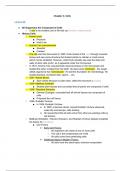
Chapter 3 - Cells
These notes cover an abundance of information on cells and go into great detail about each aspect of cells. A brief history of cells is provided and gives the names of various scientists, physicists, zoologists, etc., and their contributions to the study of biology and cells. This chapter also details Cell Theory and various measurements of cells. These notes have an overview of the cell structure and give definitions for keywords such as cell membrane, cytoplasm, DNA, Eukaryotic Cells, Prokaryo...
lilliehightower
Class notes
Chapter 2 - The Chemistry of Life
These notes cover the basics of chemistry from an undergraduate biology course. The contents include topics such as matter, elements, atoms, atomic numbers and weights, protons, neutrons, electrons, types of subatomic particles, the three isotopes of carbon, where protons, neutrons, and electrons are located in the atom, what an element's atomic number indicates, what the difference between atomic mass and an element's atomic weight is, how chemical bonds link atoms, compounds, orbitals and el...
lilliehightower
Class notes
Chapter 1 - The Scientific Study of Life
These notes describe the characteristics of life, such as biology, cells, organisms, how cells use DNA to produce proteins, as well as the five characteristics that all life shares. Additionally, this document provides the definitions and examples for all of the key terms for this chapter, such as atom, molecule, organelle, cell(s), tissue, organ, organ system, organism, population, community, ecosystem, biosphere, emergent properties, endothelial cells, sheets of endothelial cells, capillary, r...
lilliehightower