MTH 341 (MTH341)

Oregon State University

Here are the best resources to pass MTH 341 (MTH341). Find MTH 341 (MTH341) study guides, notes, assignments, and much more.

All 10 results

Sort by

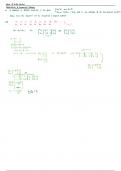
Week 10: Applications of Eigenvalues and Eigenvectors Week 10: Applications of Eigenvalues and Eigenvectors
  • Week 10: Applications of Eigenvalues and Eigenvectors

  • Class notes • 2 pages • 2025
  • Available in package deal
  • Uses of eigenvalues, particularly in dynamic systems. Revisits Markov chains. Using matrix powers, the long-term behavior of the system is analyzed through the steady-state vector.
    (0)
  • $2.99
  • + learn more
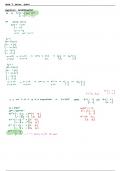
Week 9: Applications of Eigenvalues and Eigenvectors Week 9: Applications of Eigenvalues and Eigenvectors
  • Week 9: Applications of Eigenvalues and Eigenvectors

  • Class notes • 3 pages • 2025
  • Available in package deal
  • Focuses on practical uses of eigenvalues and eigenvectors, particularly in modeling systems over time. Diagonalization and introduces Markov chains, using transition matrices to model population. Discusses concept of a steady-state vector representing long-term equilibrium.
    (0)
  • $2.99
  • + learn more
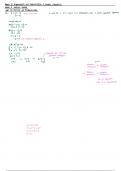
Week 8: Eigenspaces and Diagonalization & Complex Eigenvalues Week 8: Eigenspaces and Diagonalization & Complex Eigenvalues
  • Week 8: Eigenspaces and Diagonalization & Complex Eigenvalues

  • Class notes • 4 pages • 2025
  • Available in package deal
  • Expands on diagonalization and introduces complex eigenvalues. It reviews conditions under which a matrix is diagonalizable. Discusses the Fundamental Theorem of Algebra. Defines complex numbers, their conjugates, and modulus, and explains complex conjugate pairs.
    (0)
  • $2.99
  • + learn more
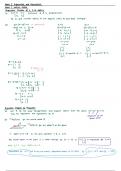
Week 7: Eigenvalues and Eigenvectors Week 7: Eigenvalues and Eigenvectors
  • Week 7: Eigenvalues and Eigenvectors

  • Class notes • 3 pages • 2025
  • Available in package deal
  • Introduces the concepts of eigenvalues and eigenvectors, how a matrix transforms vectors by stretching or reversing their direction. Explains how that eigenvectors are found. Also covers diagonalization. It includes conditions for diagonalizability and shows how the eigenvalues of a diagonal matrix are just its diagonal entries.
    (0)
  • $2.99
  • + learn more
Week 6: Linear Transformations, Matrices, Kernel and Image of a Linear Transformation Week 6: Linear Transformations, Matrices, Kernel and Image of a Linear Transformation
  • Week 6: Linear Transformations, Matrices, Kernel and Image of a Linear Transformation

  • Class notes • 3 pages • 2025
  • Available in package deal
  • Focuses on expressing linear transformations as matrix operations. Covers how to find matrices for transformations like rotations and reflections. Includes the kernel and the image. Explains how to compute transformation matrices and find bases for the kernel and image through row reduction.
    (0)
  • $2.99
  • + learn more
Week 5: Subspace, Basis, and Dimension, Row Column, Null Space, Rank-Nullity Theorem Week 5: Subspace, Basis, and Dimension, Row Column, Null Space, Rank-Nullity Theorem
  • Week 5: Subspace, Basis, and Dimension, Row Column, Null Space, Rank-Nullity Theorem

  • Class notes • 3 pages • 2025
  • Available in package deal
  • Introduces subspaces, bases, dimension, null space, column space, and row space. Explains how to find bases using row reduction, defines rank and nullity, and presents the Rank-Nullity Theorem. Shows how to determine if vectors form a basis and interpret matrices as linear transformations.
    (0)
  • $2.99
  • + learn more
Week 3: Matrix Inverse, Elementary Matrices, and Inverse Properties Week 3: Matrix Inverse, Elementary Matrices, and Inverse Properties
  • Week 3: Matrix Inverse, Elementary Matrices, and Inverse Properties

  • Class notes • 3 pages • 2025
  • Available in package deal
  • Introduces elementary matrices, row swapping, and row addition. Explains how to construct a product of elementary matrices to represent a sequence of row operations. Discusses matrix inverses, including how to compute them. Invertibility of elementary matrices, the behavior of inverses under transposition and multiplication, and conditions for a matrix to be invertible based on its row-reduced echelon form (RREF).
    (0)
  • $2.99
  • + learn more
Week 2: Rank, Homogeneous Systems, and Matrix Algebra Week 2: Rank, Homogeneous Systems, and Matrix Algebra
  • Week 2: Rank, Homogeneous Systems, and Matrix Algebra

  • Class notes • 4 pages • 2025
  • Available in package deal
  • Lecture notes on the concept of homogeneous systems; difference between trivial and nontrivial solutions. The notes define matrix rank and connects this to the number of free variables in a solution set. Covers the idea of expressing solutions as linear combinations of basic solutions. Matrix algebra, scalar multiplication, matrix multiplication, and transposition, along with their associated properties. Introduces symmetry and skew-symmetry in matrices. Defines the matrix inverse.
    (0)
  • $2.99
  • + learn more
Week 1: Systems of Linear Equations, Row Operations, and Gaussian Elimination Week 1: Systems of Linear Equations, Row Operations, and Gaussian Elimination
  • Week 1: Systems of Linear Equations, Row Operations, and Gaussian Elimination

  • Class notes • 3 pages • 2025
  • Available in package deal
  • Set of lecture notes introducing the geometric and algebraic interpretation of systems of linear equations, including examples of plane intersections in three-dimensional space. The notes cover essential definitions, such as homogeneous and consistent systems, and explain the solution sets of linear systems using variables and parameters. Key concepts of pivot positions, leading entries, and the uniqueness of RREF, and explains how to identify whether a system has a unique solution, infinitely m...
    (0)
  • $2.99
  • + learn more