Dysrhythmia

Liberty University

Here are the best resources to pass Dysrhythmia. Find Dysrhythmia study guides, notes, assignments, and much more.

All 5 results

Sort by:

RELIAS DYSRHYTHMIA BASIC TEST 35 QUESTIONS AND CORRECT ANSWERS 2025/2026 GRADED A+ LATEST UPDATE !!!
  • Exam (elaborations)

    RELIAS DYSRHYTHMIA BASIC TEST 35 QUESTIONS AND CORRECT ANSWERS 2025/2026 GRADED A+ LATEST UPDATE !!!

  • Sinus Bradycardia Regular Rate: <60 P Wave: Present, upright PR Interval: 0.12-0.20 sec QRS: <0.12 sec TUTOR23 RESOURCES Atrial Fibrillation IRREGULAR Atrial rate: UNMEASURABLE Ventricular rate: variable P wave: unable to see PR Interval: N/A QRS: <0.12 sec A 昀椀b RVR IRREGULAR Ventricular rate: 100-175 P wave: unable to see PR Interval: N/A QRS <0.12 sec
  • lectdenis
    $9.49 More Info
BASIC DYSRHYTHMIAS I 2023 GRADED A+ VERIFIED
  • Exam (elaborations)

    BASIC DYSRHYTHMIAS I 2023 GRADED A+ VERIFIED

  • 1. A dysrhythmia is any alteration in of heart from normal beat: Electrical conduction 2. Atrial dysrhythmia has an impulse from the:: Atrium 3. Junctional dysrhythmia has an impulse from the:: Area surrounding the AV node 4. Ventricular dysrhythmia has an impulse from the:: Ventricle 5. Bradycardia is a HR of BPM at rest: Slow Less than 60 6. Tachycardia is a HR of BPM at rest: Fast Greater than 100 7. In a normal conducting heart, electrical impulse begins in the : SA Node 8. In a he...
  • claytondoc
    $12.49 More Info
 Dysrhythmia-Relias 2023  BASIC A
  • Exam (elaborations)

    Dysrhythmia-Relias 2023 BASIC A

  • QUESTIONS AND ANSWERS
  • Highergrades
    $8.49 More Info
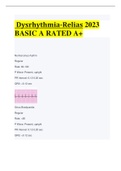
 Dysrhythmia-Relias 2023  BASIC A RATED A+
  • Exam (elaborations)

    Dysrhythmia-Relias 2023 BASIC A RATED A+

  • QUESTIONS AND ANSWERS
  • Highergrades
    $8.09 More Info
Relias Assessments Assistance Material DYSRHYTHMIAS questions with complete solutions
  • Exam (elaborations)

    Relias Assessments Assistance Material DYSRHYTHMIAS questions with complete solutions

  • EKG interpretation correct answer: One of the most useful and commonly used diagnostic tools is electrocardiography (EKG) which measures the heart's electrical activity as waveforms. An EKG uses electrodes attached to the skin to detect electric current moving through the heart. These signals are transmitted to produce a record of cardiac activity. Arrhythmia or dysrhythmia are disturbances in the normal cardiac rhythm of the heart which occurs as a result of alterations within the conduction ...
  • Classroom
    $10.99 More Info
Too much month left at the end of the money?
$6.50 for your textbook summary multiplied by 100 fellow students... Do the math: that's a lot of money! Don't be a thief of your own wallet and start uploading yours now.