

Marian University
Latest uploads at Marian University. Looking for notes at Marian University? We have lots of notes, study guides and study notes available for your school.
-
248
- 0
-
25
All courses for Marian University
Latest content Marian University
NSG 307 - Final Study Guide/NSG 307 - Final Study Guide. Assessment and care of preterm labor (PTL) o preterm birth - between 20 weeks and 0 days and 36 weeks and 6 days 12% of babies in the United States are born prematurely refers strictly to the gestational age of the baby very preterm (20 weeks to 32 weeks) moderately preterm late preterm (34 weeks 0/7 days to 36 weeks 6/7 days) (most common – 75%) COMPLICATIONS: death, mental and physical disability (Cerebral Palsy, visual p...
NSG 307 - Exam 3 Study Guide/NSG 307 - Exam 3 Study Guide. Ch 22 Newborn System Adaptations to Extra uterine Life Respiratory System Adaptations: o Initiation of breathing is stimulated by: o When the baby is born and circulation decreases in the umbilical cord, circulating oxygen decreases and carbon dioxide increases resulting in respiratory acidosis which stimulates the respiratory center in the medulla oblongata to encourage the baby to breathe o Mechanical factors stimulate breath...
NSG 307 - Exam 2 Study Guide/NSG 307 - Exam 2 Study Guide. Review - Labor and Birth Processes There are five factors affecting the process of labor and birth: (five p’s): With each prenatal visit, the baby is assessed using the 4 Leopold’s Maneuvers: 1. Fetal presentation: cephalic, breech, shoulder a. Most babies assume the cephalic position with the fetal lie being longitudinal and the fetal back either to the anterior or transverse side in relation to the mom’s abdomen b...
NSG 307- Exam 1 Study Guide/NSG 307- Exam 1 Study Guide. Module 1 Community Health Concepts: Reproductive Health Niles: pg. 287-292, 318-319, 327-329, 332-334 Aggregate in the community o Building a culture of health in the nation begins with preconception care. Healthy mothers are more likely to have improved newborn and infant outcomes. Healthy infants are more likely to grow up to be healthy adults. Issues of pregnancy & infancy o Infant mortality Preconception care Access t...
NSG 211- Patho Exam 2 Study Guide/NSG 211- Patho Exam 2 Study Guide. Module 6 Ischemia inadequate profusion to the tissues (blood flow) Dehydration: Causes, General signs/symptoms Causes: vomiting and diarrhea Excessive sweating Diabetic ketoacidosis Insufficient water intake
NSG 211- Exam 3 Study Guide/NSG 211- Exam 3 Study Guide. Module 9 – Blood and Lymphatic Disorders Part 1 ● Blood: o Functions: Transportation (O2, Glucose, Nutrients, and Hormones), Defense mechanism (WBC), promotion of homeostasis through heat distribution, clotting factors, BP, and Acid buffer system o Components: Plasma (45% total, made of 7% protein, 91% water, 2% other solutes), Platelets (<1% - normal is 150k-450k), Leukocytes (<1% - normal is 4500-9000), and Erythrocyt...
NSG 317 - Exam 3 Study Guide/NSG 317 - Exam 3 Study Guide. Module 7: The Child with Hematologic or Immunologic Dysfunction • Describe the care of the children and their families with: o Iron deficiency anemia (dietary issue caused by not getting enough iron in their diet; completely preventable) Iron-fortified cereals & formulas for infants o Sickle cell anemia Genetic disease Obstruction caused by sickled RBCs o Hemophilia o ITP & SCID
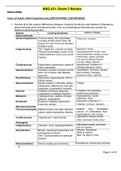
NSG 431- Exam 2 Review/NSG 431- Exam 2 Review. Care of Adult Client Experiencing ENDOCRINE DISORDERS: 1. Review all of the system differences between Cushing Syndrome and Addison’s Disease by glucocorticoids and mineralocorticoids, only, as physiological disturbances caused by Adrenocortical Dysfunction.
NSG 431- Exam 1 Study Guide/NSG 431- Exam 1 Study Guide. Module 1 - Care of Adult with Cardiovascular Disorders Assessment, cardiac diagnostic testing o Blood flow to the heart – superior and inferior vena cava bring blood to the right atrium – through the tricuspid valve into the right ventricle – then pushes through the pulmonic valves into the pulmonic arteries (right and left) passes through the lungs- the pulmonary veins being blood back to the left atrium – pushed through th...
NSG 331- FINAL EXAM STUDY GUIDE/NSG 331- FINAL EXAM STUDY GUIDE. Disorders Head and neck cancer Head and Neck Cancer • Incidence: o 2-3% of all malignancies o Men>women o May involve • Nasal cavity •Para-nasal sinuses • Nasopharynx • Oropharynx • Larynx • Oral cavity • Salivary glands o Most people have advance disease at time of diagnosis • Risk Factors: o Cigarette smoking (85% of cancers) o Alcohol o Occupational exposur...