

ERSC 180
American Military University
Here are the best resources to pass ERSC 180. Find ERSC 180 study guides, notes, assignments, and much more.
Package deal
ERSC 180 Weeks exam Quizs 100%CORRECT AND VERIFIED STUDY QUESTIONS,ANSWERS 2024 updated
ERSC 180 Weeks exam Quiz's 100%CORRECT AND VERIFIED STUDY QUESTIONS,ANSWERS 2024 updated
 Ellisolutions
Exam (elaborations)
ERSC 180 Week 8 Study Week 6 Quiz Return to Assessment List Part 1 of 4 - Week 6 Quiz: Part I
Question 1 of 33 3.0/ 3.0 Points What minimum sea surface temperature is necessary for tropical cyclone development? A. 30oC B. 25oC C. 27oC D. 32oC Question 2 of 33 3.0/ 3.0 Points When is the Atlantic hurricane season? A. May through September B. July through Oct
Ellisolutions
Exam (elaborations)
ERSC 180 Week 6 Quiz /Week 6 Quiz Return to Assessment List/Part 1 of 4 - Week 6 Quiz: Part I
3.0/ 3.0 Points What minimum sea surface temperature is necessary for tropical cyclone development? A. 30oC B. 25oC C. 27oC D. 32oC Question 2 of 33 3.0/ 3.0 Points When is the Atlantic hurricane season? A. May through September B. July through October C. June through November D. August through December Rationale: June through November is when the highest probability of warm and moist air would rise from the ocean where it can encounter ...
Ellisolutions
Exam (elaborations)
ERSC 180 Week 2 Quiz Return to Assessment List Part 1 of 4 - Week 2 Quiz: Part I
Question 1 of 33 3.0/ 3.0 Points Geographically, where is albedo lowest? • A. at 30 degrees north and south of the equator • B. at 60 degrees north and south of the equator • C. at the equator • D. nearest the North Pole and South Pole Question 2 of 33 3.0/ 3.0 Points During what two months do we experience equinoxes? • A. March and December • B. June and September • C. December and June • D. March and September Question 3 of 33 3.0/ 3.0 Points Geographica...
Ellisolutions
Exam (elaborations)
ERSC 180 Week 3 Study LATEST TESTBANK LATEST 202,QUESTIONS AND ANSWERS
Question 1 of 33 3.0/ 3.0 Points Geographically, where is albedo lowest? • A. at 30 degrees north and south of the equator • B. at 60 degrees north and south of the equator • C. at the equator • D. nearest the North Pole and South Pole Question 2 of 33 3.0/ 3.0 Points During what two months do we experience equinoxes? • A. March and December • B. June and
Ellisolutions
Case
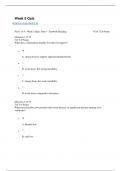
ERSC 180 Week 5 Study Week 5 Quiz Return to Assessment List Part 1 of 4 - Week 5 Quiz: Part I -
Week 5 Quiz Return to Assessment List Part 1 of 4 - Week 5 Quiz: Part I - Textbook Reading 45.0/ 72.0 Points Question 1 of 33 3.0/ 3.0 Points What does a Richardson number less than 30 suggest? • A. strong shear to support supercell thunderstorms • B. weak shear, but strong instability • C. strong shear, but weak instability • D. weak shear compared to buoyancy Question 2 of 33 3.0/ 3.0 Points What term describes low pressure that forms because of significant daytime heat...
Ellisolutions
Exam (elaborations)
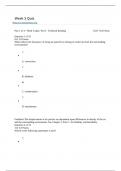
ERSC 180 Week 3 Study Week 3 QuizReturn to Assessment ListPart 1 of 4 - Week 3 Quiz: Part I
Part 1 of 4 - Week 3 Quiz: Part I - Textbook Reading 54.0/ 72.0 Points Question 1 of 33 0.0/ 3.0 Points What reduces the buoyancy of rising air parcels by mixing in cooler air from the surrounding environment? A. convection B. adiabatic C. condensation D. entrainment Feedback:The displacement of air parcels are dependent upon differences in density of the air and the surrounding environment. See Chapter 5, Part C: Air Stability and Instability. Question 2 of 33 3....
Ellisolutions
Exam (elaborations)
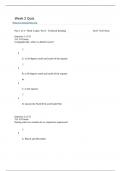
ERSC 180 Week 3 Quiz 100%CORRECT AND VERIFIED STUDY QUESTIONS,ANSWERS
Week 2 Quiz Return to Assessment List Part 1 of 4 - Week 2 Quiz: Part I - Textbook Reading 66.0/ 72.0 Points Question 1 of 33 3.0/ 3.0 Points Geographically, where is albedo lowest? A. at 30 degrees north and south of the equator B. at 60 degrees north and south of the equator C. at the equator D. nearest the North Pole and South Pole Question 2 of 33 3.0/ 3.0 Points During what two months do we experience equinoxes? A. Marc
Ellisolutions
Exam (elaborations)
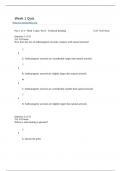
ERSC 180 W1 Quiz Week 1 Quiz Return to Assessment List
Part 1 of 4 - Week 1 Quiz: Part I - Textbook Reading 72.0/ 72.0 Points Question 1 of 33 3.0/ 3.0 Points How does the size of anthropogenic aerosols compare with natural aerosols? A. Anthropogenic aerosols are considerably larger than natural aerosols. B. Anthropogenic aerosols are slightly larger than natural aerosols. C. Anthropogenic aerosols are considerably smaller than natural aerosols. D. Anthropogenic aerosols are slightly larger than natural aerosols. Question...
Ellisolutions
Case
ERSC 180 W1 Quiz Questions & Answers (Latest 2024 / 2025).
Week 1 Quiz Return to Assessment List Part 1 of 4 - Week 1 Quiz: Part I - Textbook Reading 72.0/ 72.0 Points Question 1 of 33 3.0/ 3.0 Points How does the size of anthropogenic aerosols compare with natural aerosols? A. Anthropogenic aerosols are considerably larger than natural aerosols. B. Anthropogenic aerosols are slightly larger than natural aerosols. C. Anthropogenic aerosols are considerably smaller than natural aerosols. D. Anthropogenic aerosols are slightly...
 Ellitestar
Exam (elaborations)
ERSC 180 Week 3 Quiz Questions & Answers (Latest 2024 / 2025).
Week 2 Quiz Return to Assessment List Part 1 of 4 - Week 2 Quiz: Part I - Textbook Reading 66.0/ 72.0 Points Question 1 of 33 3.0/ 3.0 Points Geographically, where is albedo lowest? A. at 30 degrees north and south of the equator B. at 60 degrees north and south of the equator C. at the equator D. nearest the North Pole and South Pole Question 2 of 33 3.0/ 3.0 Points During what two months do we experience equinoxes? A. March and December B. June and S...
Ellitestar
Exam (elaborations)
ERSC 180 W5Q Questions and Answers | Latest 2023/2024 (Graded A+) .
Week 5 Quiz Return to Assessment List Part 1 of 4 - Week 5 Quiz: Part I - Textbook Reading 45.0/ 72.0 Points Question 1 of 33 3.0/ 3.0 Points What does a Richardson number less than 30 suggest? A. strong shear to support supercell thunderstorms B. weak shear, but strong instability C. strong shear, but weak instability D. weak shear compared to buoyancy Question 2 of 33 3.0/ 3.0 Points What term describes low pressure that forms because of significant daytime heat...
Ellitestar
Exam (elaborations)
ERSC 180 Week 5 Study Questions and Answers | Latest 2023/2024 (Graded A+) .
Week 5 Quiz Return to Assessment List Part 1 of 4 - Week 5 Quiz: Part I - Textbook Reading 45.0/ 72.0 Points Question 1 of 33 3.0/ 3.0 Points What does a Richardson number less than 30 suggest? • A. strong shear to support supercell thunderstorms • B. weak shear, but strong instability • C. strong shear, but weak instability • D. weak shear compared to buoyancy Question 2 of 33 3.0/ 3.0 Points What term describes low pressure that forms because of significant daytime heat...
Ellitestar
Exam (elaborations)
ERSC 180 Week 1 Study Questions and Answers | Latest 2023/2024 (Graded A+) .
Week 1 Quiz Return to Assessment List Part 1 of 4 - Week 1 Quiz: Part I - Textbook Reading 72.0/ 72.0 Points Question 1 of 33 3.0/ 3.0 Points How does the size of anthropogenic aerosols compare with natural aerosols? • A. Anthropogenic aerosols are considerably larger than natural aerosols. • B. Anthropogenic aerosols are slightly larger than natural aerosols. • C. Anthropogenic aerosols are considerably smaller than natural aerosols. • D. Anthropogenic aerosols are slightly...
Ellitestar
Exam (elaborations)
ERSC 180 Week 3 Study Questions and Answers | Latest 2023/2024 (Graded A+) .
Week 3 Quiz Return to Assessment List Part 1 of 4 - Week 3 Quiz: Part I - Textbook Reading 54.0/ 72.0 Points Question 1 of 33 0.0/ 3.0 Points What reduces the buoyancy of rising air parcels by mixing in cooler air from the surrounding environment? A. convection B. adiabatic C. condensation D. entrainment Feedback:The displacement of air parcels are dependent upon differences in density of the air and the surrounding environment. See Chapter 5, Part C: Air Stabilit...
Ellitestar
Exam (elaborations)
ERSC 180 Week 6 Quiz Questions and Answers | Latest 2023/2024 (Graded A+) .
Week 6 Quiz Return to Assessment List Part 1 of 4 - Week 6 Quiz: Part I - Textbook Reading 66.0/ 72.0 Points Question 1 of 33 3.0/ 3.0 Points What minimum sea surface temperature is necessary for tropical cyclone development? A. 30oC B. 25oC C. 27oC D. 32oC Question 2 of 33 3.0/ 3.0 Points When is the Atlantic hurricane season? A. May through September B. July through October C. June through November D. August through December Rational...
Ellitestar
Exam (elaborations)
ERSC 180 Week 8 Study Questions and Answers | Latest 2023/2024 (Graded A+) .
Week 8 Quiz Return to Assessment List Part 1 of 4 - Week 8 Quiz: Part I - Textbook Reading 60.0/ 72.0 Points Question 1 of 33 3.0/ 3.0 Points Describe feedback associated with increased carbon dioxide. • A. no feedback • B. indeterminant feedback • C. positive feedback • D. negative feedback Question 2 of 33 3.0/ 3.0 Points What climate forcing type takes into account the Milankovich Cycle? • A. plate tectonics • B. astronomical periodicities • C. solar variab...
Ellitestar
Exam (elaborations)
ERSC 180 Week 3 Study Questions and Answers | Latest 2023/2024 (Graded A+) .
Part 1 of 4 - Week 2 Quiz: Part I - Textbook Reading 66.0/ 72.0 Points Question 1 of 33 3.0/ 3.0 Points Geographically, where is albedo lowest? • A. at 30 degrees north and south of the equator • B. at 60 degrees north and south of the equator • C. at the equator • D. nearest the North Pole and South Pole Question 2 of 33 3.0/ 3.0 Points During what two months do we experience equinoxes? • A. March and December • B. June and September • C. December and June •...
leedia
Exam (elaborations)
ERSC 180 Week 8 Study Questions and Answers | Latest 2023/2024 (Graded A+) .
Week 8 Quiz Return to Assessment List Part 1 of 4 - Week 8 Quiz: Part I - Textbook Reading 60.0/ 72.0 Points Question 1 of 33 3.0/ 3.0 Points Describe feedback associated with increased carbon dioxide. A. no feedback B. indeterminant feedback C. positive feedback D. negative feedback Question 2 of 33 3.0/ 3.0 Points What climate forcing type takes into account the Milankovich Cycle? A. plate tectonics
leedia
Exam (elaborations)
ERSC 180 W1 Quiz Questions and Answers | Latest 2023/2024 (Graded A+) .
Week 1 Quiz Return to Assessment List Part 1 of 4 - Week 1 Quiz: Part I - Textbook Reading 72.0/ 72.0 Points Question 1 of 33 3.0/ 3.0 Points How does the size of anthropogenic aerosols compare with natural aerosols? • A. Anthropogenic aerosols are considerably larger than natural aerosols. • B. Anthropogenic aerosols are slightly larger than natural aerosols. • C. Anthropogenic aerosols are considerably smaller than natural aerosols. • D. Anthropogenic aerosols are slightly...
leedia