FIN 300 (Principles of Finance for the Private Sector)

Colorado State University - Global Campus

Here are the best resources to pass FIN 300 (Principles of Finance for the Private Sector). Find FIN 300 (Principles of Finance for the Private Sector) study guides, notes, assignments, and much more.

All 21 results

Sort by:

FIN Module 8 CT FIN300 – Principles of Finance for the Private Sector  Latest 2022-2023
  • Summary

    FIN Module 8 CT FIN300 – Principles of Finance for the Private Sector Latest 2022-2023

  • NORTH SEA OIL Executive Summary The data compiled by North Sea Oil contains information relative to the current costs of its sources of external capital which includes long term debt of 7%, preferred stock of 19%, and common stock equity of 20%. The company’s target capital structure based on the weighted average cost of capital involves 25% of long term debt, 25% of preferred stock, and 50% of common stock and retained earnings. There are two projects that are under evaluation for poss...
  • leedia
    $7.49 More Info
FIN Module 8 CT FIN 300 Questions {Answered Correctly! 2022-2023}
  • Summary

    FIN Module 8 CT FIN 300 Questions {Answered Correctly! 2022-2023}

  • NORTH SEA OIL Executive Summary The data compiled by North Sea Oil contains information relative to the current costs of its sources of external capital which includes long term debt of 7%, preferred stock of 19%, and common stock equity of 20%. The company’s target capital structure based on the weighted average cost of capital involves 25% of long term debt, 25% of preferred stock, and 50% of common stock and retained earnings. There are two projects that are under evaluation for poss...
  • leedia
    $6.99 More Info
FIN300 - Mastery Exam Questions & Answers/Rationales > 2022/2023.
  • Exam (elaborations)

    FIN300 - Mastery Exam Questions & Answers/Rationales > 2022/2023.

  • FIN300: Principles of Finance for the Private Sector Module 1: Financial Management in the Corporate Environment - Mastery Exercise 1. Strengths of the _____ form of business ownership include the owner receiving all profits, low organizational costs and ease of dissolution, and having income included on the owner's personal tax return. a. holding company b. partnership c. sole proprietorship d. corporation 2. In general, most corporate capital gains are taxed at ___________ tax rate. ...
  • leedia
    $8.49 More Info
Module 6 CT  Questions & Answers_ Spring 2022-2023
  • Other

    Module 6 CT Questions & Answers_ Spring 2022-2023

  • After analyzing the project opportunities for Galaxy Satellite Co. I found that each one provides cash flows greater to the initial investment increasing the market value of the firm. Project B and Project D both utilize a higher amount of the capital budget and provide greater NPV amounts on their own, however, by combining Projects C and D the investments maximize the capital budget and provide the greatest NPV of $410,000. When taking into consideration the IRR, Projects B and C allow th...
  • leedia
    $6.99 More Info
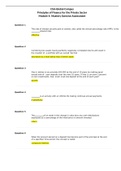
FIN300 - Principles of Finance for the Private Sector: Module 1 Mastery Exercise Assessment Questions and Answers Latest Graded A.
  • Exam (elaborations)

    FIN300 - Principles of Finance for the Private Sector: Module 1 Mastery Exercise Assessment Questions and Answers Latest Graded A.

  • Question 1 The tax rate depends on the level of taxable income. a. true Question 2 If a corporation sells certain capital equipment for more than their initial purchase price, the difference between the sale price and the purchase price is called a(n) c. capital gain Question 3 Corporations are owned by c. stockholders
  • TESTSOURCE
    $8.75 More Info
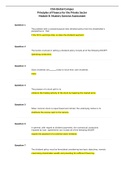
FIN 300: Principles of Finance for the Private Sector - Module 8: Mastery Exercise Assessment (WITH 100% VERIFIED ANSWERS)
  • Exam (elaborations)

    FIN 300: Principles of Finance for the Private Sector - Module 8: Mastery Exercise Assessment (WITH 100% VERIFIED ANSWERS)

  • Question 1 The problem with a constant-payout-ratio dividend policy from the shareholder's perspective is that if the firm's earnings drop, so does the dividend payment. Question 2 The factors involved in setting a dividend policy include all of the following EXCEPT Operating constraints.
  • StudyConnect
    $11.99 More Info
FIN 300: Principles of Finance for the Private Sector - Module 7: Mastery Exercise Assessment (WITH 100% VERIFIED ANSWERS)
  • Exam (elaborations)

    FIN 300: Principles of Finance for the Private Sector - Module 7: Mastery Exercise Assessment (WITH 100% VERIFIED ANSWERS)

  • Question 1 A firm has issued preferred stock at its $125 per share par value. The stock will pay a $15 annual dividend. The cost of issuing and selling the stock was $4 per share. The cost of the preferred stock is 12.4 percent.
  • StudyConnect
    $11.99 More Info
FIN 300: Principles of Finance for the Private Sector - Module 6: Mastery Exercise Assessment (WITH 100% VERIFIED ANSWERS)
  • Exam (elaborations)

    FIN 300: Principles of Finance for the Private Sector - Module 6: Mastery Exercise Assessment (WITH 100% VERIFIED ANSWERS)

  • Question 1 Initial cash flows and subsequent operating cash flows for a project are sometimes referred to as relevant cash flows. Question 2 One basic technique used to evaluate after-tax operating cash flows is to add noncash charges to net income.
  • StudyConnect
    $11.99 More Info
FIN 300: Principles of Finance for the Private Sector - Module 5: Mastery Exercise Assessment (WITH 100% VERIFIED ANSWERS)
  • Exam (elaborations)

    FIN 300: Principles of Finance for the Private Sector - Module 5: Mastery Exercise Assessment (WITH 100% VERIFIED ANSWERS)

  • Question 1 (1 point) The legal contract setting forth the terms and provisions of a corporate bond is a(n) a indenture. b debenture. c loan document. d promissory note. Question 2 (1 point) The is the annual rate of interest earned on a security purchased on a given date and held to maturity. a term structure b yield curve c risk-free rate d yield to maturity
  • StudyConnect
    $11.99 More Info
FIN 300: Principles of Finance for the Private Sector - Module 4: Mastery Exercise Assessment (WITH 100% VERIFIED ANSWERS)
  • Exam (elaborations)

    FIN 300: Principles of Finance for the Private Sector - Module 4: Mastery Exercise Assessment (WITH 100% VERIFIED ANSWERS)

  • Question 1 The rate of interest actually paid or earned, also called the annual percentage rate (APR), is the interest rate. effective Question 2 Combining two assets having perfectly negatively correlated returns will result in the creation of a portfolio with an overall risk that decreases to a level below that of either asset.
  • StudyConnect
    $12.99 More Info
FIN 300: Principles of Finance for the Private Sector - Module 3: Mastery Exercise Assessment (WITH 100% VERIFIED ANSWERS)
  • Exam (elaborations)

    FIN 300: Principles of Finance for the Private Sector - Module 3: Mastery Exercise Assessment (WITH 100% VERIFIED ANSWERS)

  • Question 1 The statement of cash flows provides a summary of the firm's all of the above. Question 2 A firm has prepared the coming year's pro forma balance sheet resulting in a plug figure in a preliminary statement called "the external financing required "of negative $250,000. The firm may prepare to invest in marketable securities totaling $250,000.
  • StudyConnect
    $11.99 More Info
FIN 300 Principles of Finance for the Private Sector - Module 2: Mastery Exercise Assessment (WITH 100% VERIFIED ANSWERS)
  • Exam (elaborations)

    FIN 300 Principles of Finance for the Private Sector - Module 2: Mastery Exercise Assessment (WITH 100% VERIFIED ANSWERS)

  • Question 1 The of a business firm is measured by its ability to satisfy its short-term obligations as they come due. 1. liquidity Question 2 is where the firm’s ratio values are compared to those of a key competitor or group of competitors, primarily to identify areas for improvement. 1. Benchmarking
  • StudyConnect
    $11.99 More Info
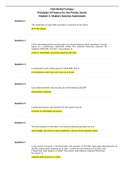
Principles of Finance for the Private Sector: MODULE 1 (MASTERY EXERCISE ASSESSMENT) WITH ANSWERS
  • Exam (elaborations)

    Principles of Finance for the Private Sector: MODULE 1 (MASTERY EXERCISE ASSESSMENT) WITH ANSWERS

  • The tax rate depends on the level of taxable income. a. true
  • StudyConnect
    $14.49 More Info
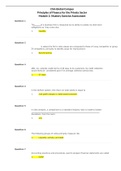
FIN300 - Principles of Finance for the Private Sector: Module 8 Mastery Exercise Assessment Questions and Answers Latest Graded A.
  • Exam (elaborations)

    FIN300 - Principles of Finance for the Private Sector: Module 8 Mastery Exercise Assessment Questions and Answers Latest Graded A.

  • Question 1 The problem with a constant-payout-ratio dividend policy from the shareholder's perspective is that if the firm's earnings drop, so does the dividend payment. Question 2 The factors involved in setting a dividend policy include all of the following EXCEPT Operating constraints. Question 3 Stock dividends are costly to issue than cash dividends. more
  • TESTSOURCE
    $8.85 More Info
FIN 300 - Principles of Finance for the Private Sector: Module 7 Mastery Exercise Assessment Questions and Answers Latest Graded A.
  • Exam (elaborations)

    FIN 300 - Principles of Finance for the Private Sector: Module 7 Mastery Exercise Assessment Questions and Answers Latest Graded A.

  • Question 1 A firm has issued preferred stock at its $125 per share par value. The stock will pay a $15 annual dividend. The cost of issuing and selling the stock was $4 per share. The cost of the preferred stock is 12.4 percent. Question 2 In order to recognize the interrelationship between financing and investments, the firm should use when evaluating an investment. the weighted average cost of all financing sources Question 3 The approximate before-tax cost of de...
  • TESTSOURCE
    $8.55 More Info
FIN 300 - Principles of Finance for the Private Sector Module 6 Mastery Exercise Assessment Questions and Answers
  • Exam (elaborations)

    FIN 300 - Principles of Finance for the Private Sector Module 6 Mastery Exercise Assessment Questions and Answers

  • Question 1 Initial cash flows and subsequent operating cash flows for a project are sometimes referred to as relevant cash flows. Question 2 One basic technique used to evaluate after-tax operating cash flows is to add noncash charges to net income. Question 3 Unsophisticated capital budgeting techniques do not explicitly consider the time value of money.
  • TESTSOURCE
    $8.95 More Info
FIN 300 - Principles of Finance for the Private Sector: Module 5 Mastery Exercise Assessment Questions and Answers.
  • Exam (elaborations)

    FIN 300 - Principles of Finance for the Private Sector: Module 5 Mastery Exercise Assessment Questions and Answers.

  • Question 1 (1 point) The legal contract setting forth the terms and provisions of a corporate bond is a(n) a indenture. b debenture. c loan document. d promissory note. Question 2 (1 point) The is the annual rate of interest earned on a security purchased on a given date and held to maturity. a term structure b yield curve c risk-free rate d yield to maturity Question 3 (1 point) If a corporate bond is issued with a coupon rate that varies dir...
  • TESTSOURCE
    $9.95 More Info
FIN300 - Principles of Finance for the Private Sector: Module 4 Mastery Exercise Assessment Questions and Answers Latest Graded A.
  • Exam (elaborations)

    FIN300 - Principles of Finance for the Private Sector: Module 4 Mastery Exercise Assessment Questions and Answers Latest Graded A.

  • Question 1 The rate of interest actually paid or earned, also called the annual percentage rate (APR), is the interest rate. effective Question 2 Combining two assets having perfectly negatively correlated returns will result in the creation of a portfolio with an overall risk that decreases to a level below that of either asset. Question 3 Xiao Li wishes to accumulate $50,000 by the end of 10 years by making equal annual end-of- year deposits over the next 10...
  • TESTSOURCE
    $9.35 More Info
FIN 300 - Principles of Finance for the Private Sector: Module 3 Mastery Exercise Assessment Questions and Answers Graded A.
  • Exam (elaborations)

    FIN 300 - Principles of Finance for the Private Sector: Module 3 Mastery Exercise Assessment Questions and Answers Graded A.

  • Question 1 The statement of cash flows provides a summary of the firm's all of the above. Question 2 A firm has prepared the coming year's pro forma balance sheet resulting in a plug figure in a preliminary statement called "the external financing required "of negative $250,000. The firm may prepare to invest in marketable securities totaling $250,000. Question 3 A corporation sold a fixed asset for $100,000. This is an investment cash flow and a source of f...
  • TESTSOURCE
    $9.45 More Info
As you read this, a fellow student has made another $4.70
How did he do that? By selling his study resources on Stuvia. Try it yourself!