BIO 202

Arizona College Of Allied Health

Here are the best resources to pass BIO 202. Find BIO 202 study guides, notes, assignments, and much more.

All 6 results

Sort by:
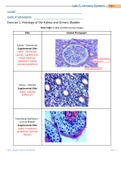
BIO 202 Week 5 Anatomy of the Urinary System Lab Report(Histology of the Kidney and Urinary Bladder) verified doc with correct answers
  • Exam (elaborations)

    BIO 202 Week 5 Anatomy of the Urinary System Lab Report(Histology of the Kidney and Urinary Bladder) verified doc with correct answers

  • HISTOLOGY QUESTIONS: 1. List distinguishing characteristics that allow identification of a glomerulus. 2. What is the importance of the transitional epithelium in the urinary bladder
  • greatsolutions
    $9.99 More Info
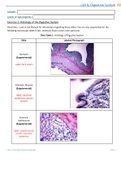
Arizona College, MesaBIO 202BIO202_Week4_DigestiveSystem_LabReport(DIGESTIVE SYSTEM LAB REPORT PAGE)
  • Exam (elaborations)

    Arizona College, MesaBIO 202BIO202_Week4_DigestiveSystem_LabReport(DIGESTIVE SYSTEM LAB REPORT PAGE)

  • xercise 1: Histology of the Digestive System Directions: Look in Lab Manual for information regarding these slides; You are also responsible for the following microscope slides in lab: stomach; ileum; colon; liver; pancreas Data Table 1. Histology of Digestive System Slide Labeled Photograph Stomach (Supplemental) Label: All 4 Layers Stomach, Mucosa (Supplemental) Label: columnar epithelium; lamina propria Stomach, Submucosa (Supplemental) Label:
  • greatsolutions
    $10.99 More Info
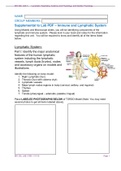
BIO202_Week3_Lymphatic_Respiratory_LabReport/BIO 202, LAB 3 Lymphatic, Respiratory Anatomy and Physiology, and Cardiac Physiology
  • Exam (elaborations)

    BIO202_Week3_Lymphatic_Respiratory_LabReport/BIO 202, LAB 3 Lymphatic, Respiratory Anatomy and Physiology, and Cardiac Physiology

  • Lymphatic System: Part I: Identify the major anatomical features of the human lymphatic system including the lymphatic vessels, lymph ducts (trunks), nodes and accessory organs on models and illustrations. Identify the following on torso model: 1. Right Lymphatic Duct; 2. Thoracic Duct with cisterna chyli; 3. Lymphatic vessels; 4. Major lymph nodes regions in body (cervical, axillary, and inguinal) 5. Thymus 6. Spleen 7. Tonsils (pharyngeal – adenoids; palatine; lingual) Place L...
  • greatsolutions
    $11.99 More Info
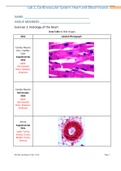
BIO202_Week2_Cardiovascular_System_LabReport.(Lab 2, Cardiovascular System: Heart and Blood Vessels)
  • Exam (elaborations)

    BIO202_Week2_Cardiovascular_System_LabReport.(Lab 2, Cardiovascular System: Heart and Blood Vessels)

  • Why do capillaries facilitate nutrient and gas exchange better than arteries and veins? What are the unique features of cardiac contractile cells that separate them from skeletal and smooth muscle cells?
  • greatsolutions
    $12.99 More Info
BIO 202 Week 6 Reproductive System Lab Report
  • Exam (elaborations)

    BIO 202 Week 6 Reproductive System Lab Report

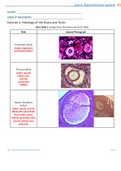
  • Exercise 1: Histology of the Ovary and Testis Data Table 1. Images from the Ovary and Testis Slides Slide Labeled Photograph Primordial Follicle (Label: oogonium; primordial follicle) Primary Follicle (Label: oocyte; follicle cells; antrum; primordial follicle) Mature (Graafian) Follicle (Label: oocyte; antrum filled with antral fluid; theca cells; corpus luteum; granulosa cells; corona radiata; zona pellucida) LAB 7: REPRODUCTIVE SYSTEM LAB REPORT PAGE | 2 Lab 6, Reproducti...
  • Havilah
    $8.99 More Info
Want to regain your expenses?
How much did you already spend on Stuvia? Imagine there are plenty more of you out there paying for study notes, but this time YOU are the seller. Ka-ching!