

Wilkes University
Latest uploads at Wilkes University. Looking for notes at Wilkes University? We have lots of notes, study guides and study notes available for your school.
-
1355
- 0
-
407
All courses for Wilkes University
-
Biology 14
-
NRS 530 NRS530 1
-
NSG 211 NSG211 7
-
NSG526 NSG526 1
-
NURS 526 1
-
NURSING HEALTH ASS NURSING HEALTH ASS 2
-
Wilkes University 1
Latest content Wilkes University
NSG 552 Psychopharmacology Exam 2 Study Prep • Exam covers Modules 3, 4, and 5 (weeks 5-8). Some synthesis of information from previous material is needed (antidepressants, antipsychotic MOA and treatments for SE) • Topics include • Anxiety (Social anxiety, generalized anxiety, • Obsessive compulsive disorder (OCD) • Post traumatic stress disorder (PTSD) • Eating Disorders • Psychosomatic Disorders • Sleep/Wake Disorders • Insomnia • Narcolepsy •...
- Exam (elaborations)
- • 13 pages's •
-
Wilkes University•NRS 530
Preview 2 out of 13 pages
Getting your document ready...
NSG 552 Psychopharmacology Exam 2 Study Prep • Exam covers Modules 3, 4, and 5 (weeks 5-8). Some synthesis of information from previous material is needed (antidepressants, antipsychotic MOA and treatments for SE) • Topics include • Anxiety (Social anxiety, generalized anxiety, • Obsessive compulsive disorder (OCD) • Post traumatic stress disorder (PTSD) • Eating Disorders • Psychosomatic Disorders • Sleep/Wake Disorders • Insomnia • Narcolepsy •...
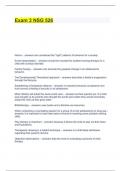
Exam 3 NSG 526 Norms - answers Event interpretation - answers Family therapy - answers can promote the greatest change in an adolescent's behavior. The Developmental Theoretical approach - answers describes a family's progression through the lifecycle. Establishing a therapeutic alliance - answers is important because acceptance and trust convey a feeling of security in an adolescent. Most children will adopt the same world view - answers as their...
- Exam (elaborations)
- • 21 pages's •
-
Wilkes University•NSG526
Preview 3 out of 21 pages
Getting your document ready...
Exam 3 NSG 526 Norms - answers Event interpretation - answers Family therapy - answers can promote the greatest change in an adolescent's behavior. The Developmental Theoretical approach - answers describes a family's progression through the lifecycle. Establishing a therapeutic alliance - answers is important because acceptance and trust convey a feeling of security in an adolescent. Most children will adopt the same world view - answers as their...
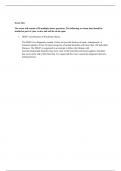
Exam One The exam will consist of 50 multiple choice questions. The following are items that should be studied as part of your review and will be on the quiz: 1. DSM 5 classification of Psychiatric illness. The DSM-5 is a diagnostic manual. It does not provide theories of cause, management, or treatment options. It lists 22 major categories of mental disorders with more than 150 individual illnesses. The DSM-5 is organized in an attempt to follow the lifespan with neurodevelopmental dis...
- Other
- • 41 pages's •
-
Wilkes University•NURS 526
Preview 4 out of 41 pages
Getting your document ready...
Exam One The exam will consist of 50 multiple choice questions. The following are items that should be studied as part of your review and will be on the quiz: 1. DSM 5 classification of Psychiatric illness. The DSM-5 is a diagnostic manual. It does not provide theories of cause, management, or treatment options. It lists 22 major categories of mental disorders with more than 150 individual illnesses. The DSM-5 is organized in an attempt to follow the lifespan with neurodevelopmental dis...
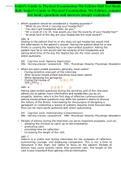
1. Which question would be considered a “leading question?” a. “What do you think is causing your headaches?” b. “You don’t get headaches often, do you?” c. “On a scale of 1 to 10, how would you rate the severity of your headaches?” d. “At what time of the day are your headaches the most severe?” ANS: B Stating to the patient that he or she does not get headaches would limit the information in the patient’s answer. Asking the patient what he or she thinks is causin...
- Book
- Exam (elaborations)
- • 198 pages's •
-
Wilkes University•NSG 211
-
Seidel\'s Guide to Physical Examination - E-Book • Jane W. Ball, Joyce E. Dains, John A. Flynn, Barry S. Solomon, Rosalyn W. Stewart• ISBN 9780323545389
Preview 4 out of 198 pages
Getting your document ready...
1. Which question would be considered a “leading question?” a. “What do you think is causing your headaches?” b. “You don’t get headaches often, do you?” c. “On a scale of 1 to 10, how would you rate the severity of your headaches?” d. “At what time of the day are your headaches the most severe?” ANS: B Stating to the patient that he or she does not get headaches would limit the information in the patient’s answer. Asking the patient what he or she thinks is causin...