

Nursing education
Latest uploads at Nursing education. Looking for notes at Nursing education? We have lots of notes, study guides and study notes available for your school.
-
404
- 0
-
28
All courses for Nursing education
-
Nursing education 404
Latest content Nursing education
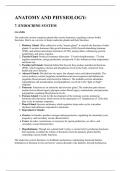
The endocrine system is a complex network of glands and organs that produce and release hormones, which are chemical messengers that regulate various physiological processes in the body. These hormones help maintain homeostasis, coordinate growth and development, regulate metabolism, and influence mood.
- Package deal
- Summary
- • 4 pages's •
-
Nursing education•Nursing education
-
anatomy and physiology• Bycrispymeeee
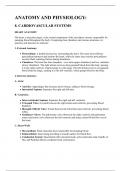
The cardiovascular system, also known as the circulatory system, is a complex network of organs and vessels that transport blood, oxygen, nutrients, and waste products throughout the body. It consists of the heart, blood vessels, and blood. The cardiovascular system plays a crucial role in maintaining homeostasis and supporting the overall function of the body.
- Package deal
- Summary
- • 8 pages's •
-
Nursing education•Nursing education
-
anatomy and physiology• Bycrispymeeee
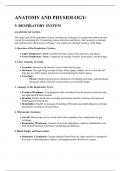
The respiratory system is a complex organ system responsible for the exchange of gases, primarily oxygen and carbon dioxide, between the body and the environment. It consists of various organs and structures that work together to facilitate breathing and gas exchange.
- Package deal
- Summary
- • 8 pages's •
-
Nursing education•Nursing education
-
anatomy and physiology• Bycrispymeeee
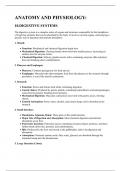
The digestive system is a complex system that processes food, extracts nutrients, and eliminates waste. It consists of a series of organs working together to break down ingested food into smaller, absorbable components.
- Package deal
- Summary
- • 3 pages's •
-
Nursing education•Nursing education
-
anatomy and physiology• Bycrispymeeee
The urinary system, also known as the renal system, plays a vital role in maintaining homeostasis by eliminating waste products and excess substances from the body, regulating water and electrolyte balance, and contributing to blood pressure regulation. The key components of the urinary system include the kidneys, ureters, bladder, and urethra.
- Package deal
- Summary
- • 9 pages's •
-
Nursing education•Nursing education
-
anatomy and physiology• Bycrispymeeee
The reproductive system is responsible for the production of offspring and perpetuation of a species. In humans, the reproductive system is divided into male and female systems, each with specific organs and functions.
- Package deal
- Summary
- • 6 pages's •
-
Nursing education•Nursing education
-
anatomy and physiology• Bycrispymeeee
The integumentary system is the organ system that consists of the skin, hair, nails, and various glands. It serves as the body's outer protective covering and is involved in a variety of functions, including protection against physical damage, pathogens, and dehydration. Additionally, the integumentary system plays roles in temperature regulation, sensation, and the synthesis of vitamin D.
- Package deal
- Summary
- • 4 pages's •
-
Nursing education•Nursing education
-
anatomy and physiology• Bycrispymeeee
he lymphatic system is a network of vessels, nodes, and organs that work together to transport and filter lymph, a colorless fluid containing white blood cells, throughout the body. It plays a crucial role in maintaining fluid balance, filtering foreign substances, and supporting the immune system. The immune system, in turn, is responsible for defending the body against infections and diseases.
- Package deal
- Summary
- • 7 pages's •
-
Nursing education•Nursing education
-
anatomy and physiology• Bycrispymeeee
The special senses refer to the five senses: vision (sight), hearing (audition), taste (gustation), smell (olfaction), and touch (somatosensation). These senses are responsible for perceiving and interpreting specific stimuli from the external environment, providing information to the nervous system.
- Package deal
- Summary
- • 11 pages's •
-
Nursing education•Nursing education
-
anatomy and physiology• Bycrispymeeee
Homeostasis is the body's ability to maintain a stable internal environment despite external changes. It involves a dynamic equilibrium that is regulated by various physiological processes. These processes work to keep internal conditions within a narrow range, ensuring the proper functioning of cells, tissues, and organs. Homeostasis is crucial for the survival and optimal functioning of living organisms.
- Package deal
- Summary
- • 3 pages's •
-
Nursing education•Nursing education
-
anatomy and physiology• Bycrispymeeee
NUR/NUR 3125 MS EXAM - QUESTIONS
- Exam (elaborations)
- • 12 pages's •
-
Nursing education•Nursing education