

inorganic chemistry
Latest uploads at inorganic chemistry. Looking for notes at inorganic chemistry? We have lots of notes, study guides and study notes available for your school.
-
162
- 0
-
11
All courses for inorganic chemistry
-
Inorganic chemistry INORGANIC CHEMISTRY 162
Latest content inorganic chemistry
Lewis Structures Hybrid Orbitals Shapes of Molecules (Common Stereochemistries in Main Group Compounds)
- Summary
- • 18 pages's •
-
Inorganic Chemistry•Inorganic Chemistry
Lewis Structures Concepts and Vocabulary: Formal Charges, Valences, Oxidation States Resonance Structures; Hyper and Hypovalent sites VSEPR
- Summary
- • 28 pages's •
-
Inorganic Chemistry•Inorganic Chemistry
Using the shapes of Molecules to define: Symmetry Operations Symmetry Elements Point Groups and Assignments
- Summary
- • 20 pages's •
-
Inorganic Chemistry•Inorganic Chemistry
Symmetry in Nature and in Molecules Symmetry Operations Symmetry Elements Point Groups and Assignments
- Summary
- • 47 pages's •
-
Inorganic Chemistry•Inorganic Chemistry
Symmetry elements/operations can be manipulated by Group Theory, Representations and Character Tables
- Summary
- • 24 pages's •
-
Inorganic Chemistry•Inorganic Chemistry

The following slides were modified from a gift from Professor Martyn Poliakoff Of the Department of Chemistry in Nottingham, England. Tom Poliakoff also used these slides and prepared them, to my knowledge. You might also check The MIT open courseware lecture to refresh your memory of molecular orbitals.
- Summary
- • 24 pages's •
-
Inorganic Chemistry•Inorganic Chemistry
Solution will involve molecular orbitals - similar to atomic orbitals - but centred around all of the nuclei in molecule. Each defined by sets of quantum numbers,
- Summary
- • 25 pages's •
-
Inorganic Chemistry•Inorganic Chemistry
Descriptive Inorganic Chemistry 16-MO Theory for Heteronuclear Diatomics, Texas A&MU 2019
- Summary
- • 11 pages's •
-
Inorganic Chemistry•Inorganic Chemistry
Delocalization as in benzene Delocalization as in Carbon Monoxide and Metal Carbonyls Delocalization as in Electron Deficient Molecules
- Summary
- • 8 pages's •
-
Inorganic Chemistry•Inorganic Chemistry
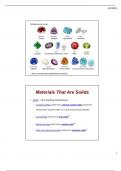
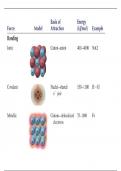
Solids : Four bonding classifications – Covalent bonding, which forms network covalent solids (sometimes called simply "covalent solids” as in diamond and silicon dioxide) – Ionic bonding, which forms ionic solids * – Metallic bonding, which forms metallic solids* – Weak intermolecular bonding, which forms molecular solids*
- Summary
- • 43 pages's •
-
Inorganic Chemistry•Inorganic Chemistry
What are the characteristics of the metals that might be correlated with their crystal structures? What is metallic Bonding? Can MO theory describe it? Account for properties?
- Summary
- • 26 pages's •
-
Inorganic Chemistry•Inorganic Chemistry
In physical chemistry, the van der Waals force (or van der Waals' interaction), named after Dutch scientist Johannes Diderik van der Waals, is the sum of the attractive or repulsive forces between molecules (or between parts of the same molecule) other than those due to covalent bonds, or the electrostatic interaction of ions with one another, with neutral molecules, or with charged molecules.
- Summary
- • 12 pages's •
-
Inorganic Chemistry•Inorganic Chemistry
Lewis, 1930s: Lewis Concept Base is a donor of an electron pair. Acid is an acceptor of an electron pair.
- Summary
- • 22 pages's •
-
Inorganic Chemistry•Inorganic Chemistry
The defining characteristic of a RedOx reaction is that electron(s) have completely moved from one atom / molecule to another. The molecule receiving the electrons has been Reduced The molecule giving the electrons has been Oxidized
- Summary
- • 39 pages's •
-
Inorganic Chemistry•Inorganic Chemistry
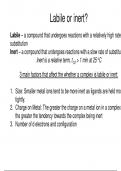
Labile or inert? Labile – a compound that undergoes reactions with a relatively high rate of substitution Inert – a compound that undergoes reactions with a slow rate of substitution Inert is a relative term, t 1/2> 1 min at 25 C
- Summary
- • 7 pages's •
-
Inorganic Chemistry•Inorganic Chemistry
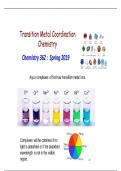
The dative or coordinate covalent bond The valence bond approach to keeping track of electrons in Lewis acid/Lewis base adducts; The Hard/Soft, LA/LB, approach to binding preferences How to assemble molecular orbitals from linear combination of atomic orbitals
- Summary
- • 72 pages's •
-
Inorganic Chemistry•Inorganic Chemistry
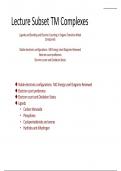
Ligands and Bonding and Electron Counting in Organo-Transition Metal Compounds Stable electronic configurations: MO Energy Level Diagrams Reviewed Electron count preference Electron count and Oxidation States
- Summary
- • 41 pages's •
-
Inorganic Chemistry•Inorganic Chemistry
Solutions Manual to A ccompany Inorganic Chemistry Sixth Edition by Alen Hadzovic (Comprehensive Solutions)
- Exam (elaborations)
- • 236 pages's •
-
Inorganic Chemistry•Inorganic Chemistry