

CBMT
Latest uploads at CBMT. Looking for notes at CBMT? We have lots of notes, study guides and study notes available for your school.
-
1415
- 0
-
96
All courses for CBMT
-
CBMT 1415
-
CBMT 1
-
CBMT, 1
-
CBMT 1
Latest content CBMT
A 17 year old is demonstrating a sudden decline in grades, increased unexcused absences, and inability to concentrate when in school. Facial affect has changed from friendly to flat. When approached, the student states he is fine. Reports indicate the client responds to music, so a music therapy referral is requested. To assess possible causes of the change in behavior, a music therapist should FIRST A. Observe the student in other classes B. Discuss concerns with the guidance counselor C...
- Exam (elaborations)
- • 44 pages's •
-
CBMT•CBMT
A 17 year old is demonstrating a sudden decline in grades, increased unexcused absences, and inability to concentrate when in school. Facial affect has changed from friendly to flat. When approached, the student states he is fine. Reports indicate the client responds to music, so a music therapy referral is requested. To assess possible causes of the change in behavior, a music therapist should FIRST identify current stressors in the student's life. A 52-year-old woman hospitalized for ova...
- Exam (elaborations)
- • 25 pages's •
-
CBMT•CBMT
A 17-year old is demonstrating a sudden decline in grades, increased unexcused absences, and inability to concentrate when in school. Facial affect has changed from friendly to flat. When approached, the student states he is fine. Reports indicate the client responds to music, so a music therapy referral is requested. To assess possible causes of the change in behavior, a music therapist should first: A) observe the student in other classes B) discuss concerns with the guidance counselor ...
- Exam (elaborations)
- • 85 pages's •
-
CBMT•CBMT
Behavior Therapy (applied behavior analysis, behavior modification) Therapeutic intervention designed to change behavior using techniques of operant and respondent conditioning as well as behavior analysis. Cue stimulus, prompt): An event that sets the occasion or a certain event to occur. Discriminative Stimulus A cue which results in a response when that response occurs only after its presentation, and not after other cues. Fading The gradual removal of explicit prompts or cues in an att...
- Package deal
- Exam (elaborations)
- • 4 pages's •
-
CBMT•CBMT
-
CMBT EXAM complete package verified 100%• ByLayer
Psychodynamic Approach -Human behavior is based on unconscious psychological processes (impulses, desires, motives) -Early childhood events Eclectic Approach -Draw freely from all approaches without accepting the frameworks behind them -Goal: more efficient treatment Behavioral Approach -Meant to change behavior -Classical/operant conditioning -ABA: applied behavioral analysis (autism) -Positive/negative reinforcement -Punishment and Reward Episodic Memory long-term memory of specific...
- Package deal
- Exam (elaborations)
- • 29 pages's •
-
CBMT•CBMT
-
CMBT EXAM complete package verified 100%• ByLayer
Alzheimer's Disease A progressive, degenerative disease with insidious onset, characterized by multiple cognitive deficits and significant decline in functioning. Attention Deficit Disorder (ADD) A disorder characterized by maladaptive inattention, hyperactivity, or impulsiveness which results in pervasive and clinically significant impairment. Some symptoms should have presented before seven years of age, although it may be diagnosed in adulthood. Auditory Discrimination Ability to hear ...
- Package deal
- Exam (elaborations)
- • 32 pages's •
-
CBMT•CBMT
-
CMBT EXAM complete package verified 100%• ByLayer
A music therapist completes an assessment of a 3 year old with a profound developmental disability. The child responds to music by turning their head towards the sound consistently. The overall goal identified by the treatment team is to increase the child's responsiveness to the environment. What is the music therapist's best approach towards this goal when creating and documenting the treatment plan? A. Adapt objectives from other team members. B. Create a hierarchy of objectives lea...
- Package deal
- Exam (elaborations)
- • 45 pages's •
-
CBMT•CBMT
-
CMBT EXAM complete package verified 100%• ByLayer
A 17-year old is demonstrating a sudden decline in grades, increased unexcused absences, and inability to concentrate when in school. Facial affect has changed from friendly to flat. When approached, the student states he is fine. Reports indicate the client responds to music, so a music therapy referral is requested. To assess possible causes of the change in behavior, a music therapist should first: A) observe the student in other classes B) discuss concerns with the guidance counselor ...
- Package deal
- Exam (elaborations)
- • 85 pages's •
-
CBMT•CBMT
-
CMBT EXAM complete package verified 100%• ByLayer
A 17 year old is demonstrating a sudden decline in grades, increased unexcused absences, and inability to concentrate when in school. Facial affect has changed from friendly to flat. When approached, the student states he is fine. Reports indicate the client responds to music, so a music therapy referral is requested. To assess possible causes of the change in behavior, a music therapist should FIRST A. Observe the student in other classes B. Discuss concerns with the guidance counselor C...
- Package deal
- Exam (elaborations)
- • 44 pages's •
-
CBMT•CBMT
-
CMBT EXAM complete package verified 100%• ByLayer
A 17 year old is demonstrating a sudden decline in grades, increased unexcused absences, and inability to concentrate when in school. Facial affect has changed from friendly to flat. When approached, the student states he is fine. Reports indicate the client responds to music, so a music therapy referral is requested. To assess possible causes of the change in behavior, a music therapist should FIRST identify current stressors in the student's life. A 52-year-old woman hospitalized for ova...
- Package deal
- Exam (elaborations)
- • 25 pages's •
-
CBMT•CBMT
-
CMBT EXAM complete package verified 100%• ByLayer
A music therapist completes an assessment of a 3 year old with a profound developmental disability. The child responds to music by turning their head towards the sound consistently. The overall goal identified by the treatment team is to increase the child's responsiveness to the environment. What is the music therapist's best approach towards this goal when creating and documenting the treatment plan? A. Adapt objectives from other team members. B. Create a hierarchy of objectives lea...
- Package deal
- Exam (elaborations)
- • 85 pages's •
-
CBMT•CBMT
-
CMBT EXAM complete package verified 100%• ByLayer
CBMT: 127 Q&A
- Package deal
- Exam (elaborations)
- • 12 pages's •
-
CBMT•CBMT
-
BUNDLE:: CBMT TESTS/EXAMS 2023• ByLeCrae
CBMT Exam Music Therapy Boards 2023, Verified Solution Psychodynamic Approach -Human behavior is based on unconscious psychological processes (impulses, desires, motives) -Early childhood events Eclectic Approach -Draw freely from all approaches without accepting the frameworks behind them -Goal: more efficient treatment Behavioral Approach -Meant to change behavior -Classical/operant conditioning -ABA: applied behavioral analysis (autism) -Positive/negative reinforcement -Punishme...
- Exam (elaborations)
- • 12 pages's •
-
CBMT•CBMT
CBMT Exam Practice Questions With Correct Answers + Rationale 2023, Verified Solution A 17 year old is demonstrating a sudden decline in grades, increased unexcused absences, and inability to concentrate when in school. Facial affect has changed from friendly to flat. When approached, the student states he is fine. Reports indicate the client responds to music, so a music therapy referral is requested. To assess possible causes of the change in behavior, a music therapist should FIRST A. O...
- Exam (elaborations)
- • 23 pages's •
-
CBMT•CBMT
CBMT Practice Exam QUESTIONS WITH COMPLETE SOLUTIONS A 6 year old client is incredibly social, afraid of the sound of a vacuum, and is small for their age. What may be their diagnosis? A. Rett Syndrome B. Autism Spectrum Disorder C. Williams Syndrome D. Disintegrative Disorder C. Williams Syndrome A client during music therapy brings up that they feel "odd" around a coworker. They share distinct examples of them feeling "odd" with lots of descriptive details. What type of thinking i...
- Exam (elaborations)
- • 15 pages's •
-
CBMT•CBMT
CBMT Exam data-based model An approach based on information retrieved through experimentation or direct observation reversal design (ABAB design) A single subject, applied behavior analysis design which generally involves observing behavior during baseline, treatment, a return to baseline, and treatment reapplied. Psychodynamic treatment model By Freud; unconscious material is root of problems, focuses on analysis of thought; free association and Rorschach test Biomedical treatment mode...
- Other
- • 12 pages's •
-
CBMT•CBMT
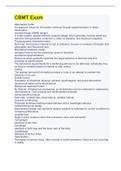
CBMT Exam data-based model An approach based on information retrieved through experimentation or direct observation reversal design (ABAB design) A single subject, applied behavior analysis design which generally involves observing behavior during baseline, treatment, a return to baseline, and treatment reapplied. Psychodynamic treatment model By Freud; unconscious material is root of problems, focuses on analysis of thought; free association and Rorschach test Biomedical treatment mode...
- Exam (elaborations)
- • 12 pages's •
-
CBMT•CBMT
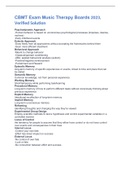
CBMT Exam Music Therapy Boards 2023, Verified Solution Psychodynamic Approach -Human behavior is based on unconscious psychological processes (impulses, desires, motives) -Early childhood events Eclectic Approach -Draw freely from all approaches without accepting the frameworks behind them -Goal: more efficient treatment Behavioral Approach -Meant to change behavior -Classical/operant conditioning -ABA: applied behavioral analysis (autism) -Positive/negative reinforcement -Punishme...
- Exam (elaborations)
- • 12 pages's •
-
CBMT•CBMT
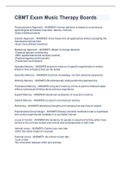
Psychodynamic Approach - ANSWER--Human behavior is based on unconscious psychological processes (impulses, desires, motives) -Early childhood events Eclectic Approach - ANSWER--Draw freely from all approaches without accepting the frameworks behind them -Goal: more efficient treatment Behavioral Approach - ANSWER--Meant to change behavior -Classical/operant conditioning -ABA: applied behavioral analysis (autism) -Positive/negative reinforcement -Punishment and Reward Episodic Memory -...
- Exam (elaborations)
- • 12 pages's •
-
CBMT•CBMT