

BIOD 171
Latest uploads at BIOD 171. Looking for notes at BIOD 171? We have lots of notes, study guides and study notes available for your school.
-
2233
- 0
-
221
All courses for BIOD 171
-
BIOD 171 18
-
BIOD 171 2200
-
BIOD 171 , 1
-
BIOD 171, 4
-
BIOD 171: 1
-
BIOD 171/ 4
Latest content BIOD 171
BIOD 171 ALL EXAMS ALL VERIFIED AND GRADED A BIOD 171 ALL EXAMS ALL VERIFIED AND GRADED A BIOD 171 ALL EXAMS ALL VERIFIED AND GRADED A
- Exam (elaborations)
- • 35 pages's •
-
BIOD 171•BIOD 171
Preview 4 out of 35 pages
Getting your document ready...
BIOD 171 ALL EXAMS ALL VERIFIED AND GRADED A BIOD 171 ALL EXAMS ALL VERIFIED AND GRADED A BIOD 171 ALL EXAMS ALL VERIFIED AND GRADED A
Module 1 Review Quiz (16 questions), BIOD 171, Portage Learning
- Exam (elaborations)
- • 4 pages's •
-
BIOD 171•BIOD 171
Preview 1 out of 4 pages
Getting your document ready...
Module 1 Review Quiz (16 questions), BIOD 171, Portage Learning
True or False: Metabolism is a controlled set of biochemical reactions that occur in living organisms in to maintain life True T/F: Enzymes are polysaccharides that catalyze chemical reactions False (enzymes are proteins) 00:48 01:24 What are usually metal ions and assists enzyme during the catalysis reaction? Cofactors Define catabolism The process of breaking down larger molecules into useful energy sources. Upon cellular injury, which metabolic process is invol...
- Exam (elaborations)
- • 3 pages's •
-
BIOD 171•BIOD 171
Preview 1 out of 3 pages
Getting your document ready...
True or False: Metabolism is a controlled set of biochemical reactions that occur in living organisms in to maintain life True T/F: Enzymes are polysaccharides that catalyze chemical reactions False (enzymes are proteins) 00:48 01:24 What are usually metal ions and assists enzyme during the catalysis reaction? Cofactors Define catabolism The process of breaking down larger molecules into useful energy sources. Upon cellular injury, which metabolic process is invol...
True/False. A virus is classified as a microbe. True True or False: The smallest biological unit of life is the molecule. False -smallest unit of life is the cell. 00:42 01:24 At a generalized level, all cells are comprised of what? Proteins, lipids, nucleic acids, and Polysaccharides How many different types of amino acids are available from which to make proteins? 20 How many amino acids are classified as being essential amino acids? 9 What are the two maj...
- Exam (elaborations)
- • 6 pages's •
-
BIOD 171•BIOD 171
Preview 2 out of 6 pages
Getting your document ready...
True/False. A virus is classified as a microbe. True True or False: The smallest biological unit of life is the molecule. False -smallest unit of life is the cell. 00:42 01:24 At a generalized level, all cells are comprised of what? Proteins, lipids, nucleic acids, and Polysaccharides How many different types of amino acids are available from which to make proteins? 20 How many amino acids are classified as being essential amino acids? 9 What are the two maj...
True or False: A virus is considered a microorganism. False. Viruses are not living and as such are not considered microorganisms. Viruses can, however, be classified as microbes, a more general term that includes microorganisms and viruses What is the smallest biological unit of life? A cell. At a generalized level, all cells are comprised of what? Macromolecules A student may also answer: Proteins, Lipids, Nucleic acids and Polysaccharides but they must answer with all four ...
- Exam (elaborations)
- • 16 pages's •
-
BIOD 171•BIOD 171
Preview 3 out of 16 pages
Getting your document ready...
True or False: A virus is considered a microorganism. False. Viruses are not living and as such are not considered microorganisms. Viruses can, however, be classified as microbes, a more general term that includes microorganisms and viruses What is the smallest biological unit of life? A cell. At a generalized level, all cells are comprised of what? Macromolecules A student may also answer: Proteins, Lipids, Nucleic acids and Polysaccharides but they must answer with all four ...
True or False. The presence of cytochrome C is often associated with aerobic bacteria. True Which STD is most often identified using the oxidase test? Gonorrhea 00:55 01:24 Using the catalase test, a Staphylococcus sample would be: Gram (+), Catalase (+ True or False. The catalase test is a qualitative and selective assay. False Fibrin is another term for _______________? blood clots Once you inoculate the rabbit plasma containing media for the coagulase tes...
- Exam (elaborations)
- • 1 pages's •
-
BIOD 171•BIOD 171
Preview 1 out of 1 pages
Getting your document ready...
True or False. The presence of cytochrome C is often associated with aerobic bacteria. True Which STD is most often identified using the oxidase test? Gonorrhea 00:55 01:24 Using the catalase test, a Staphylococcus sample would be: Gram (+), Catalase (+ True or False. The catalase test is a qualitative and selective assay. False Fibrin is another term for _______________? blood clots Once you inoculate the rabbit plasma containing media for the coagulase tes...
Microbiology is the study of what? My answer: Microbiology is the study of microorganisms and their biological processes at what is called the "micro" or "microscopic" level. Answer Key: Microbiology is the study of microbes (microorganisms and viruses) and their biological processes. What is the smallest biological unit of life? the cell 00:26 01:24 What is a macromolecule? My answer: Macromolecules are large and complicated molecules that are made up of smaller mole...
- Exam (elaborations)
- • 4 pages's •
-
BIOD 171•BIOD 171
Preview 1 out of 4 pages
Getting your document ready...
Microbiology is the study of what? My answer: Microbiology is the study of microorganisms and their biological processes at what is called the "micro" or "microscopic" level. Answer Key: Microbiology is the study of microbes (microorganisms and viruses) and their biological processes. What is the smallest biological unit of life? the cell 00:26 01:24 What is a macromolecule? My answer: Macromolecules are large and complicated molecules that are made up of smaller mole...
True or False: viruses can be classified as prokaryotic or eukaryotic False. Viruses are neither prokaryotic or eukaryotic What is an obligate intracellular parasite? viruses cannot replicate unless inside a living host cell. As a parasite, a virus depends on its living host to provide the framework (proteins, etc) to replicate—to make additional copies of itself. 00:58 01:24 What is a viral capsid? a membrane-like protective structure that contains genetic material simila...
- Exam (elaborations)
- • 7 pages's •
-
BIOD 171•BIOD 171
Preview 2 out of 7 pages
Getting your document ready...
True or False: viruses can be classified as prokaryotic or eukaryotic False. Viruses are neither prokaryotic or eukaryotic What is an obligate intracellular parasite? viruses cannot replicate unless inside a living host cell. As a parasite, a virus depends on its living host to provide the framework (proteins, etc) to replicate—to make additional copies of itself. 00:58 01:24 What is a viral capsid? a membrane-like protective structure that contains genetic material simila...
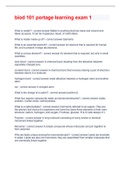
What is matter? Matter is anything that has mass and volume and takes up space. It can be in gaseous, liquid, or solid states. What is matter made up of? Elements 00:22 01:35 What is an essential element? An element that is required for human life, and is present in large abundances. What is a trace element? An element that is required, but only in small quantities. ionic bond A chemical bond resulting from the attraction between oppositely charged ions. cov...
- Exam (elaborations)
- • 5 pages's •
-
BIOD 171•BIOD 171
Preview 2 out of 5 pages
Getting your document ready...
What is matter? Matter is anything that has mass and volume and takes up space. It can be in gaseous, liquid, or solid states. What is matter made up of? Elements 00:22 01:35 What is an essential element? An element that is required for human life, and is present in large abundances. What is a trace element? An element that is required, but only in small quantities. ionic bond A chemical bond resulting from the attraction between oppositely charged ions. cov...
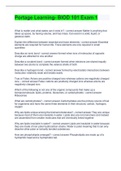
What is matter and what states can it exist in? Matter is anything that takes up space, by having volume, and has mass. Can exist in a solid, liquid, or gaseous state. Explain the difference between essential and trace elements Essential elements are required for human life. Trace elements are only required in small quantities 01:05 01:35 Describe an ionic bond formed when ions of molecules of opposite charge are attracted to one another Describe a covalent bond formed...
- Exam (elaborations)
- • 3 pages's •
-
BIOD 171•BIOD 171
Preview 1 out of 3 pages
Getting your document ready...
What is matter and what states can it exist in? Matter is anything that takes up space, by having volume, and has mass. Can exist in a solid, liquid, or gaseous state. Explain the difference between essential and trace elements Essential elements are required for human life. Trace elements are only required in small quantities 01:05 01:35 Describe an ionic bond formed when ions of molecules of opposite charge are attracted to one another Describe a covalent bond formed...