

12 class
Latest uploads at 12 class. Looking for notes at 12 class? We have lots of notes, study guides and study notes available for your school.
-
237
- 0
-
5
All courses for 12 class
Latest content 12 class
Chemistry class 12th Atoms question and numerical notes
- Book
- Class notes
- • 3 pages's •
-
12 class•12 class
-
NCERT Examplar Chemistry Class 12th • Ramashish Paul• ISBN 9789351764649
Preview 1 out of 3 pages
Getting your document ready...
Chemistry class 12th Atoms question and numerical notes
Chemistry class 12th Nuclei Question paper and numerical notes
- Book
- Class notes
- • 3 pages's •
-
12 class•12 class
-
NCERT Examplar Chemistry Class 12th • Ramashish Paul• ISBN 9789351764649
Preview 1 out of 3 pages
Getting your document ready...
Chemistry class 12th Nuclei Question paper and numerical notes
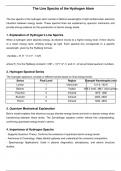
The hydrogen line spectrum consists of discrete spectral lines emitted when electrons transition between energy levels in a hydrogen atom. These lines are grouped into series, such as Lyman (UV), Balmer (visible), Paschen, Brackett, and Pfund (infrared). When an electron absorbs energy, it moves to a higher level, and upon returning to a lower level, it emits a photon of a specific wavelength. The Balmer series is visible, with lines like H-alpha (656 nm). The hydrogen spectrum supports Bohr’s...
- Book
- Class notes
- • 1 pages's •
-
12 class•12 class
-
NCERT Examplar Chemistry Class 12th • Ramashish Paul• ISBN 9789351764649
Preview 1 out of 1 pages
Getting your document ready...
The hydrogen line spectrum consists of discrete spectral lines emitted when electrons transition between energy levels in a hydrogen atom. These lines are grouped into series, such as Lyman (UV), Balmer (visible), Paschen, Brackett, and Pfund (infrared). When an electron absorbs energy, it moves to a higher level, and upon returning to a lower level, it emits a photon of a specific wavelength. The Balmer series is visible, with lines like H-alpha (656 nm). The hydrogen spectrum supports Bohr’s...
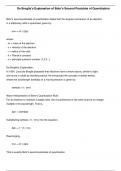
De Broglie’s explanation introduced the concept of wave-particle duality, proposing that matter, like light, exhibits both particle and wave properties. He suggested that moving particles, such as electrons, have an associated wavelength, known as the de Broglie wavelength, given by λ = h/p, where h is Planck’s constant and p is momentum. This idea explained why electrons in atoms occupy specific orbits, as only certain wavelengths fit as standing waves. His hypothesis was later confirmed b...
- Book
- Class notes
- • 2 pages's •
-
12 class•12 class
-
NCERT Examplar Chemistry Class 12th • Ramashish Paul• ISBN 9789351764649
Preview 1 out of 2 pages
Getting your document ready...
De Broglie’s explanation introduced the concept of wave-particle duality, proposing that matter, like light, exhibits both particle and wave properties. He suggested that moving particles, such as electrons, have an associated wavelength, known as the de Broglie wavelength, given by λ = h/p, where h is Planck’s constant and p is momentum. This idea explained why electrons in atoms occupy specific orbits, as only certain wavelengths fit as standing waves. His hypothesis was later confirmed b...
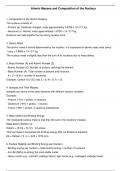
The atomic mass of an element is the total mass of its protons, neutrons, and electrons, though electrons contribute negligibly. It is measured in atomic mass units (amu), with one amu defined as one-twelfth the mass of a carbon-12 atom. The nucleus, composed of protons and neutrons (nucleons), is the dense core of an atom, responsible for most of its mass. The number of protons determines the element, while neutrons affect isotopes. Nuclear forces hold the nucleus together, overcoming proton re...
- Book
- Class notes
- • 2 pages's •
-
12 class•12 class
-
NCERT Examplar Chemistry Class 12th • Ramashish Paul• ISBN 9789351764649
Preview 1 out of 2 pages
Getting your document ready...
The atomic mass of an element is the total mass of its protons, neutrons, and electrons, though electrons contribute negligibly. It is measured in atomic mass units (amu), with one amu defined as one-twelfth the mass of a carbon-12 atom. The nucleus, composed of protons and neutrons (nucleons), is the dense core of an atom, responsible for most of its mass. The number of protons determines the element, while neutrons affect isotopes. Nuclear forces hold the nucleus together, overcoming proton re...
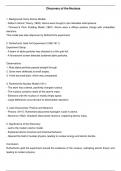
The nucleus was discovered by Ernest Rutherford in 1911 through his gold foil experiment. In this experiment, alpha particles were directed at a thin gold foil. Most passed through, but some were deflected at large angles, suggesting that atoms have a small, dense, positively charged core—the nucleus. This overturned J.J. Thomson’s plum pudding model, which proposed a diffuse positive charge. Rutherford’s discovery led to the modern atomic model, later refined by Bohr and quantum mechanics...
- Book
- Class notes
- • 1 pages's •
-
12 class•12 class
-
NCERT Examplar Chemistry Class 12th • Ramashish Paul• ISBN 9789351764649
Preview 1 out of 1 pages
Getting your document ready...
The nucleus was discovered by Ernest Rutherford in 1911 through his gold foil experiment. In this experiment, alpha particles were directed at a thin gold foil. Most passed through, but some were deflected at large angles, suggesting that atoms have a small, dense, positively charged core—the nucleus. This overturned J.J. Thomson’s plum pudding model, which proposed a diffuse positive charge. Rutherford’s discovery led to the modern atomic model, later refined by Bohr and quantum mechanics...
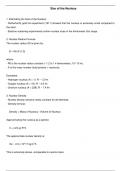
The size of a nucleus is extremely small compared to the overall atom, typically ranging from 1 to 10 femtometers (fm) in diameter. It is determined using experiments like Rutherford’s scattering and electron diffraction. The nuclear radius follows the empirical formula R = R₀ A^(1/3), where R₀ ≈ 1.2 fm and A is the mass number. Since the nucleus contains most of an atom's mass, its high density is around 10¹⁷ kg/m³. Understanding nuclear size is essential in nuclear physics, helpin...
- Book
- Class notes
- • 2 pages's •
-
12 class•12 class
-
Chemistry • Christopher N. Prescott• ISBN 9789810193270
Preview 1 out of 2 pages
Getting your document ready...
The size of a nucleus is extremely small compared to the overall atom, typically ranging from 1 to 10 femtometers (fm) in diameter. It is determined using experiments like Rutherford’s scattering and electron diffraction. The nuclear radius follows the empirical formula R = R₀ A^(1/3), where R₀ ≈ 1.2 fm and A is the mass number. Since the nucleus contains most of an atom's mass, its high density is around 10¹⁷ kg/m³. Understanding nuclear size is essential in nuclear physics, helpin...
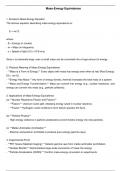
Mass-energy equivalence, expressed by Einstein’s famous equation E = mc², states that mass and energy are interchangeable. This principle means that a small amount of mass can be converted into a large amount of energy. It explains nuclear reactions, where mass defects in fission and fusion release immense energy. This concept underlies atomic bombs, nuclear power, and even energy production in stars. It also plays a crucial role in particle physics, such as in annihilation reactions where ma...
- Book
- Class notes
- • 2 pages's •
-
12 class•12 class
-
Chemistry • Christopher N. Prescott• ISBN 9789810193270
Preview 1 out of 2 pages
Getting your document ready...
Mass-energy equivalence, expressed by Einstein’s famous equation E = mc², states that mass and energy are interchangeable. This principle means that a small amount of mass can be converted into a large amount of energy. It explains nuclear reactions, where mass defects in fission and fusion release immense energy. This concept underlies atomic bombs, nuclear power, and even energy production in stars. It also plays a crucial role in particle physics, such as in annihilation reactions where ma...
Nuclear binding energy is the energy required to separate a nucleus into its individual protons and neutrons. It arises from the strong nuclear force, which holds nucleons together, overcoming electrostatic repulsion between protons. Binding energy per nucleon determines nuclear stability; iron-56 has one of the highest, making it highly stable. When lighter nuclei fuse (fusion) or heavier nuclei split (fission), energy is released due to mass-to-energy conversion, as described by Einstein’s e...
- Book
- Class notes
- • 3 pages's •
-
12 class•12 class
-
Chemistry • Christopher N. Prescott• ISBN 9789810193270
Preview 1 out of 3 pages
Getting your document ready...
Nuclear binding energy is the energy required to separate a nucleus into its individual protons and neutrons. It arises from the strong nuclear force, which holds nucleons together, overcoming electrostatic repulsion between protons. Binding energy per nucleon determines nuclear stability; iron-56 has one of the highest, making it highly stable. When lighter nuclei fuse (fusion) or heavier nuclei split (fission), energy is released due to mass-to-energy conversion, as described by Einstein’s e...
The Rutherford nuclear model, proposed by Ernest Rutherford in 1911, describes the atom as having a dense, positively charged nucleus surrounded by electrons. It was developed after the gold foil experiment, where alpha particles were fired at a thin gold foil. Most passed through, but some were deflected, indicating a small, massive nucleus. This overturned the plum pudding model and led to the modern atomic structure. However, it couldn't explain electron stability or spectral lines, later re...
- Book
- Class notes
- • 2 pages's •
-
12 class•12 class
-
Chemistry • Christopher N. Prescott• ISBN 9789810193270
Preview 1 out of 2 pages
Getting your document ready...
The Rutherford nuclear model, proposed by Ernest Rutherford in 1911, describes the atom as having a dense, positively charged nucleus surrounded by electrons. It was developed after the gold foil experiment, where alpha particles were fired at a thin gold foil. Most passed through, but some were deflected, indicating a small, massive nucleus. This overturned the plum pudding model and led to the modern atomic structure. However, it couldn't explain electron stability or spectral lines, later re...