

12 class
Latest uploads at 12 class. Looking for notes at 12 class? We have lots of notes, study guides and study notes available for your school.
-
237
- 0
-
5
All courses for 12 class
Latest content 12 class
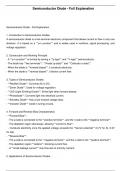
A semiconductor diode is an electronic component that allows current to flow in one direction while blocking it in the opposite direction. It consists of a p-n junction, formed by joining p-type and n-type semiconductor materials. When forward-biased (positive voltage on the p-side), the diode conducts electricity. When reverse-biased, it blocks current flow, except for a small leakage current. Diodes are used in rectification, signal processing, and voltage regulation. Special types include Zen...
- Book
- Class notes
- • 2 pages's •
-
12 class•12 class
-
NCERT Examplar Chemistry Class 12th • Ramashish Paul• ISBN 9789351764649
Preview 1 out of 2 pages
Getting your document ready...
A semiconductor diode is an electronic component that allows current to flow in one direction while blocking it in the opposite direction. It consists of a p-n junction, formed by joining p-type and n-type semiconductor materials. When forward-biased (positive voltage on the p-side), the diode conducts electricity. When reverse-biased, it blocks current flow, except for a small leakage current. Diodes are used in rectification, signal processing, and voltage regulation. Special types include Zen...
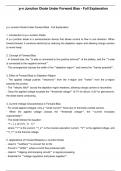
In a forward-biased p-n junction, the p-side is connected to the positive terminal and the n-side to the negative terminal of a voltage source. This reduces the depletion region and lowers the barrier potential, allowing majority charge carriers (holes in p-region, electrons in n-region) to move across the junction. As a result, current flows due to the recombination of electrons and holes. The current increases exponentially with applied voltage, following the diode equation. Forward bias is es...
- Book
- Class notes
- • 2 pages's •
-
12 class•12 class
-
NCERT Examplar Chemistry Class 12th • Ramashish Paul• ISBN 9789351764649
Preview 1 out of 2 pages
Getting your document ready...
In a forward-biased p-n junction, the p-side is connected to the positive terminal and the n-side to the negative terminal of a voltage source. This reduces the depletion region and lowers the barrier potential, allowing majority charge carriers (holes in p-region, electrons in n-region) to move across the junction. As a result, current flows due to the recombination of electrons and holes. The current increases exponentially with applied voltage, following the diode equation. Forward bias is es...
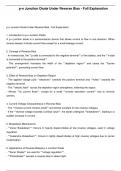
In reverse bias, a p-n junction diode is connected so that the p-side is negative and the n-side is positive, increasing the depletion region and preventing current flow. This setup creates a strong electric field that pushes charge carriers away from the junction, allowing only a small leakage current due to minority carriers. If the reverse voltage exceeds a critical value, breakdown occurs, leading to a sudden increase in current. Two main breakdown mechanisms are Zener breakdown (dominant in...
- Book
- Class notes
- • 2 pages's •
-
12 class•12 class
-
NCERT Examplar Chemistry Class 12th • Ramashish Paul• ISBN 9789351764649
Preview 1 out of 2 pages
Getting your document ready...
In reverse bias, a p-n junction diode is connected so that the p-side is negative and the n-side is positive, increasing the depletion region and preventing current flow. This setup creates a strong electric field that pushes charge carriers away from the junction, allowing only a small leakage current due to minority carriers. If the reverse voltage exceeds a critical value, breakdown occurs, leading to a sudden increase in current. Two main breakdown mechanisms are Zener breakdown (dominant in...
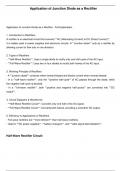
A junction diode rectifier is an electronic device that converts alternating current (AC) to direct current (DC) using a semiconductor p-n junction. In forward bias, the diode allows current flow, while in reverse bias, it blocks current, enabling rectification. There are two types: half-wave rectifiers, which allow only one half of the AC cycle, and full-wave rectifiers, which use both halves, improving efficiency. Full-wave rectification can be achieved using a bridge rectifier circuit with fo...
- Book
- Class notes
- • 2 pages's •
-
12 class•12 class
-
NCERT Examplar Chemistry Class 12th • Ramashish Paul• ISBN 9789351764649
Preview 1 out of 2 pages
Getting your document ready...
A junction diode rectifier is an electronic device that converts alternating current (AC) to direct current (DC) using a semiconductor p-n junction. In forward bias, the diode allows current flow, while in reverse bias, it blocks current, enabling rectification. There are two types: half-wave rectifiers, which allow only one half of the AC cycle, and full-wave rectifiers, which use both halves, improving efficiency. Full-wave rectification can be achieved using a bridge rectifier circuit with fo...
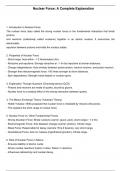
The nuclear force is the strong interaction that binds protons and neutrons together in an atomic nucleus. It overcomes the repulsive electromagnetic force between positively charged protons, holding the nucleus stable. This force is short-range, acting only at distances comparable to the size of a nucleus, and is strongest at about 1 femtometer. It is a residual effect of the strong nuclear force, which binds quarks inside protons and neutrons. The nuclear force is essential for the existence o...
- Book
- Class notes
- • 2 pages's •
-
12 class•12 class
-
NCERT Examplar Chemistry Class 12th • Ramashish Paul• ISBN 9789351764649
Preview 1 out of 2 pages
Getting your document ready...
The nuclear force is the strong interaction that binds protons and neutrons together in an atomic nucleus. It overcomes the repulsive electromagnetic force between positively charged protons, holding the nucleus stable. This force is short-range, acting only at distances comparable to the size of a nucleus, and is strongest at about 1 femtometer. It is a residual effect of the strong nuclear force, which binds quarks inside protons and neutrons. The nuclear force is essential for the existence o...
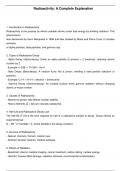
Radioactivity is the process by which unstable atomic nuclei decay, releasing energy in the form of radiation. This radiation can be alpha particles (helium nuclei), beta particles (electrons or positrons), or gamma rays (high-energy photons). Radioactive decay occurs naturally in elements like uranium, radon, and carbon-14, as well as in artificial isotopes. It has various applications, including medical imaging, cancer treatment, power generation, and archaeological dating. However, exposure t...
- Book
- Class notes
- • 2 pages's •
-
12 class•12 class
-
NCERT Examplar Chemistry Class 12th • Ramashish Paul• ISBN 9789351764649
Preview 1 out of 2 pages
Getting your document ready...
Radioactivity is the process by which unstable atomic nuclei decay, releasing energy in the form of radiation. This radiation can be alpha particles (helium nuclei), beta particles (electrons or positrons), or gamma rays (high-energy photons). Radioactive decay occurs naturally in elements like uranium, radon, and carbon-14, as well as in artificial isotopes. It has various applications, including medical imaging, cancer treatment, power generation, and archaeological dating. However, exposure t...
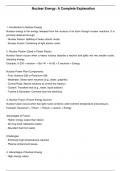
Nuclear energy is the energy released from atomic nuclei through fission or fusion. In nuclear power plants, fission splits heavy atoms like uranium-235, producing heat that generates steam to drive turbines and produce electricity. It is a low-carbon energy source, reducing greenhouse gas emissions compared to fossil fuels. However, challenges include radioactive waste disposal, nuclear accidents, and high initial costs. Fusion, the process powering the sun, could offer a safer, more sustainabl...
- Book
- Class notes
- • 2 pages's •
-
12 class•12 class
-
NCERT Examplar Chemistry Class 12th • Ramashish Paul• ISBN 9789351764649
Preview 1 out of 2 pages
Getting your document ready...
Nuclear energy is the energy released from atomic nuclei through fission or fusion. In nuclear power plants, fission splits heavy atoms like uranium-235, producing heat that generates steam to drive turbines and produce electricity. It is a low-carbon energy source, reducing greenhouse gas emissions compared to fossil fuels. However, challenges include radioactive waste disposal, nuclear accidents, and high initial costs. Fusion, the process powering the sun, could offer a safer, more sustainabl...
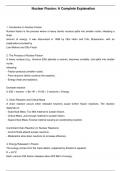
Nuclear fission is a process in which a heavy atomic nucleus, such as uranium-235 or plutonium-239, splits into two smaller nuclei when struck by a neutron. This reaction releases a large amount of energy, along with additional neutrons, which can trigger a chain reaction. The energy produced is primarily in the form of heat, which is used in nuclear power plants to generate electricity. Fission also releases radiation and radioactive byproducts. While it provides a powerful energy source, it re...
- Book
- Class notes
- • 2 pages's •
-
12 class•12 class
-
NCERT Examplar Chemistry Class 12th • Ramashish Paul• ISBN 9789351764649
Preview 1 out of 2 pages
Getting your document ready...
Nuclear fission is a process in which a heavy atomic nucleus, such as uranium-235 or plutonium-239, splits into two smaller nuclei when struck by a neutron. This reaction releases a large amount of energy, along with additional neutrons, which can trigger a chain reaction. The energy produced is primarily in the form of heat, which is used in nuclear power plants to generate electricity. Fission also releases radiation and radioactive byproducts. While it provides a powerful energy source, it re...
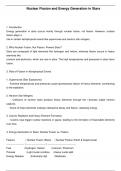
Nuclear fission, the splitting of heavy atomic nuclei, powers nuclear reactors on Earth but does not occur naturally in stars. Instead, stars generate energy through nuclear fusion, where lighter nuclei (like hydrogen) fuse into heavier ones (like helium), releasing vast amounts of energy. In massive stars, fusion continues up to iron, beyond which energy production ceases, leading to supernova explosions and the formation of neutron stars or black holes. While fission occurs in artificial setti...
- Book
- Class notes
- • 2 pages's •
-
12 class•12 class
-
NCERT Examplar Chemistry Class 12th • Ramashish Paul• ISBN 9789351764649
Preview 1 out of 2 pages
Getting your document ready...
Nuclear fission, the splitting of heavy atomic nuclei, powers nuclear reactors on Earth but does not occur naturally in stars. Instead, stars generate energy through nuclear fusion, where lighter nuclei (like hydrogen) fuse into heavier ones (like helium), releasing vast amounts of energy. In massive stars, fusion continues up to iron, beyond which energy production ceases, leading to supernova explosions and the formation of neutron stars or black holes. While fission occurs in artificial setti...
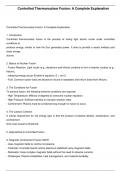
Controlled thermonuclear fusion is the process of fusing atomic nuclei under high temperature and pressure to release energy, mimicking the Sun’s power source. It aims to provide a nearly limitless, clean energy supply with minimal radioactive waste. Fusion requires extreme conditions—millions of degrees Celsius—to overcome electrostatic repulsion between nuclei. Current approaches include magnetic confinement (e.g., tokamaks) and inertial confinement (e.g., laser-driven fusion). Despite d...
- Book
- Class notes
- • 2 pages's •
-
12 class•12 class
-
NCERT Examplar Chemistry Class 12th • Ramashish Paul• ISBN 9789351764649
Preview 1 out of 2 pages
Getting your document ready...
Controlled thermonuclear fusion is the process of fusing atomic nuclei under high temperature and pressure to release energy, mimicking the Sun’s power source. It aims to provide a nearly limitless, clean energy supply with minimal radioactive waste. Fusion requires extreme conditions—millions of degrees Celsius—to overcome electrostatic repulsion between nuclei. Current approaches include magnetic confinement (e.g., tokamaks) and inertial confinement (e.g., laser-driven fusion). Despite d...