

12 class
Latest uploads at 12 class. Looking for notes at 12 class? We have lots of notes, study guides and study notes available for your school.
-
237
- 0
-
5
All courses for 12 class
Latest content 12 class
Solubility of a solid in a liquid refers to the maximum amount of the solid that can dissolve in a given quantity of liquid at a specific temperature and pressure. It depends on factors such as temperature, nature of the solute and solvent, and presence of other substances. Generally, solubility increases with temperature for most solids, as higher temperatures provide more energy to break intermolecular bonds. The solubility is also influenced by polarity—polar solids dissolve better in polar...
- Book
- Class notes
- • 2 pages's •
-
12 class•12 class
-
NCERT Examplar Chemistry Class 12th • Ramashish Paul• ISBN 9789351764649
Preview 1 out of 2 pages
Getting your document ready...
Solubility of a solid in a liquid refers to the maximum amount of the solid that can dissolve in a given quantity of liquid at a specific temperature and pressure. It depends on factors such as temperature, nature of the solute and solvent, and presence of other substances. Generally, solubility increases with temperature for most solids, as higher temperatures provide more energy to break intermolecular bonds. The solubility is also influenced by polarity—polar solids dissolve better in polar...
The solubility of a gas in a liquid refers to the amount of gas that dissolves in a liquid at a given temperature and pressure. It follows Henry’s Law, which states that the solubility of a gas (C) is directly proportional to its partial pressure (P) over the liquid: C = kP, where k is Henry’s constant. Higher pressure increases gas solubility, while higher temperature decreases it due to increased kinetic energy. Factors like nature of gas, liquid, and presence of other solutes also affect ...
- Book
- Class notes
- • 2 pages's •
-
12 class•12 class
-
NCERT Examplar Chemistry Class 12th • Ramashish Paul• ISBN 9789351764649
Preview 1 out of 2 pages
Getting your document ready...
The solubility of a gas in a liquid refers to the amount of gas that dissolves in a liquid at a given temperature and pressure. It follows Henry’s Law, which states that the solubility of a gas (C) is directly proportional to its partial pressure (P) over the liquid: C = kP, where k is Henry’s constant. Higher pressure increases gas solubility, while higher temperature decreases it due to increased kinetic energy. Factors like nature of gas, liquid, and presence of other solutes also affect ...
Vapor pressure of a liquid solution is the pressure exerted by its vapor when the liquid and vapor phases are in equilibrium. It depends on the nature of the components and their concentration. According to Raoult’s Law, the vapor pressure of an ideal solution is the sum of the partial pressures of each component, given by P_total = P_A X_A + P_B X_B, where P_A and P_B are the vapor pressures of pure components, and X_A and X_B are their mole fractions.** Non-ideal solutions** show positive or...
- Book
- Class notes
- • 2 pages's •
-
12 class•12 class
-
NCERT Examplar Chemistry Class 12th • Ramashish Paul• ISBN 9789351764649
Preview 1 out of 2 pages
Getting your document ready...
Vapor pressure of a liquid solution is the pressure exerted by its vapor when the liquid and vapor phases are in equilibrium. It depends on the nature of the components and their concentration. According to Raoult’s Law, the vapor pressure of an ideal solution is the sum of the partial pressures of each component, given by P_total = P_A X_A + P_B X_B, where P_A and P_B are the vapor pressures of pure components, and X_A and X_B are their mole fractions.** Non-ideal solutions** show positive or...
Materials are classified into metals, semiconductors, and insulators based on their electrical conductivity and band structure. Metals (e.g., copper, silver) have high conductivity due to free electrons in their overlapping valence and conduction bands. Insulators (e.g., rubber, glass) have a wide band gap, preventing electron flow. Semiconductors (e.g., silicon, germanium) have a moderate band gap, allowing controlled conductivity, which increases with temperature or doping. Semiconductors are ...
- Book
- Class notes
- • 3 pages's •
-
12 class•12 class
-
NCERT Examplar Chemistry Class 12th • Ramashish Paul• ISBN 9789351764649
Preview 1 out of 3 pages
Getting your document ready...
Materials are classified into metals, semiconductors, and insulators based on their electrical conductivity and band structure. Metals (e.g., copper, silver) have high conductivity due to free electrons in their overlapping valence and conduction bands. Insulators (e.g., rubber, glass) have a wide band gap, preventing electron flow. Semiconductors (e.g., silicon, germanium) have a moderate band gap, allowing controlled conductivity, which increases with temperature or doping. Semiconductors are ...
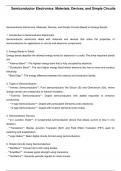
Semiconductor electronics is the foundation of modern technology, utilizing semiconductors like silicon (Si) and germanium (Ge) to create electronic components. Semiconductors can be intrinsic (pure) or extrinsic (doped with impurities) to form p-type and n-type materials. The P-N junction enables key devices like diodes, transistors, and integrated circuits (ICs), which are essential in computers, communication, and power systems. Their ability to control current flow, amplify signals, and perf...
- Book
- Class notes
- • 2 pages's •
-
12 class•12 class
-
NCERT Examplar Chemistry Class 12th • Ramashish Paul• ISBN 9789351764649
Preview 1 out of 2 pages
Getting your document ready...
Semiconductor electronics is the foundation of modern technology, utilizing semiconductors like silicon (Si) and germanium (Ge) to create electronic components. Semiconductors can be intrinsic (pure) or extrinsic (doped with impurities) to form p-type and n-type materials. The P-N junction enables key devices like diodes, transistors, and integrated circuits (ICs), which are essential in computers, communication, and power systems. Their ability to control current flow, amplify signals, and perf...
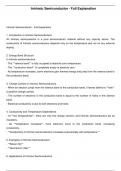
An intrinsic semiconductor is a pure semiconductor material, such as silicon (Si) or germanium (Ge), without any intentional doping. Its electrical conductivity depends solely on thermal excitation, where heat energy excites some electrons from the valence band to the conduction band, creating electron-hole pairs. In intrinsic semiconductors, the number of electrons and holes is equal, making them less conductive than extrinsic semiconductors. Their conductivity increases with temperature. Intri...
- Book
- Class notes
- • 2 pages's •
-
12 class•12 class
-
NCERT Examplar Chemistry Class 12th • Ramashish Paul• ISBN 9789351764649
Preview 1 out of 2 pages
Getting your document ready...
An intrinsic semiconductor is a pure semiconductor material, such as silicon (Si) or germanium (Ge), without any intentional doping. Its electrical conductivity depends solely on thermal excitation, where heat energy excites some electrons from the valence band to the conduction band, creating electron-hole pairs. In intrinsic semiconductors, the number of electrons and holes is equal, making them less conductive than extrinsic semiconductors. Their conductivity increases with temperature. Intri...
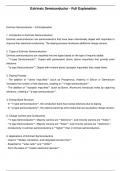
An extrinsic semiconductor is a doped semiconductor where impurities are intentionally added to enhance electrical conductivity. Based on the type of impurity, it can be n-type (doped with pentavalent atoms like phosphorus, adding free electrons) or p-type (doped with trivalent atoms like boron, creating holes). The doping process introduces additional charge carriers, significantly increasing conductivity compared to intrinsic semiconductors, which rely only on thermally generated carriers. Ext...
- Book
- Class notes
- • 1 pages's •
-
12 class•12 class
-
NCERT Examplar Chemistry Class 12th • Ramashish Paul• ISBN 9789351764649
Preview 1 out of 1 pages
Getting your document ready...
An extrinsic semiconductor is a doped semiconductor where impurities are intentionally added to enhance electrical conductivity. Based on the type of impurity, it can be n-type (doped with pentavalent atoms like phosphorus, adding free electrons) or p-type (doped with trivalent atoms like boron, creating holes). The doping process introduces additional charge carriers, significantly increasing conductivity compared to intrinsic semiconductors, which rely only on thermally generated carriers. Ext...
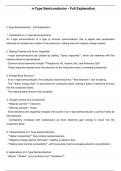
An n-type semiconductor is created by doping a pure semiconductor like silicon (Si) or germanium (Ge) with a pentavalent impurity such as phosphorus (P), arsenic (As), or antimony (Sb). These atoms have five valence electrons, with four forming bonds with the silicon lattice, leaving an extra free electron available for conduction. As a result, electrons become the majority charge carriers, while holes are the minority carriers. N-type semiconductors have higher conductivity due to the availabil...
- Book
- Class notes
- • 2 pages's •
-
12 class•12 class
-
NCERT Examplar Chemistry Class 12th • Ramashish Paul• ISBN 9789351764649
Preview 1 out of 2 pages
Getting your document ready...
An n-type semiconductor is created by doping a pure semiconductor like silicon (Si) or germanium (Ge) with a pentavalent impurity such as phosphorus (P), arsenic (As), or antimony (Sb). These atoms have five valence electrons, with four forming bonds with the silicon lattice, leaving an extra free electron available for conduction. As a result, electrons become the majority charge carriers, while holes are the minority carriers. N-type semiconductors have higher conductivity due to the availabil...
A p-type semiconductor is formed by doping a pure semiconductor, like silicon (Si) or germanium (Ge), with a trivalent impurity such as boron (B), aluminum (Al), or gallium (Ga). These impurities create holes, which act as the majority charge carriers. Since trivalent atoms have only three valence electrons, they cannot fully bond with the four-valent silicon atoms, leaving a vacant electron spot (hole). Electrons from neighboring atoms can move into these holes, allowing electrical conduction. ...
- Book
- Class notes
- • 2 pages's •
-
12 class•12 class
-
NCERT Examplar Chemistry Class 12th • Ramashish Paul• ISBN 9789351764649
Preview 1 out of 2 pages
Getting your document ready...
A p-type semiconductor is formed by doping a pure semiconductor, like silicon (Si) or germanium (Ge), with a trivalent impurity such as boron (B), aluminum (Al), or gallium (Ga). These impurities create holes, which act as the majority charge carriers. Since trivalent atoms have only three valence electrons, they cannot fully bond with the four-valent silicon atoms, leaving a vacant electron spot (hole). Electrons from neighboring atoms can move into these holes, allowing electrical conduction. ...
A P-N junction forms when a p-type and n-type semiconductor are joined together, creating a boundary where charge carriers diffuse. Electrons from the n-side move to the p-side, and holes from the p-side migrate to the n-side, leading to charge recombination. This process leaves behind an immobile ionized region called the depletion region, which acts as an electric field preventing further carrier movement. This junction enables rectification, allowing current to flow in one direction (forward ...
- Book
- Class notes
- • 2 pages's •
-
12 class•12 class
-
NCERT Examplar Chemistry Class 12th • Ramashish Paul• ISBN 9789351764649
Preview 1 out of 2 pages
Getting your document ready...
A P-N junction forms when a p-type and n-type semiconductor are joined together, creating a boundary where charge carriers diffuse. Electrons from the n-side move to the p-side, and holes from the p-side migrate to the n-side, leading to charge recombination. This process leaves behind an immobile ionized region called the depletion region, which acts as an electric field preventing further carrier movement. This junction enables rectification, allowing current to flow in one direction (forward ...