

12 class
Latest uploads at 12 class. Looking for notes at 12 class? We have lots of notes, study guides and study notes available for your school.
-
237
- 0
-
5
All courses for 12 class
Latest content 12 class
- Book
- Class notes
- • 2 pages's •
-
12 class•12 class
-
NCERT Examplar Chemistry Class 12th • Ramashish Paul• ISBN 9789351764649
Preview 1 out of 2 pages
Getting your document ready...
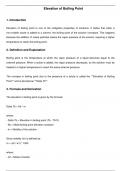
Elevation of the boiling point is a colligative property where the boiling point of a solvent increases when a non-volatile solute is added. This occurs because solute particles disrupt solvent molecules at the surface, requiring more energy (higher temperature) to convert the liquid into vapor. The increase in boiling point depends on the solute concentration and its van 't Hoff factor (degree of dissociation). This phenomenon is described by ΔTb = iKb m, where Kb is the boiling point elevati...
- Book
- Class notes
- • 2 pages's •
-
12 class•12 class
-
NCERT Examplar Chemistry Class 12th • Ramashish Paul• ISBN 9789351764649
Preview 1 out of 2 pages
Getting your document ready...
Elevation of the boiling point is a colligative property where the boiling point of a solvent increases when a non-volatile solute is added. This occurs because solute particles disrupt solvent molecules at the surface, requiring more energy (higher temperature) to convert the liquid into vapor. The increase in boiling point depends on the solute concentration and its van 't Hoff factor (degree of dissociation). This phenomenon is described by ΔTb = iKb m, where Kb is the boiling point elevati...
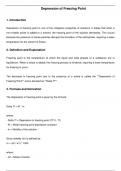
Depression of the freezing point is a colligative property in which the freezing point of a solvent decreases when a solute is added. This occurs because solute particles disrupt the formation of a solid crystalline structure, requiring a lower temperature for freezing. The extent of freezing point depression depends on the solute concentration and its van 't Hoff factor (number of particles it dissociates into). This principle is used in applications such as antifreeze in car engines, de-icing...
- Book
- Class notes
- • 2 pages's •
-
12 class•12 class
-
NCERT Examplar Chemistry Class 12th • Ramashish Paul• ISBN 9789351764649
Preview 1 out of 2 pages
Getting your document ready...
Depression of the freezing point is a colligative property in which the freezing point of a solvent decreases when a solute is added. This occurs because solute particles disrupt the formation of a solid crystalline structure, requiring a lower temperature for freezing. The extent of freezing point depression depends on the solute concentration and its van 't Hoff factor (number of particles it dissociates into). This principle is used in applications such as antifreeze in car engines, de-icing...
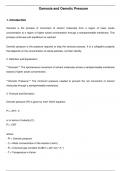
Osmosis is the movement of water molecules through a semipermeable membrane from a region of lower solute concentration to higher concentration, aiming to equalize concentrations on both sides. This natural process is essential in biological systems, such as nutrient absorption in cells. Osmotic pressure is the pressure required to stop this water movement. It depends on solute concentration—the higher the concentration, the greater the osmotic pressure. This principle is used in medical treat...
- Book
- Class notes
- • 2 pages's •
-
12 class•12 class
-
NCERT Examplar Chemistry Class 12th • Ramashish Paul• ISBN 9789351764649
Preview 1 out of 2 pages
Getting your document ready...
Osmosis is the movement of water molecules through a semipermeable membrane from a region of lower solute concentration to higher concentration, aiming to equalize concentrations on both sides. This natural process is essential in biological systems, such as nutrient absorption in cells. Osmotic pressure is the pressure required to stop this water movement. It depends on solute concentration—the higher the concentration, the greater the osmotic pressure. This principle is used in medical treat...
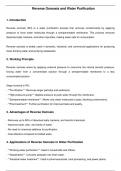
Reverse osmosis (RO) is a water purification process that removes contaminants by using pressure to force water through a semipermeable membrane. This membrane blocks impurities such as bacteria, viruses, salts, and chemicals, allowing only pure water molecules to pass through. RO is widely used for drinking water purification, wastewater treatment, and desalination. It effectively removes heavy metals, chlorine, and dissolved solids, improving taste and safety. However, the process produces was...
- Book
- Class notes
- • 2 pages's •
-
12 class•12 class
-
NCERT Examplar Chemistry Class 12th • Ramashish Paul• ISBN 9789351764649
Preview 1 out of 2 pages
Getting your document ready...
Reverse osmosis (RO) is a water purification process that removes contaminants by using pressure to force water through a semipermeable membrane. This membrane blocks impurities such as bacteria, viruses, salts, and chemicals, allowing only pure water molecules to pass through. RO is widely used for drinking water purification, wastewater treatment, and desalination. It effectively removes heavy metals, chlorine, and dissolved solids, improving taste and safety. However, the process produces was...
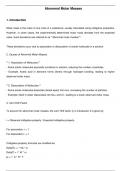
Abnormal molar masses occur when a substance’s experimentally determined molar mass differs from its theoretical value. This deviation is often caused by molecular association or dissociation in a solution. Association happens when molecules cluster together, increasing the observed molar mass, while dissociation occurs when compounds break into smaller particles, reducing the molar mass. Factors like intermolecular forces, ionization, and colligative properties influence these anomalies. Elec...
- Book
- Class notes
- • 2 pages's •
-
12 class•12 class
-
NCERT Examplar Chemistry Class 12th • Ramashish Paul• ISBN 9789351764649
Preview 1 out of 2 pages
Getting your document ready...
Abnormal molar masses occur when a substance’s experimentally determined molar mass differs from its theoretical value. This deviation is often caused by molecular association or dissociation in a solution. Association happens when molecules cluster together, increasing the observed molar mass, while dissociation occurs when compounds break into smaller particles, reducing the molar mass. Factors like intermolecular forces, ionization, and colligative properties influence these anomalies. Elec...
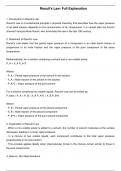
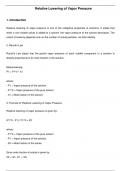
Raoult’s Law states that in an ideal solution, the partial vapor pressure of each volatile component is proportional to its mole fraction in the liquid phase and its pure vapor pressure. Mathematically, P_A = X_A * P_A⁰, where P_A is the partial pressure, X_A is the mole fraction, and P_A⁰ is the pure component’s vapor pressure. This law explains colligative properties like vapor pressure lowering, boiling point elevation, and freezing point depression. It is most accurate for ideal solu...
- Book
- Class notes
- • 2 pages's •
-
12 class•12 class
-
NCERT Examplar Chemistry Class 12th • Ramashish Paul• ISBN 9789351764649
Preview 1 out of 2 pages
Getting your document ready...
Raoult’s Law states that in an ideal solution, the partial vapor pressure of each volatile component is proportional to its mole fraction in the liquid phase and its pure vapor pressure. Mathematically, P_A = X_A * P_A⁰, where P_A is the partial pressure, X_A is the mole fraction, and P_A⁰ is the pure component’s vapor pressure. This law explains colligative properties like vapor pressure lowering, boiling point elevation, and freezing point depression. It is most accurate for ideal solu...
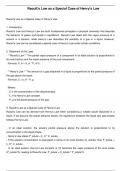
Raoult's Law states that the partial vapor pressure of a component in an ideal liquid mixture is proportional to its mole fraction and its pure vapor pressure. It explains how the presence of a solute lowers the vapor pressure of a solvent. Henry's Law states that the amount of gas dissolved in a liquid is directly proportional to its partial pressure above the liquid, given constant temperature. It explains gas solubility in liquids, such as oxygen in water. Both laws describe equilibri...
- Book
- Class notes
- • 2 pages's •
-
12 class•12 class
-
NCERT Examplar Chemistry Class 12th • Ramashish Paul• ISBN 9789351764649
Preview 1 out of 2 pages
Getting your document ready...
Raoult's Law states that the partial vapor pressure of a component in an ideal liquid mixture is proportional to its mole fraction and its pure vapor pressure. It explains how the presence of a solute lowers the vapor pressure of a solvent. Henry's Law states that the amount of gas dissolved in a liquid is directly proportional to its partial pressure above the liquid, given constant temperature. It explains gas solubility in liquids, such as oxygen in water. Both laws describe equilibri...
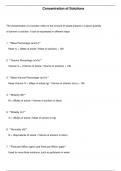
The concentration of a solution refers to the amount of solute dissolved in a given quantity of solvent or solution. It is commonly expressed in terms of molarity (moles of solute per liter of solution), molality (moles of solute per kilogram of solvent), mass percent, volume percent, or parts per million (ppm). A solution can be dilute (low solute concentration) or concentrated (high solute concentration). Temperature and pressure can affect concentration, especially for gases. Dilution involve...
- Book
- Class notes
- • 2 pages's •
-
12 class•12 class
-
NCERT Examplar Chemistry Class 12th • Ramashish Paul• ISBN 9789351764649
Preview 1 out of 2 pages
Getting your document ready...
The concentration of a solution refers to the amount of solute dissolved in a given quantity of solvent or solution. It is commonly expressed in terms of molarity (moles of solute per liter of solution), molality (moles of solute per kilogram of solvent), mass percent, volume percent, or parts per million (ppm). A solution can be dilute (low solute concentration) or concentrated (high solute concentration). Temperature and pressure can affect concentration, especially for gases. Dilution involve...
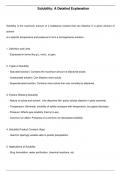
Solubility is the ability of a substance (solute) to dissolve in a solvent to form a homogeneous solution. It depends on factors like temperature, pressure, and the nature of both solute and solvent. For solids in liquids, solubility usually increases with temperature, while for gases, it decreases. Polar solutes dissolve in polar solvents (e.g., sugar in water), while non-polar solutes dissolve in non-polar solvents (e.g., oil in benzene). A solution becomes saturated when it holds the maximum ...
- Book
- Class notes
- • 1 pages's •
-
12 class•12 class
-
Chemistry class 11th & 12th 2.o • Vivek• ISBN 9781638867340
Preview 1 out of 1 pages
Getting your document ready...
Solubility is the ability of a substance (solute) to dissolve in a solvent to form a homogeneous solution. It depends on factors like temperature, pressure, and the nature of both solute and solvent. For solids in liquids, solubility usually increases with temperature, while for gases, it decreases. Polar solutes dissolve in polar solvents (e.g., sugar in water), while non-polar solutes dissolve in non-polar solvents (e.g., oil in benzene). A solution becomes saturated when it holds the maximum ...