

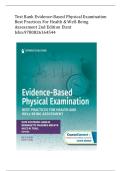
Test Bank Evidence-Based Physical Examination
Best Practices For Health & Well-Being
Assessment 2nd Edition Etext
Isbn:9780826164544
,Table Of Contents
Part I: Foundations of Clinical Practice
1. Approach to Evidence-Based Assessment of Health and Well-Being
2. Evidence-Based History-Taking Approach for Wellness Exams,
Episodic Visits, and Chronic Care Management
3. Approach to Implementing and Documenting Patient-Centered,
Culturally Sensitive Evidence-Based Assessment
4. Evidence-Based Assessment of Children and Adolescents
5. Approach to the Physical Examination: General Survey and
Assessment of Vital Signs
Part II: Evidence-Based Physical Examination and Assessment of Body
Systems
6. Evidence-Based Assessment of the Heart and Circulatory System
7. Evidence-Based Assessment of the Lungs and Respiratory System
8. Approach to Evidence-Based Assessment of Body Habitus (Height,
Weight, Body Mass Index, Nutrition)
9. Evidence-Based Assessment of Skin, Hair, and Nails
10. Evidence-Based Assessment of the Lymphatic System
11. Evidence-Based Assessment of the Head and Neck
12. Evidence-Based Assessment of the Eye
13. Evidence-Based Assessment of the Ears, Nose, and Throat
14. Evidence-Based Assessment of the Nervous System
15. Evidence-Based Assessment of the Musculoskeletal System
16. Evidence-Based Assessment of the Abdominal, Gastrointestinal, and
Urological Systems
17. Evidence-Based Assessment of the Breasts and Axillae
18. Evidence-Based Assessment of Sexual Orientation, Gender Identity,
and Health
19. Evidence-Based Assessment of Male Genitalia, Prostate, Rectum,
and Anus
20. Evidence-Based Assessment of the Female Genitourinary System
21. Evidence-Based Obstetric Assessment
Part IV: Evidence-Based Physical Examination and Assessment of
Mental Health
22. Evidence-Based Assessment of Mental Health
23. Evidence-Based Assessment of Substance Use Disorder
,24. Evidence-Based Assessment and Screening for Traumatic
Experiences: Abuse, Neglect, and Intimate Partner Violence
25. Evidence-Based Therapeutic Communication and Motivational
Interviewing in Health Assessment
Part V: Special Topics in Evidence-Based Assessment
26. Evidence-Based History and Physical Examinations for Sports
Participation Evaluation
27. Using Health Technology in Evidence-Based Assessment
28. Evidence-Based Assessment of Personal Health and Well-Being for
Clinicians: Key Strategies to Achieve Optimal Wellness
29. Evidence-Based Health and Well-Being Assessment: Putting it All
Together
, Chapter 1. Approach To Evidence-Based Assessment Of Health And Well- Being
Multiple Choice
1. After Completing An Initial Assessment Of A Patient, The Nurse Has Charted That His
Respirations Are Eupneic And His Pulse Is 58 Beats Per Minute. These Types Of Data Would
Be:
A Objective.
.
B Reflective.
.
C Subjective.
.
D Introspective.
.
Answer: A
Objective Data Are What The Health Professional Observes By Inspecting, Percussing,
Palpating, And Auscultating During The Physical Examination. Subjective Data Is What The
Person Says About Him Or Herself During History Taking. The Terms Reflective And
Introspective Are Not Used To Describe Data.
Dif: Cognitive Level: Understanding (Comprehension) Ref: Z. 2
Msc: Client Needs: Safe And Effective Care Environment: Management Of Care
2. A Patient Tells The Nurse That He Is Very Nervous, Is Nauseated, And Feels Hot. These
Types Of Data Would Be:
A Objective.
.
B Reflective.
.
C Subjective.
.
D Introspective.
.
Answer: C
Subjective Data Are What The Person Says About Him Or Herself During History Taking. Objective
Best Practices For Health & Well-Being
Assessment 2nd Edition Etext
Isbn:9780826164544
,Table Of Contents
Part I: Foundations of Clinical Practice
1. Approach to Evidence-Based Assessment of Health and Well-Being
2. Evidence-Based History-Taking Approach for Wellness Exams,
Episodic Visits, and Chronic Care Management
3. Approach to Implementing and Documenting Patient-Centered,
Culturally Sensitive Evidence-Based Assessment
4. Evidence-Based Assessment of Children and Adolescents
5. Approach to the Physical Examination: General Survey and
Assessment of Vital Signs
Part II: Evidence-Based Physical Examination and Assessment of Body
Systems
6. Evidence-Based Assessment of the Heart and Circulatory System
7. Evidence-Based Assessment of the Lungs and Respiratory System
8. Approach to Evidence-Based Assessment of Body Habitus (Height,
Weight, Body Mass Index, Nutrition)
9. Evidence-Based Assessment of Skin, Hair, and Nails
10. Evidence-Based Assessment of the Lymphatic System
11. Evidence-Based Assessment of the Head and Neck
12. Evidence-Based Assessment of the Eye
13. Evidence-Based Assessment of the Ears, Nose, and Throat
14. Evidence-Based Assessment of the Nervous System
15. Evidence-Based Assessment of the Musculoskeletal System
16. Evidence-Based Assessment of the Abdominal, Gastrointestinal, and
Urological Systems
17. Evidence-Based Assessment of the Breasts and Axillae
18. Evidence-Based Assessment of Sexual Orientation, Gender Identity,
and Health
19. Evidence-Based Assessment of Male Genitalia, Prostate, Rectum,
and Anus
20. Evidence-Based Assessment of the Female Genitourinary System
21. Evidence-Based Obstetric Assessment
Part IV: Evidence-Based Physical Examination and Assessment of
Mental Health
22. Evidence-Based Assessment of Mental Health
23. Evidence-Based Assessment of Substance Use Disorder
,24. Evidence-Based Assessment and Screening for Traumatic
Experiences: Abuse, Neglect, and Intimate Partner Violence
25. Evidence-Based Therapeutic Communication and Motivational
Interviewing in Health Assessment
Part V: Special Topics in Evidence-Based Assessment
26. Evidence-Based History and Physical Examinations for Sports
Participation Evaluation
27. Using Health Technology in Evidence-Based Assessment
28. Evidence-Based Assessment of Personal Health and Well-Being for
Clinicians: Key Strategies to Achieve Optimal Wellness
29. Evidence-Based Health and Well-Being Assessment: Putting it All
Together
, Chapter 1. Approach To Evidence-Based Assessment Of Health And Well- Being
Multiple Choice
1. After Completing An Initial Assessment Of A Patient, The Nurse Has Charted That His
Respirations Are Eupneic And His Pulse Is 58 Beats Per Minute. These Types Of Data Would
Be:
A Objective.
.
B Reflective.
.
C Subjective.
.
D Introspective.
.
Answer: A
Objective Data Are What The Health Professional Observes By Inspecting, Percussing,
Palpating, And Auscultating During The Physical Examination. Subjective Data Is What The
Person Says About Him Or Herself During History Taking. The Terms Reflective And
Introspective Are Not Used To Describe Data.
Dif: Cognitive Level: Understanding (Comprehension) Ref: Z. 2
Msc: Client Needs: Safe And Effective Care Environment: Management Of Care
2. A Patient Tells The Nurse That He Is Very Nervous, Is Nauseated, And Feels Hot. These
Types Of Data Would Be:
A Objective.
.
B Reflective.
.
C Subjective.
.
D Introspective.
.
Answer: C
Subjective Data Are What The Person Says About Him Or Herself During History Taking. Objective


