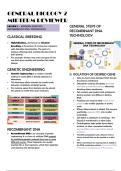
GENERAL BIOLOGY 2
MIDTERM REVIEWER
LESSON 1 – MODERN GENETICS: GENERAL STEPS OF
RECOMBINANT DNA TECHNOLOGY
RECOMBINANT DNA
CLASSICAL BREEDING TECHNOLOGY
• Hybridization, also known as classical
breeding, is the process of crossing two organisms
with desirable characteristics. The goal is to
produce offsprings that combine the best traits of
both parents.
• For example, farmers may cross two types of rice:
one that grows quickly and another that resists
disease.
GENETIC ENGINEERING
• Genetic engineering is a modern scientific 1) ISOLATION OF DESIRED GENE
method in which DNA is directly altered in a
• Cells are lysed using detergent that disrupts
laboratory.
the plasma membrane.
• This technique allows scientists to transfer traits
• Detergents work by disrupting lipid-lipid
between completely unrelated species.
and lipid-protein interactions, effectively
• For instance, genes from bacteria can be placed
dissolving these membranes.
into plants to make them pest-resistance.
• Cell contents are treated with protease to
destroy protein, and RNase to destroy
RNA.
• Proteases are enzymes that break down
proteins into smaller peptides or amino
acids.
• RNase (ribonuclease) is added. This enzyme
specifically degrades RNA into smaller
nucleotides.
• Cell debris is pelleted in a centrifuge. The
(liquid) is transferred to a clean tube.
• Centrifugation helps pellet down debris,
proteins, or other unwanted materials,
RECOMBINANT DNA leaving DNA in the supernatant (liquid
portion).
• Recombinant DNA is an example of genetic
• The DNA precipitated with ethanol. It forms
engineering. It is a form of artificial DNA created viscous strands that can be spooled on a glass
by combining genetic material from two or more rod.
different sources. These fragments are usually • When cold ethanol (or isopropanol) is added to
inserted into a host organism, which then replicates the DNA-containing solution, it causes the DNA
and expresses the desired gene. molecules to precipitate out of the solution.
, 2) CUTTING DNA WITH
RESTRICTION ENZYMES
• Restriction enzymes cut DNA at specific
sequences known as restriction sites,
creating either sticky ends (single-stranded
overhangs) or blunt ends (straight cuts).
These bacterial enzymes are crucial for
genetic engineering and recombinant DNA
technology, allowing scientists to isolate
genes, analyze DNA, and combine DNA
from different sources by joining fragments
3) SELECTION AND INSERTION
with complementary sticky ends. INTO A VECTOR
• HOW THEY WORK: • A vector is a DNA molecule used as a tool
a. Recognition – each restriction enzyme to carry foreign genetic material into
recognizes and binds to a specific, another cell, where it can be replicated or
unique DNA sequence expressed.
b. Cutting – the enzyme then cleaves • Smaller vectors are easier to manipulate
(cuts) both strands of the DNA and are more stable in host cells.
molecule at that precise restriction site • Plasmid – is a small, circular, double-
c. End formation – the way the enzyme stranded DNA molecule that is distinct
cuts determine the type of end from cell’s chromosomal DNA Plasmids
produced. naturally exist in bacterial cells.
1. Sticky Ends – some enzymes make
a staggered cut, resulting in short,
single-stranded overhangs on each
fragment.
2. Blunt Ends – other enzymes cut
straight across both DNA strands,
creating fragments with no
overhangs.
MIDTERM REVIEWER
LESSON 1 – MODERN GENETICS: GENERAL STEPS OF
RECOMBINANT DNA TECHNOLOGY
RECOMBINANT DNA
CLASSICAL BREEDING TECHNOLOGY
• Hybridization, also known as classical
breeding, is the process of crossing two organisms
with desirable characteristics. The goal is to
produce offsprings that combine the best traits of
both parents.
• For example, farmers may cross two types of rice:
one that grows quickly and another that resists
disease.
GENETIC ENGINEERING
• Genetic engineering is a modern scientific 1) ISOLATION OF DESIRED GENE
method in which DNA is directly altered in a
• Cells are lysed using detergent that disrupts
laboratory.
the plasma membrane.
• This technique allows scientists to transfer traits
• Detergents work by disrupting lipid-lipid
between completely unrelated species.
and lipid-protein interactions, effectively
• For instance, genes from bacteria can be placed
dissolving these membranes.
into plants to make them pest-resistance.
• Cell contents are treated with protease to
destroy protein, and RNase to destroy
RNA.
• Proteases are enzymes that break down
proteins into smaller peptides or amino
acids.
• RNase (ribonuclease) is added. This enzyme
specifically degrades RNA into smaller
nucleotides.
• Cell debris is pelleted in a centrifuge. The
(liquid) is transferred to a clean tube.
• Centrifugation helps pellet down debris,
proteins, or other unwanted materials,
RECOMBINANT DNA leaving DNA in the supernatant (liquid
portion).
• Recombinant DNA is an example of genetic
• The DNA precipitated with ethanol. It forms
engineering. It is a form of artificial DNA created viscous strands that can be spooled on a glass
by combining genetic material from two or more rod.
different sources. These fragments are usually • When cold ethanol (or isopropanol) is added to
inserted into a host organism, which then replicates the DNA-containing solution, it causes the DNA
and expresses the desired gene. molecules to precipitate out of the solution.
, 2) CUTTING DNA WITH
RESTRICTION ENZYMES
• Restriction enzymes cut DNA at specific
sequences known as restriction sites,
creating either sticky ends (single-stranded
overhangs) or blunt ends (straight cuts).
These bacterial enzymes are crucial for
genetic engineering and recombinant DNA
technology, allowing scientists to isolate
genes, analyze DNA, and combine DNA
from different sources by joining fragments
3) SELECTION AND INSERTION
with complementary sticky ends. INTO A VECTOR
• HOW THEY WORK: • A vector is a DNA molecule used as a tool
a. Recognition – each restriction enzyme to carry foreign genetic material into
recognizes and binds to a specific, another cell, where it can be replicated or
unique DNA sequence expressed.
b. Cutting – the enzyme then cleaves • Smaller vectors are easier to manipulate
(cuts) both strands of the DNA and are more stable in host cells.
molecule at that precise restriction site • Plasmid – is a small, circular, double-
c. End formation – the way the enzyme stranded DNA molecule that is distinct
cuts determine the type of end from cell’s chromosomal DNA Plasmids
produced. naturally exist in bacterial cells.
1. Sticky Ends – some enzymes make
a staggered cut, resulting in short,
single-stranded overhangs on each
fragment.
2. Blunt Ends – other enzymes cut
straight across both DNA strands,
creating fragments with no
overhangs.