14/10/2024
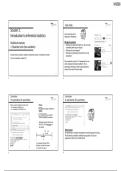
Case study
Session 3:
Introduction to inferential statistics Jenny wants to open a
restaurant in Rotterdam.
Statistical analyses Managerial questions
• What type of restaurant? Right now, she is mostly
1. Bivariate tests (two variables) considering either pizza or burger.
• What type of price category?
• What type of positioning? Gourmet food or cool
Example research questions: testing the relationship between an independent variable
atmosphere
(IV) and a dependent variable (DV).
She conducted a study of 141 restaurants from an
online restaurant reservation platform. She is
particularly interested in better understanding the
drivers of the overall 10-point rating.
27 25
1 2
Correlation Correlation
IV: quantitative, DV: quantitative IV: quantitative, DV: quantitative
Is rating_overall correlated with rating_food? Results
• H0: correlation is EQUAL to 0
• H1: correlation is NOT EQUAL to 0 r=0.29 the correlation coefficient is
positive
p = 0.0004<0.05 : we reject H0,
there is a significant correlation
Alternative decision criterion: the
95%CI [0.13;0.44] excludes the
test value 0.
Result section
0.13 0.44
We performed a correlation test between overall rating and food rating.
We find that the correlation coefficient was positive (r=0.29) and
-1 significant (t(139)=3.60, p=0.0004<0.05).
-1 0
In comparison the blue 95%CI
(fictitious) “includes” the value 0
or “crosses” the value 0. 29 4
3 4
, 14/10/2024
Correlation Correlation
IV: quantitative, DV: quantitative IV: quantitative, DV: quantitative
Is rating_overall correlated with rating_atmosphere? Measurements
• H0: correlation is EQUAL to 0 • Rating_overall (from 1 to 10)
• H1: correlation is NOT EQUAL to 0 • Rating_atmosphere (from 1 to 10)
Results
r=0.08 the correlation coefficient is
positive
p = 0.36>0.05 : we cannot reject H0,
there is no significant correlation
Result section
Alternative decision criterion: the
We performed a correlation test between overall rating and atmosphere
95%CI [-.09;.24] includes the test
value 0. rating. We find that the correlation coefficient was positive (r=0.08) yet it
was not statistically significant (t(139)=0.92, p=0.36>0.05).
-0.09 0.24
-1 0 -1
5 6
5 6
t-test (“independent samples” or “two samples”)
Follow-up managerial question IV: binary, DV: quantitative
The null and alternative hypotheses are:
H0: MPizza = MBurger (mean rating for Pizza is EQUAL to mean rating for Burger)
H1: MPizza ≠ MBurger (mean rating for Pizza is NOT EQUAL to mean rating for Burger)
When we focus on the difference in means, the null and alternative can be re-written as:
H0: MPizza - MBurger = 0
Managerial questions: Jenny is thinking about positioning the restaurant as a gourmet H1: MPizza - MBurger ≠ 0
food restaurant or cool atmosphere restaurant. Based on these results, what would be
your managerial recommendation between these two options? Therefore, the R output for the “independent sample” t-test will use 0 as the test value.
Answer: We find that overall rating is associated with food rating, but not with
atmosphere rating. This result could suggest that consumers in Rotterdam care mostly
about the quality of the food rather than the atmosphere. Overall, these results suggest
that Jenny should consider the gourmet food positioning.
7
7 8
Case study
Session 3:
Introduction to inferential statistics Jenny wants to open a
restaurant in Rotterdam.
Statistical analyses Managerial questions
• What type of restaurant? Right now, she is mostly
1. Bivariate tests (two variables) considering either pizza or burger.
• What type of price category?
• What type of positioning? Gourmet food or cool
Example research questions: testing the relationship between an independent variable
atmosphere
(IV) and a dependent variable (DV).
She conducted a study of 141 restaurants from an
online restaurant reservation platform. She is
particularly interested in better understanding the
drivers of the overall 10-point rating.
27 25
1 2
Correlation Correlation
IV: quantitative, DV: quantitative IV: quantitative, DV: quantitative
Is rating_overall correlated with rating_food? Results
• H0: correlation is EQUAL to 0
• H1: correlation is NOT EQUAL to 0 r=0.29 the correlation coefficient is
positive
p = 0.0004<0.05 : we reject H0,
there is a significant correlation
Alternative decision criterion: the
95%CI [0.13;0.44] excludes the
test value 0.
Result section
0.13 0.44
We performed a correlation test between overall rating and food rating.
We find that the correlation coefficient was positive (r=0.29) and
-1 significant (t(139)=3.60, p=0.0004<0.05).
-1 0
In comparison the blue 95%CI
(fictitious) “includes” the value 0
or “crosses” the value 0. 29 4
3 4
, 14/10/2024
Correlation Correlation
IV: quantitative, DV: quantitative IV: quantitative, DV: quantitative
Is rating_overall correlated with rating_atmosphere? Measurements
• H0: correlation is EQUAL to 0 • Rating_overall (from 1 to 10)
• H1: correlation is NOT EQUAL to 0 • Rating_atmosphere (from 1 to 10)
Results
r=0.08 the correlation coefficient is
positive
p = 0.36>0.05 : we cannot reject H0,
there is no significant correlation
Result section
Alternative decision criterion: the
We performed a correlation test between overall rating and atmosphere
95%CI [-.09;.24] includes the test
value 0. rating. We find that the correlation coefficient was positive (r=0.08) yet it
was not statistically significant (t(139)=0.92, p=0.36>0.05).
-0.09 0.24
-1 0 -1
5 6
5 6
t-test (“independent samples” or “two samples”)
Follow-up managerial question IV: binary, DV: quantitative
The null and alternative hypotheses are:
H0: MPizza = MBurger (mean rating for Pizza is EQUAL to mean rating for Burger)
H1: MPizza ≠ MBurger (mean rating for Pizza is NOT EQUAL to mean rating for Burger)
When we focus on the difference in means, the null and alternative can be re-written as:
H0: MPizza - MBurger = 0
Managerial questions: Jenny is thinking about positioning the restaurant as a gourmet H1: MPizza - MBurger ≠ 0
food restaurant or cool atmosphere restaurant. Based on these results, what would be
your managerial recommendation between these two options? Therefore, the R output for the “independent sample” t-test will use 0 as the test value.
Answer: We find that overall rating is associated with food rating, but not with
atmosphere rating. This result could suggest that consumers in Rotterdam care mostly
about the quality of the food rather than the atmosphere. Overall, these results suggest
that Jenny should consider the gourmet food positioning.
7
7 8